Most “Monitor” pages are written in Polish. There were the occasional ones in English, though. So this time I will attempt a bilingual version in both languages. Not an exact translation, but the same story in both and commentary. Sort of editorial experiment.
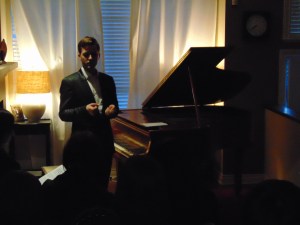
On March 24, I attended a small, chamber-like concert of Łukasz Mikołajczyk in a private residence at UBC. It was private residence, but it was organized by a group called “Music Friends’ as a public event , with paid tickets. Therefore it was and should be treated as a regular concert.
Yet, the size and particular quarters were reminiscent of time when baroque, than classical and romantic music were meant to be played. And not on opulent, powerful grand piano but somewhat diminutive ‘baby grand’. Which does create a different, more delicate and intimate sound. And what a gem it was. I have heard him (Mikołajczyk), by now, many times. On a grand stage and on stages truly not so grand at all. That one must have been perfect, for his play was delicate, so emotional and thoughtful that, at times, I was lost in different world of sounds and different reality. As in any concert there were better parts and regular parts. But parts of it was pure magic. Not often found in more official concerts.
Chopin’s last ballade, the one with number 52 in F major, was played exquisitely, poetically. The only way you can master it, as it is the most difficult of his ballades and not easily giving up to the pianist it’s secrets. It is the most abstract of his ballades, the most musical and not very clear of the story behind it. But story there is. So if you just give up on the meaning and simply follow the notes – it could be as flat as the paper Chopin used to write it down. Yet, if you create a world of images, feelings in your mind when you play it – it becomes alive. For the player and subsequently for the listener. Ballades are fully structured and developed musical compositions and offer the pianist a wide spectrum of play. They are often highly stylised. In my commentaries I try to avoid comparing two different pianist, as it is not really fair on certain level of technical and musical prowess. Nonetheless, we do have our private, individual tastes, likes and so on. As far as that Ballade is concern, for myself, I do have immense respect for the way it is played by phenomenal pianist Kristian Zimerman. I think that he just adds an extra level of sublime majesty to it. It becomes a music of heavenly experience. So if I add that comment, I must say that Mikołajczyk play was different. But different in a good way. Whether on purpose or just the atmosphere and the smaller sound of his piano – his version took me back to earth. And not in unpleasant way. To the contrary. The ballad suddenly become more real. Yes, it was a dream, but a real dream, a musical stroll toward concrete (even if we do not know that particular moment, the ‘thing’ that gave it an impetus for Chopin) – it was touchable, within listener’s grab. And that helped me to see the other level of the music. Another way of ‘feeling’ it. And I truly liked it a lot.
What followed were two Chopin’s nocturnes from the same opus 62 (no 1 and 2). Both, as intended by Chopin, played ‘note to note’, without interruption. Mikołajczyk played them with high respect for the musicality of it. As if he was trying to understand the still young, yet already weary and tired of life Chopin, as it was composed by emotion, not the strength of his hands. I thought that he used the tempo augmented by intervals not just to travel through time but actually to attempt to travel through space. To let the sound fully develope before it dies naturally or is shorten by mechanical way. It added an extra depth to the music, or rather showed the depth of it as surely intended by composer.
Franz Schubert music (Mikołajczyk played his two Impromptus: G-Flat Major, No 3 and E-flat Major, No 2) is very different than Chopin’s. An early, German romantic composer was still under strong influences of classical period and the way music was played in countless little Royal and Princely Houses (or Bishopric palaces) spread through Austria and German states and palatinates. The German style of romantic music was also different than Polish romanticism. It was more absorbed by elements of nature, certain darkness and mysticism of it, tragic love and old myths, following the footsteps of Goethe and Schiller. That early romanticism, coupled with somewhat ornamental music of the German courts is representative in his Impromptus. More an arte pro arte musical prowess than a deep spiritual experiment.
In second part we have heard how Canadian contemporary composers, of which Coulthard Piano sonata no 2 is another gem. Very well composed, combining audible parts of western musical tradition and modern music compositions. A marriage of descriptive music ( as classical music from renaissance till modernism used to be) to abstract musical forms. Considering the fact that it is very new composition for Mikolajczyk, he played it exceptionally well. I have heard it before and his interpretation did not fall behind it – to the contrary, perhaps. Maybe I’m a bit skewed in my praises, as I do like his style of playing, but I am also rather known (unfortunately) for being honest and not easily giving praise, were praise is not warranted. I said it, because I think that even in that short period of time since I heard him acutely the first time – Mikolajczyk’s play has already matured, become more refined and more confident. I have the feeling that he either already is in that moment or ready just to enter one, where a musician, an artist, can – without arrogance- say: I know what I’m doing here. Just give me the score and the instrument and there will be music. Let it be music, then. Ladies and Gentlemen.
I would be amiss, if I wouldn’t write about another, very special moment from that concert. Special moment, that touched me very much so. As we know Mikołajczyk is a young and talented pianist, who last year came to Canada, straight from Poland. The same generation as our Canadian Jan Lisiecki (of course, they have much more in
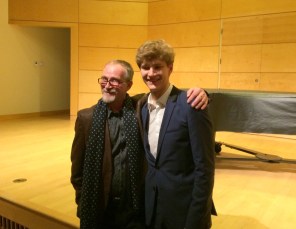
common, as Lisiecki – this year JUNO Awards recipient – was born in Calgary but has a very strong and dear to him connections to Poland, not only because of Chopin but mainly because he was raised as Polish Canadian and is proud of it). Generation that is future of Canadian, Polish and international music. But – before we take the flight into the future – we should never allow ourselves to forget about those, who cultivated music here in earlier generations. They were the ones, who toiled the soil. Toiled it also for the new, younger generations of musicians. As is the case of Richard Wrzaskała (ah, the Polish names, ha ha ha – how do they manage to spell it?!) – a prominent Polish born and educated composer and orchestra director, who moved to Canada many years ago. Richard, also a dear friend of mine, made a mark on our, Canadian musical stage.
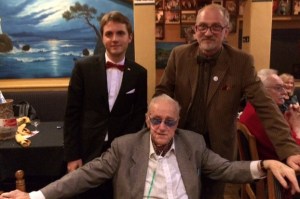
One of his popular composition is called ‘Mazurka Fantasie’ – it’s a play, a musical commentary of sort on his own connection and sources of musical inspiration in beloved Chopin’s musical heritage. Elegantly composed, uses the repeating main theme to stress the point of what is the central core of his own inspirations. I see it, whenever I listen to it, as a nostalgic nod to the past, as eloquent saying: thank you Monsieur Chopin, it has been a privilege to walk through my life with your music.
Mikołajczyk’s program for the concert did not contain Wrzaskala music. But, as the concert ended and the audience, as often expected, demanded an encore – the young pianist returned and played exactly that composition: Wrzaskala ‘Mazurka Fantasie’. And played it so tenderly, so soft that it moved me to the core. It is very obvious and beyond any need to explain, that Chopin’s music is at the heart of both Mikołajczyk and Wrzaskała musical heritage. By playing that piece he did pay homage to it. How elegant, Lukasz.
Finally, last but not least – not least by a huge margin under any circumstances. Very soon, thanks to Vancouver’s own classical music organizers and promotors, Vancouver Chopin Society, we will be treated to special event: piano concert of one of the best pianists of his generation, the incomparable Rafał Blechacz. Blechacz international fame could be only compared to his own talent and hard work. If nothing unexpected or tragic will happen, this 33 year old musician in 20 years’ time will be what Zimerman is now, what Garrick Ohlsson and Martha Argerich are, earlier Vladimir Ashkenazy, Daniel Barenboim and what Horowitz and Rubinstein were.

- Rafał Blechacz (photo: By Michał Kobyliński – used under Wikipedia Commons Share Licence)
His star shot to fame right after winning the prestigious International Chopin Competition in Warsaw in 2005. Since than he received top prizes and accolades in many international competitions, festivals. In 2014 the New York based America Gilmore Artist Award (considered by many as the equivalent to ‘Nobel Prize” in music) named him the most outstanding pianist in the world.
His concert in Vancouver will take place on the main stage of Playhouse Theater, on Sunday, Aprill 22 at 3 PM. The program consists of A. Mozart Rondo in A minor, K. 511; Sonata in a minor, K. 310; L. van Beethoven Sonata in A Major, Op. 101; R. Schumann Sonata No. 2 in g minor, Op. 22; F. Chopin 4 Mazurkas, Op. 24 and Polonaise No. 6 in A-flat Major Op. 53.
It will also be a special, anniversary concert commemorating 20 years of Vancouver Chopin Society, which in that time has become a staple of our musical life here.
(note from an author: what follows is a Polish language musing on the same subject. However, at the very end of the review, there is a short rebuke of an unfortunate tirade of Vancouver well known musician and pianist, Robert Silverman. As it is not really a part of my review of Mikolajczyk concert, but very much part of the conversation on the subject of Chopin and his music – I decided to show you an excerpt of Mr. Sliverman’s strange diatribe and my response to it. So, please do scroll to the end and you will find the texts in English.)
24 marca, w prywatnej rezydencji na terenie Uniwersytetu British Columbia miał miejsce bardzo udany, kameralny koncert pianistyczny Łukasza Mikołajczyka. Organizatorami koncertu była grupa Music Friends, która podjęła się organizowania tego typu kameralnych, w tradycji dawnych Salonów Muzycznych, spotkań z ciekawymi muzykami z Vancouver i okolic. Zachęcam bardzo melomanów do śledzenia kalendarza koncertowego tej grupy – możliwość uczestnictwa w tak kameralnym wydarzeniu muzycznym jest nieporównywalna do wielkich sal koncertowych! Nastrój i specyficzna intymność, która łączy wykonawcę ze słuchaczem są przeżyciem specjalnym i wyjątkowym.
W programie Mikołajczyka (nazwanym bardzo ładnie: „From Europe to Canada with Lukas Mikolajczyk”) była muzyka Chopina (Ballada Nr 4 f-moll; Scherzo Nr 4 E-dur; i Nokturny Nr 1 i 2, B-dur i E-dur), Schuberta ( Impromptu Nr 3 Ges-dur i Nr 2 Es-dur), kanadyjskich kompozytorów współczesnych Paula Crawford (kompozycja, którą można określić ‘obrazkiem muzycznym’ pt. „Did you hear that winter’s over” z pogranicza muzyki poważnej i muzyki popularnej) oraz Jeana Coultharda (Piano Sonata Nr 2).
Pianista każdą część koncertu poprzedzał bardzo dobrze przygotowanym wprowadzeniem słownym. Posunął się nawet nieco dalej w opisie, ilustrując stosownym fragmentem muzycznym cechę lub specyficzność muzyczną utworu, który opisywał. Takie personalne wprowadzenie jest bardzo dobra i mile widzianą rzeczą. I choć czasem trudną do przeprowadzenia na wielkiej, formalnej scenie olbrzymich sal koncertowych – wyjątkowo przydatną właśnie w takich kameralnych warunkach. Olbrzymia większość z nas nie przychodzi na koncerty ze zwojem nut i bez względu na zasób wiedzy muzycznej nie jesteśmy w stanie znać szczegółowo większość utworów nam prezentowanych.
Ballada nr 4 f-moll jest ostatnią balladą Chopina i wyjątkowo bogatą w muzyczne ‘słownictwo’. To utwór wyjątkowo piękny a jednocześnie trudny dla pianisty. Gdyby tylko skupić się na jej technicznie idealnym wykonaniu – bardzo łatwo zagubić jej element poetycki, marzycielski. Jest zajęciem chybionym (na pewnym etapie talentu i umiejętności technicznych wykonawcy) porównywanie jednego pianisty do drugiego. Mimo to, wyjątkowo tylko, zrobię to by oddać własne, indywidualne sympatie muzyczne. Otóż do tej pory, ze współczesnych koncertujących teraz pianistów, za najlepsza jej interpretację uznaję sposób, w jaki robi to Krystian Zimerman. Jest to technicznie idealne a jednocześnie przekazuje jakąś dziwną majestatyczną tajemniczość tej ballady. Gra Mikołajczyka obudziła we mnie inne wrażenia. Wydała mi się podkreślać nie jej akcent majestatyczno-tajemniczy, a dużo lżejszy, poetycko-osobisty. I bardzo mi się to podobało. Dzięki temu otworzyło to dla mnie, tylko amatora muzyki a nie muzykologa, nowe pokłady tego pięknego utworu. Może była to też ‘wina’ kameralności, intymności tego koncertu? Nie wiem. Takie w każdym razie – dobre – wrażenie z tego odniosłem. Nie przysłoniło to w niczym wyjątkowości interpretacyjnej Zimermana ale pozwoliło na inne na nią (tej ballady) spojrzenie, zrozumienie jej wielowarstwowości. Gdyby wszyscy ‘najwięksi’ grali identycznie – jakiż sens byłoby chodzić na koncerty? Ostatecznie pianista, skrzypek czy wiolonczelista tylko siedzi lub stoi w miejscu przy instrumencie i gra. Nic więcej. Ani sztuczek nie pokazuje, ani skacze, biega, nie gimnastykuje się na drążku lub linach. Wystarczyłoby tą ‘najlepszą’ płytę kupić i grać sobie w domu na okrągło. Wszak ideału, raz osiągniętego, ulepszyć nie sposób.
W scherzu miał możliwość wykazania całej bogatej tkaniny temp, melodii. Podobnie, jak Ballada f-moll, te scherzo jest ostatnim scherzem Chopina. I trochę innym od pozostałych. Jest tematycznie (nie muzycznie) utworem najlżejszym, więc jakby nieco ukłonem wobec poprzedniej, barokowo-klasycystycznej tradycji. Trzeba generalnie zaznaczyć, mimo tego ukłonu wobec tradycji starszej, że scherzo , jako rodzaj muzyczny, dzieli się na dwa kompletnie odmienne etapy rozwoju: scherzo, jako gatunek muzyczny przed Chopinem i scherzo, jako gatunek muzyczny po Chopinie. Nie ma tu nawet cienia wątpliwości. Tak, jak astronomia dzieli się na przed-kopernikańską i po-kopernikańską, tak scherzo jest przed-szopenowskie i po-szopenowskie. Trochę zaczął iść w tym kierunku już Beethoven – ale dopiero Chopin zrobił z tego kompletnie nowa szkołę komponowania tego gatunku muzycznego. Z bardzo dobrej gry Mikołajczyka tą głębię i wielopłaszczyznowość scherza było łatwo rozpoznać i ją docenić.
Nokturny, zgodnie z życzeniem zresztą samego kompozytora, grał łącznie. I znowu – celował w ich materii poetyckiej, marzycielskiej.
Franz Schubert, niemiecki kompozytor przełomu między szkołą klasycystyczna a romantyczną, u schyłku swego życia skomponował kilka impromptu. Krótkiej, niezbyt rozbudowanej formy muzycznej, która właśnie u romantyków stała się dość popularna. Ale powiadają, że czym skorupka za młodu nasiąknie … Takoż i impromptu Schuberta stale w swej ornamentyce cofają się do czasów jego mistrzów i jego własnej wczesnej twórczości. Odnosi się czasem wrażenie, że słucha się ich w jakimś dworze niemieckiego królewiątka lub palatyna tudzież na dworze biskupim w Austrii lub Bawarii. Przy baroku kapiącym złotem z plafonów i ścian… Miłe uchu przerywniki muzyczne.
Schubert i kanadyjski kompozytor współczesny Paul Crawford były właśnie takim miłym i lekkim przerywnikiem muzycznym w koncercie Mikołajczyka.
Natomiast utwór ostatni, również kanadyjskiej kompozytorki z Brytyjskiej Kolumbii, Jean Coulthard, Piano Sonata No 2 był głęboki i bardzo ewokacyjny. Słuchający tego utworu mógł znaleźć tam wyraźnie zarysowane fragmenty całej opisowej, europejskiej tradycji muzycznej, by nagle wejść w obszary współczesne muzyki ‘czystej’, abstrakcyjnej. Skomponowana w formie pełnej sonaty kompozycja daje dobry przykład muzycznej wiedzy i zdolności Coulthard. We mnie Mikołajczykowi udało się obudzić zainteresowanie tą kompozytorką (tą że sonatę gdzieś kiedyś już słyszałem ale najwyraźniej nie była chyba tak dobrze grana, bo wrażeń z tego głębokich w pamięci nie zostawiła) i chęć poszukania jej muzyki, poznania więcej z jej spuścizny.
Na zakończenie tych muzycznych refleksji nie mogę pominąć ostatniego wydarzenia tego koncertu, poza-programowego. Na bis pianista przygotował utwór Ryszarda Wrzaskały, „Mazurka Fantasie’. Był to bardzo uroczy ukłon wobec pana Ryszarda, jego wszechstronnych talentów muzycznych i energii, z jaką się przez dziesięciolecia tymi talentami z nami dzielił. Tego mazurka Wrzaskały słuchałem wielokrotnie w licznych interpretacjach. I w licznych, nie zawsze idealnych, warunkach koncertowych. Mikołajczyka ‘ukłon muzyczny’ był bodaj najlepszym wykonaniem tej kompozycji. Pełen wdzięku, tęsknoty i oddający ducha tego mazurka. Mazurka Fantasie to utwór na wskroś nostalgiczny, to muzyczny, prosty i czysty w formie, spacer w przeszłość i podziękowanie Fryderykowi Chopinowi za muzykę, która towarzyszy Wrzaskale prze całe życie i jakże często jest źródłem jego własnych inspiracji muzycznych. Łukasz Mikołajczyk przekazał nam wizje tego ‘spaceru’ w sposób nader elegancki, lekki i ujmujący serce. Należy mu się za to ode mnie głęboki i wdzięczny ukłon.
Now, that subject of a strange diatrybe of Robert Silverman… Perhaps I would first quote a particularly strong fragment of his opnion and, at the end, offer you a link to the full text of Silverman. Right after the quote is my responce.
“Franz Liszt for instance, played Chopin with such virtuosity, brilliance and panache, not to mention his own emendations to the scores calculated to show off his unique skills, that he quickly spawned a crowd of emulators whose descendants existed well into the 20th Century. Rachmaninoff, Horowitz, and later, Nelson Freire and perhaps Argerich in her most frenetic moments come to mind. Chopin, however, could not stand the liberties Liszt took with his scores. (“He can’t keep his hands off ANYTHING!” he once said about Liszt. Still, the fact remains, audiences loved Liszt’s performances of Chopin. I’m sure I would too.
A couple of decades later later, the Russian pianist Anton Rubinstein found in his music a sense of world-weariness and romantic longing that gave it an undeniably attractive romantic aura that you’d have to be a cold fish not to like. And so another “Chopin Tradition” was born. Anton Rubinstein was unquestionably a great pianist, as were those who have followed in his footsteps, primarily Josef Hoffmann. That’s probably the style I feel most comfortable with.
But in the hands of lesser talents, that “Tradition”(usually pronounced with a rolled “r”) resulted in what would have given the composer nightmares: vulgar, undisciplined, technically sloppy exhibitions of how not to play Chopin, or for that matter, any other composer. But because Chopin’s music is so beguiling, so utterly effective, audiences who have not studied what’s actually on the page were and still are easily fooled. (Vancouver recently was treated to an exhibition of this sort of dilettantism at a church downtown several weeks ago. The final insult was that the guy played on a period instrument so that he could lay claim to “authenticity.”) Fortunately that style of playing has all but died out.” (Robert Silverman “Chopin at the piano“)
Robert Silverman, well known Canadian pianist and former Head of UBC School of Music, offers his , hmm, let’s say personal insights on the character of Chopin’s music. Of whom, as a musician and a pianist, he seems to be a big fan. And, as a music scholar, his insight is much appreciated and worthwhile. Especially when he talks about the way Chopin composed, wrote down his music. How meticulous he was in many directions he left on the score for other pianists to augment their playing of his compositions. One can argue about this or that in his opinions. One cannot refuse him his knowledge and reasons for such, though. But when he is giving, in a style of ex cathedra, very strong opinions on the way Chopin must an must not be played –that’s altogether different matter. His caesarian ’edicts’ on which school of playing Chopin is the right one and which is wrong are nothing but opinions of Mr. Silverman. One does not disavows with such a cavalier manner entire traditions going back to the time of his last students. And the students of their students. These were people, who heard Chopin playing. Not just written opinions about it. And when Mr. Silverman notices the recent concert in Christ Church Cathedral (or as he calls it: ‘in one of the churches Downtown), when Chopin was played on an epoch piano by very much internationally respected pianist (not a star by any means, but then neither is Silverman) without even using his name and referring to his play as ‘dilettantism’ – this is not only a sign of bad manners. It is a sign of overgrown ego. Or jealous player.
As to the accuracy of how Chopin wrote his compositions and how he wanted them to be played—I can’t even try to dispute his level of professional knowledge with mine—yes, dilettantism, on this matter. Only a side note: it is worth mentioning that it was Chopin well known practice of re-working his compositions ad nausea at times. Even after copying the last, final version (the ‘final’ was not an important word in Chopin’s vocabulary) of manuscript. To add to confusion—he regularly sent his ‘final’ editions to three different publishers in three different countries: France, England and Germany. And then, after a while, sending them some changes here and there in the composition. Not always the same changes to all three publishers. Sometime just to his French printers, forgetting about the others … . Sometimes, when his students were playing his printed/published composition … he would grab the score and cross out some melodies, or tempo, or change slightly a passage … . Indeed, he was very uniform, always clear of the concept and pianists always had the unchanged, final version of his music… yes, it is my slight attempt at sarcasm.
There are even unresolved disputes as to the use of tempo rubato in Chopin’s compositions. Case in study: Ignacy Paderewski, who was a star and most important of Chopin’s music pianist in his time. Today many say he used the rubato excessively. Did he? I have no opinion nor enough knowledge about that subject. On the other hand I know that Paderewski studied under professor Leszetycki, who in turn worked with Russian great musician Antol Rubinstein, who played for Chopin and for whom Chopin played. Perhaps they knew a bit how he played … Perhaps. Anyhow, that’s just my opinion.
How do we know what was Bach preference of playing his fugas? That goes for all art forms that need to be performed by others, by stage artists. We are so used to the way Shakespeare is spoken today, in a style of great actors like Gielgud and Olivier, which mimmicks that of XIX century British aristocracy, that only recently linguist scholars protested against it as totally innacurate and therefor making the plays way too long. Poor William (or was it Marlow?) would have been forrified hearing how it is spoken from stage today. Perhaps his ability of understanding the words would be constrained as often as ours is, when we read his plays.
As to the the pianist, who, according to Mr. Silverman, played Chopin so ‘dilletantly’ in that concert in Aglican Cathedral – it was was no other than Janusz Olejniczak. One of my personal favored. And another side note: I do write from time to time, here and there, my personal notes from concerts and musical performances. But they are what they are – personal reflections and opinions, not a formal musical reviews, I have no formal musical education to pretend to such a role. Classical music simply surrounded me from the cradle (and that is a fact as a huge concert piano towered above my baby bed and was often used by classical pianists and amateurs alike) till today. I just love it with a passion. Mr. Silverman, I am certain, possess far more theoretical knowledge about music that I ever will. And one assumes that knowledge goes with wisdom hand in hand. Unfortunately, not always …
 > > Pogwarki < <