W pół masztu. Znowu w pół, jakby bała się szczytu.
Miała być dumna, jest smutna, zawstydzona cicho.
Obok, w płytkiej wodzie, po piaszczystym dnie biegają wesołe dzieci. Chlapią, tupią, nawołują się wzajem okrzykami,gestami, wiecznie niecierpliwe. Ale Fayez Afzaal nie biega z nimi. A tak bym chciał by tupał o dno, by krzyczał na całe gardło: tata! no chodź tu, patrz! Znalazłem muszlę! Mama, powiedz tacie, żeby przyszedł!
Wiatr na chwile milknie, znika, flaga na maszcie zwisa zmęczona, jakby oklapła z tego rwetesu. Nie lubię tych flag, które stale trzeba spuszczać do połowy. Tak, jakby maszt był za wysoki, jakby dziurawił chmury swym szczytem.
Chciałbym Fayeza otulić ramionami i sercem, jak szeroką peleryną. Przekonać, że go kocham i że kocha go świat i miliony ludzi. I że nigdy nie będzie sam, że nigdy więcej już … . I milknę pamiętając ilekroć już mówiliśmy: nigdy więcej.
Zbiegną się ludzie z sąsiedztwa, z regionów, ze świata na czuwanie i będą szli w marszach, protestach, będą zapalać świeczki w oknach i na skrzyżowaniach pełnych wiązanek kwiatów, pocztówek, manifestów. Mamy powiedzą dzieciom, by położyły obok tych kwiatów swoje pluszowe misie, swoje lalki. Dzieci zrobią to niechętnie, z pewnym żalem za ukochanym pluszaczkiem. No bo niby co zawiniły w tym ich zabawki? Zostawią je tam jednak posłusznie, bezradne w tym strasznym dniu.
Potem ktoś rzuci kamieniem słowo: Rodezja;
ktoś oskarży innych o gwałt na Palestynie;
ktoś lament podniesie o Holokauście. Ściana
Płaczu zaszlocha, trąby zabrzmią pod Jerycho.
Przypomni się słoneczna Langwedocja, która spłynie niewinną krwią katarów, albigensów. Morduje się wszak nie tylko obcych. Jeszcze krwawiej tępi się własnych, na ich nieszczęście nieco innych. Są jak ziarnka piasku w trzewiku. Niby nie zagrażające życiu ale jakże niewygodne, uparcie uwierające.
Satanael, spoglądając zza murów swego zamczyska na szczycie Arafatu, ściśnie w dłoniach wodze Eufratu i Tygrysu, łypnie okiem na zielone szczyty gór Küre i pomyśli: póki te lasy nie podejdą pod moje bramy, nic mi z waszych bratobójczych mordów. Cóż obchodzić mnie może nieszczęście jednego chłopca lub całych narodów? Nic. Łzy wasze spuszczam z Anatolii warkoczem Eufratu, a wasz ślinotok klątw strumieniem Tygrysa. Ślę je ku wodom Perskiej zatoki. Namawiać was do niczego nie muszę ni chcę. Sami usłaliście swe łoża, które nie są moim, a waszym przekleństwem.
Tak myślał Satanael zawarowany w boskiej twierdzy Araratu. Podobnie, jak królobójczy król Makbet w twierdzy na wzgórzu Dunsinane w Szkocji. Póki u bram jego twierdzy nie pojawił się rząd drzew z lasu Birnam.
I mnie was już nie żal. Ale żal mi tego chłopca. Dziewięcioletniego Fayeza. Z pięknymi, smutnymi oczami. Czy ten smutek też kiedyś zastąpicie nienawiścią?
Bogumił Pacak-Gamalski
Anioł Śmierci, Pomnik Zbrodni Katyńskiej we Wrocławiu
od autora: ten krótki utwór pisałem przez kilka dni, zaczynając drugiego dnia po strasznym morderstwie w London, mieście prowincji Ontario w Kanadzie. Tego dnia młody, dwudziestoletni biały chłopak, powodowany nienawiścią w stosunku do mahometan, świadomie i celowo wjechał w spacerująca chodnikiem rodzinę Afzaal, rozpoznając w nich po ubiorze, ich wyznanie religijne. Na miejscu zginęli: babcia, małżeństwo Afzaal i ich dwie córki. Najmłodszy syn, dziewięcioletni Fayez, bardzo ciężko ranny, został zabrany do szpitala, gdzie lekarze uratowali go przed śmiercią. Jedyny, który pozostał z tej rodziny. Z całą Kanadą przeżywałem ten szok, poruszony do głębi okrucieństwem tego zamachu, a jednocześnie jego niezwykłą absurdalnością w objawieniu zła doskonałego. Ale nic mnie tak nie zasmuciło, jak wizja tego chłopca, Fayeza. Ci, którzy giną wydają się czasem (w porównaniu być może okrutnym) wybrańcami losu – ich już ból żaden nie sięgnie, żadna zbrodnia nie dotknie. Ci, którzy zbrodnie przeżyją, śmierci umkną – skazani są na cierpienia wielokrotne, na przeżywanie tej zbrodni, tego momentu setki, tysiące może razy. A cóż dopiero, gdy mówimy o dziecku? Dziecku wystarczajaco dorosłym, by mieć za sobą całe bogactwo ( w tym wypadku te bogactwo stać się może ciężarem niemożliwym do udźwignięcia) pamięci najbliższych i pamięci momentu zbrodni.
Niesamowity patos, tragedia na skalę mitologiczną omal, postaci tego chłopca i tej zbrodni stały się dla mnie syntezą zbrodni nienawiści człowieka w całym ciągu naszej wspólnej historii. Niemożliwym do opisania językiem innym niż język poezji. Ale każda forma tradycyjna wiersza też kłóciła się ze współczesnym spsobem opisu i odczuwania tragedii. Zgrzytała pod ołówkiem kreślącym litery na papierze. W sukurs (mam nadzieję) przyszła proza poetycka, z dwoma tylko ustępami trzynastozgłoskowca. Ten utwór, jak zreszta jasno wskazuje tytuł, jest niczym innym jak moją jałmużną kwestą o dar miłości dla Fayeza. Tylko ten jeden dar może chłopca i nas uratować.
Residential Schools and modern day placement of native children in the care of non-native families and system (provincially mandated but with tacit support of federal authorities) is a drama without comparison to none other in Canada’s history and Canada today. It affected and affects everything that happened and that is happening to all First Nations. Abject poverty, lack of resources, lack of education, high unemployment, pervasive alcoholism and drug addiction. All of it was almost (an argument could be easily made that it was indeed) planned, arranged by local colonial powers and even more so, by the new Canadian Confederation. The country we call our own. To say the truth, I am having a lot of doubt if that system of full cultural genocide would have happened if Canada remained a fragmented colony for fifty or seventy years longer. Separate entities of Upper Canada ( present day southern Ontario), Lower Canada (Quebec and Labrador) and three Maritime Provinces. That would mean no creation of unified confederation and no strong federal executive and legislative power. With much stronger oversight and decision making from Great Britain and it’s Colonial Office. The precursor to our constitution and the still important core of it, the British North America Act would have not happened.
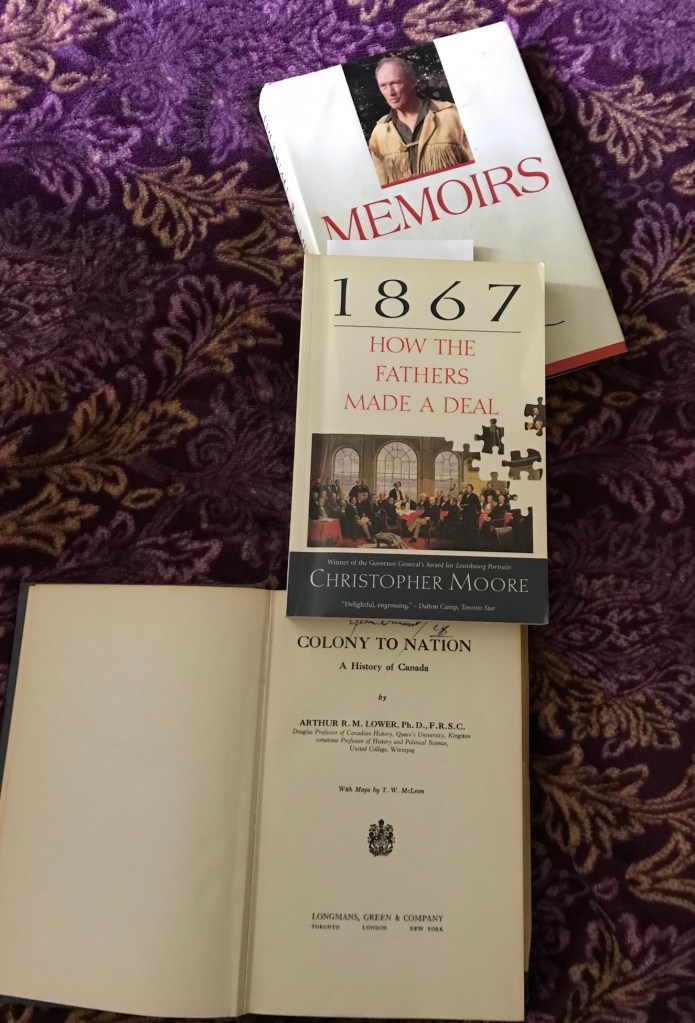
Our renewed national discussion of our past ignited again the controversies of whom we admire, who is the hero of Canada’s history. More or less, who is the Father of the Nation? And centres very much so on the person of John Alexander Macdonald. Was he or wasn’t he? And if he was the Father – was he a good, wise father or a bully with drunken rages? Smart and competent to achieve his goals but bully nonetheless? Let’s go back a notch to remember what happened circa 1867.
Of course, as we know very well – history could be re-written many times but historical facts can’t. Yes, there was a Maritime Conference in Charlottetown called by Tupper and Howe from Nova Scotia that was going to discuss possible unification of New Brunswick, Nova Scotia and Prince Edward Island. But delegates from Upper and Lower Canada asked for permission to come and observe. Such was granted and those guests quickly posed a question: why only Maritime Provinces? Perhaps we should unite all of Canadas into one confederation? And that, ladies and gentleman, was the night that the conception of Canada happened.
Why do I bother writing about the obscure tidbits of history if the text might suggest to be about the effects of Residential Schools and in general the planned and executed action of destroying political, economic and cultural base of First Nation? Also their biological existence, if not totally, than in numbers greatly diminished and easy to control.
The very recent discovery of hidden bodies of children buried deep in the ground by Residential School in Kamloops surprised and shocked many Canadians. Shook the nation to the core. A lot of us. Except … the First Nations themselves. They knew that many such hidden graves exist. They knew because that’s not an ancient history and old tales and myths. That’s now, very recent. Their uncles, maybe even brothers and cousins, great aunts and great uncles. Those that everybody in the community knew they existed, were forcefully snatched by raids from their petrified and crying parents, placed in the Residential School and never came back. Were never seen or heard of. They were not the children of proud tribes sought of, as a powerful allies, in the great struggle between the French and British empires and later in the struggle to maintain British territories during the US War of Independence. Those nations and tribes the King and Queen in London signed treaties with. No, by the end of the first two decades of XIX century they become an obstacle to plans of the new settlers. The colonists, who wanted to wrestle more local control from the imperial Colony Office in London. These colonist had neither desire nor respect for the spirit and letter of these treaties. The settlers wanted more land and control of natural resources and the religious leaders of these settlers couldn’t stand the savages, who would not recognize the new Christian god. The native gods and beliefs needed to be destroyed and the administration and interpretation of the Treaties needed to be wrestled from London political master and given to local legislative and executive powers in the new colonies.
Finally, the War of Independence, won by the new United States in 1812, forced the British and their Colonial Office to push for some form of political unity, some sort of federalism between separate colonies, hoping it will better protect the British territories and interests against the republicans from the south. That push came in the form of uniting Upper and Lower Canadas into one Canada Province west of Maritimes. And in New Brunswick, Newfoundland, Nova Scotia and Prince Edward Island an attempt to unify them as one Maritime province or federation. Both interests – the Empire and the Colonist in North America – converged at convenient time at the very moment of history in the middle of XIX century.
On Canadian and Maritime side there were many politicians, regional or local leaders, opponents and proponents of unity in what become the Confederation. Almost all of them could be called Fathers of Confederation. Generally we call it the Charlottetown Conference. But that was only preliminary discussion. It was followed by Conference in Halifax and Conference in Quebec, which by far was the most important. The Quebec accord spelled and crystalized the boundaries of political powers, the separation between British Parliament (and Colonial Office) and new confederation legislative, judicial and executive branches. And the ambition for importing from Britain the tenets of ‘responsible government’. If Charlottetown and Halifax gave some general architectural idea of the new political structure – it was the Quebec Conference that produced first concrete drawings of the design.
All of it would have been in vain if there wasn’t a push for some sort of unification of the Provinces in Britain itself. The Colony Office in London could have and would have scuttled it at the bud. Probably without even a need for Parliamentary debate either by the Commons or by the Lords.
There were very few main architects of the entire project. Many others that helped and whose support was indispensable. But the main architects remained the true Fathers of Confederation. Some of them, like Joseph Howe and notably John A. Macdonald, were strong opponents to the idea at the beginning.
Other truly great leaders were George-Etienne Cartier from Quebec, George Brown from Ontario and Charles Tupper from Nova Scotia. It was mainly thanks to strong support of Tupper, that Macdonald rose to prominence and took the reins of the debate (aside from Macdonald personal skills as shrewd politicians on almost Machiavellian scale). Tupper did not like George Brown (who was one would say the anti-thesis of Macdonald, as Brown believed in a democratic and ethical government) and neither liked nor understand Cartier and the intricacies of Quebec (Lower Canada) French culture and politics.
I would suggest that if not for the support of Tupper, it would have been very likely that Macdonald would never rose to the prominence that he achieved and that led him to become the first (and lasting) Prime Minister of the Canadian Confederacy. In comparison to Cartier and Brown and their leadership – his star was of second category. Although it shone as superstar in category of shrewdness, lack of morals, thirst for power.
Enough of the annals and internal battles, debates of the articles of Confederation both in Canada and later in London, where the final birth of Canada happened. They were done, cooked and signed. New Federal Government of new (almost) independent state-dominion was formed. And victorious Macdonald become the first Prime Minister of Canada. With the passing of times he become a legend. Monuments were build, streets and buildings of prominence named after him. If there is a conscious afterlife – I am sure that John Alexander Macdonald soul is smiling in the glory. But it probably gets a bit angry in the last decade or so. Some begin to lose faith in that heavily colorized portrait.
After studying his life and carrier a bit more in detail and less from propaganda pages of some school texts and popular government pamphlets – I have some opinions and a bit more clear picture. Not a scholarly one by any means. I am not a Canadian historian by any stretch of imagination. Just a history buff at times.
Here is my sketch of Macdonald in a few movement of a pencil.
He was a very intelligent and shrewd politician. Hungry for power. A good lawyer with ability to concentrate on minuscule detail to achieve the greater goal. Good debater with the talent to steal the moment and force others to notice him and pay attention to him. A drunkard, who could function rather well with his alcoholism. Scheming on the level akin to dangerous courtiers from a time of absolute monarchs.
His government introduced bribery, nepotism, patronage on a scale never repeated again in the history of Canada. I would dare to say and dare to argue in any debate, that if John Macdonald won a majority in any general election in Canada in the past 30 years – he would end up in prison. Or, at the very least – be kicked out into oblivion from political life. Even in the circles of Conservative Party. His great admirer recently, Jason Kenny of Alberta, would most likely scream in the Legislative Assembly in Edmonton: get him out of here right away!
Macdonald didn’t risk winning elections by giving people a chance to make their mind, by a true debate (in which he was very skilled after all). No. That’s like playing a roulette. A politician should not play roulette. So he would appoint every little government (state) position only to people, who would understand where their sympathies must stay. From every tiny post office, every railway station, everywhere that state employee or commissioner would and could affect the daily life of a citizen.
He would have been horrified of the Office of Election Canada and the fact that it is not stuffed from top to bottom with party patronages. In 1885 he forced a legislation that gave him (or any other Prime Minister at that time) the power to appoint (by strict party patronage) a federal Revising Officer to supervise elections in every riding! No wonder he could be seen by some modern prime ministers as a hero and saint – they could have only dream of it. He himself called it ‘the greatest triumph of my life’. Not the Charlottetown Accord and the British North American Act – but the obscene patronage that goes against every principle of good democracy. That also paved the way for party discipline and the death blow to parliamentarians independence. The golden standard of the day (in many ways still existing in many parliaments, including Britain) was a relatively broad independence of judgment of a single Member of Parliament . Governments did and do fall, when Cabinets fail to persuade their own party parliamentarians during a debate in House of Commons. Not in Canada anymore, thanks to Macdonald. Party leader is almost like a monarch itself. Members form the line or face political death. Some still valiantly protest. But very few survive the consequences.
With one exception – Macdonald did resign as Prime Minister after the eruption of the details of enormous bribery scandal in giving the licence for Canadian Pacific Railway company. The amount of bribes his party and MP’s received and the bribes he took for himself is of no comparison to any other corruption scandal in Canada before and after.
Many bad traits of today executive and parliamentary branches of Government in Canada could be traced back to John Macdonald. As one British newspaper reported in 1891: “ For twenty three years, Sir John and his party had maintained themselves in power … by a colossal system of bribery”.
And since the Rapport of the Truth and Reconciliation Commission many years ago it become painfully clear that John A. Macdonald was the man responsible for creating the infamous system of Indian Residential Schools in Canada. Now we are just learning of even more horrid facts of these Schools.
Yes, the worst transgressions, crimes calling to Heavens, were perpetrated by the Roman Catholic orders and clergy (overseen by Canadian bishops). While Catholic institutions were the worst, other (United and Presbyterian Churches) committed crimes, too. At least the others offered uncontested and unreserved apology and responsibility – the Catholic Church failed again. From the very top in Vatican to every diocese. In a way we are used to it – from scandals in Ireland, in Quebec in the 30., 40. and 50; in Newfoundland; in Poland; in the USA and many, many more countries. But here, in this article, I deal with the secular, the power that gives consent and institutes policies and rules. And one particular, most powerful politician of that time. The one, who factually could be called the Father of Indian Residential School System. John Alexander Macdonald. Politician, who for a long time enjoyed the status of national hero, nation-building leader. Father of nation. Was he?
In my opinion not at all. In neither of these titles, epithets. He does have a very prominent role in our history. Was a very skillful politician. But neither a hero nor a father. I will not miss his monuments, educational, cultural or administrative buildings named after him. He has a solid and permanent place in Canadian history. In history books. But it is not a place of great leadership and definitely not a place of public celebration.


 > > Pogwarki < <