Bogumil Pacak-Gamalski
When I was a young admirer of classical music, I sought well established, famous musicians. To be at a concert of someone known to be a master, virtuoso of an instrument. To listen to music played the way the music ought to be played. Orchestral or solo, chamber type or powerful experience of full orchestra in a symphony directed by an admired director! Ah, for young, hungry for excellence youth – that was the pinnacle. I am glad I did it. Solid base, fundament is very helpful. For as long as you are not too timid (I wasn’t) to allow yourself to freely like or dislike certain composition, specific type of music. Art is not a religion. Art is freedom foremost. Of course, it didn’t hurt that I lived in a big city, that was very well known for its affinity for music and no shortage of good concert halls, musicians – Warsaw. Even in communist times (or perhaps in spite of it), culture flourished in Poland. And (that must be acknowledged) it was affordable, fully supported by the government. The results were not always pleasant for the authorities but wonderful for the public. Art schools of all sorts and levels were also heavily subsidized by the communists. And art was our escape from the dreary and boring life around. There was no shortage of exceptionally talented people in every field of culture. The most difficult task was for writers, the easiest for musicians. Visual arts were somewhere in between. With written or spoken word your intentions (freedom, truth) were clearly visible, audible. So writers and poets had to manipulate, use so called ‘writing in between the lines’ technique. But musicians could escape they eye and furry of the censor much easier. Particularly (as often was the case) if the censor was not very perceptive or of more feeble then intellectual mind. As it is often the case with censors.
That solid base allowed me to be comfortable to change my tastes in music and musicians. With time I preferred live concerts with younger, knew players, voices, sounds. The masters, after all, are always within arm’s reach on the vinyl, CD’s, online.
It is a marvelous journey to observe a young player blossoming, becoming mature musician. How his playing changes and goes through a metamorphosis. It is thanks to these players that an old, sometime very old, sheet of music that you have heard so many times – becomes alive again, young, vibrant. As it should. The composer might be gone long time ago but the music must be kept alive, current. Otherwise a concert is like a visit in a museum – interesting, enriching but often too long, tiring at the end. Canons are important for technical reasons, not for spirited interpretation. The overwhelming desire must be always kept on the essence of art and being an artist: what story I have to offer to the listener? What is my commentary on beauty or philosophy, ethics and esthetics to a contemporary listener? Of course, the trick is to remain respectful and true to the notes written often very long ago. Being always aware that circumstances and habits change with epochs. But human soul, dreams, emotions remain the same for millennia. Therefore you must try to find in the composition and your study of the composer biography, that inner message, the emotion that should be immortal. The story of human condition. And you, the pianist, violinist, trumpeter, flautist, guitarist must tell the story in your own voice. We, the audience must believe that you are telling us your own story. Just like Hamlet on the theater stage should no longer belong only to Shakespeare – you must become that Hamlet and it must be a contemporary voice. It must be your desire, your despair or triumph that will move us.
Just playing good, properly adhering to the tempo, intervals, tonality, melody will not do much for art. It might be proper, might be even elegant. But it lacks creativity. Just because you go every Sunday to a church to attend mass, know the hymns, the prayers – does not make you pious. In this way art and religion are very similar indeed: they require fervor and passion in the ultimate consumption.
Have been lucky to observe, over the years, many carriers and artists. Known some of them personally, with some have even become friends (that is rewarding but also difficult for someone who writes about their art). Some exceptional, others less but still truthful to their search. Still, others have given up the stage for the safety of teaching careers in musical schools, in academia. Stage is not for everybody. It could be a terrifying place. But it also offers the freedom to fly, to soar. Just make sure that your wings are strong. Rewards could be amazing.
On April 30th, at the evening, I drove over hundred kilometres from Halifax to Lunenburg to listen to a young pianist, Jean-Luc Therrien. He was just about to end (except for one more concert in Antigonish) his tour of Debut Atlantic, well established artistic venue supported by Canada Council for the Arts. Afterwards, I planned to write a review of the concert. But life, at times, has other plans for us and I had to postpone writing it. To a point that typical review becomes obsolete. Your own memory and emotions are no longer as vivid as a day or two later. Yet, I wanted to mention it and the pianist, for it was a very good musical experience. Worth mentioning.
Alas, on that day I drove to Lunenburg in search of that young passion in music, for new musical meeting with new pianist. Almost like on a first date: with a bit of tension and trepidation but excited and looking forward to it.
The setting was similar to my previous concert outing in Halifax, in St. Andrew United Church, with acclaimed pianist Richard-Hamelin and a young cellist Cameron Crozman. Again, Therrien concert was in an old, Central United Church, with beautiful stain glasses, settled in district filled with gorgeous old churches.

It was such a shame that the venue wasn’t either advertised properly to local community (considering the fact that Lunenburg and its neighbour, Mahon Bay, are small towns with densely populated smaller downtowns) or the locals are interested only in tourist dollars, not in supporting and admiring culture. The small audience that gathered inside was definitely not disappointed. And the young, smiling and very pleasant pianist did not show lack of enthusiasm for music or respect for listeners.
Perhaps the opening piece, Prelude et dance op.24 by Jacques Hétu was the most difficult to play. Not only for the fact that this Canadian (from Quebec) contemporary composer is probably not very popularly known. It is composed with extensive pedal work and requires a strong, modern piano. I’m afraid that the old, venerable grand piano of Heitzman (best Canadian piano maker in XX century) could not fully reproduce the sound that Hétu intended. Yet, definitely it was a very interesting composition and I listened to it with great interest.
The next part paid off any misgivings in multifold. Third part of great Suite bergamasque – one of the most played and loved Clair de Lune. Heard it so many times played by the greatest pianists. But chased away any thoughts of any comparisons, which would have been unfair. Let the young man play it the way he hears it in his soul. And he did. Maybe a bit timid at the very first phrases but the rest was beautiful. So poetic. With that interpretation he sold me. The rest of the concert I just enjoyed myself.
Jean-Luc Therrien is definitely an emotional pianist. His music comes not only through his fingertips but also from his heart and soul. It is not yet pristine and fully disciplined technically, but it flourishes by full emotional immersion of the pianist. You can always improve your technical skills if talent, luck and perseverance gives a long stage career. But that God’s given touch of emotionality cannot be learnt, it must reside in your soul from the very beginning.
That was seen also in somewhat diabolic prelude of Debussy: the F-sharp minor “What the west wind saw” – fast paced and full of arpeggios composition not for timid pianists.
Therrien finished this part by playing one of the giants of romanticism (Debussy personal hero) Franz Liszt Mefisto Waltz No.1. I must admit that I never liked that composition and do not see it as a musical achievement of this great Romantic pianist and composer. Therefore can’t offer my personal opinion on Jean-Luc Therrien play of it. It sounded proper – that’s all I can say.
Second part of the concert was difficult and challenging for any pianist. Introduction of modern Canadian composer from Alberta, David McIntyre in “A wild innocence“. It was very short and technically interesting. But in a whole – lacking artistic musical purpose. I suppose, since the entire tour is organized traditionally by Canadian Council of Arts – the repertoire must include domestic contemporary composers.
True challenge and musical artistic genius was brought by the final piece, Sergei Prokofiev Sonata no.2 op. 4. It is very transformative music composed in times of great upheavals and changes in artistic expression. It is also affected by personal sorrow of Prokofiev due to sudden and tragic death of his close personal friend. Yet, as a true artist, the composer packed the score with much deeper, philosophical discord of great changes on the horizon of humankind. It has parts that seem almost too easy, almost not worthy the title ‘classical music’. Somewhat reminds me of music by Gershwin on the other side of Atlantic at the same time. But it is all misleading. The ‘easiness’ of these parts underscores the other parts of the compositions. One compliments the other. It speaks in new language, different of languages of Debussy, of Liszt, Chopin and Mozart. I thought that Therrien played it splendidly. Emotionally and with great musicality. I could clearly see young Prokofiev overwhelmed with sadness of losing very close friend and escaping to memories and happy times, melodies and finding somehow peace in the finale were he brings all the rhythms, all the movements of previous parts into conclusion. With somewhat stoic understanding, even moments of lightness: nothing is forever, nothing is given in perpetuity. Neither in private life nor in world habits, styles, epochs.
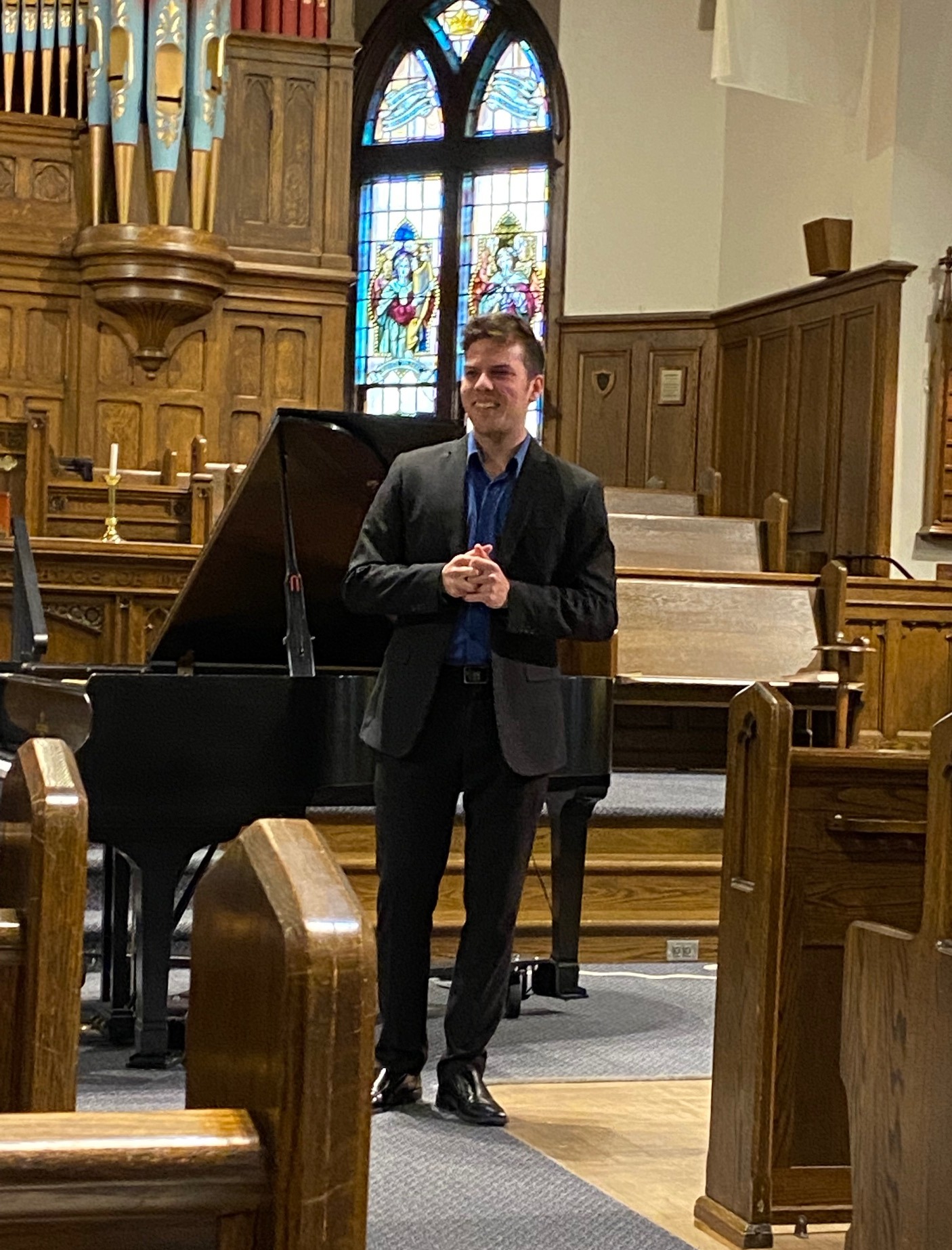
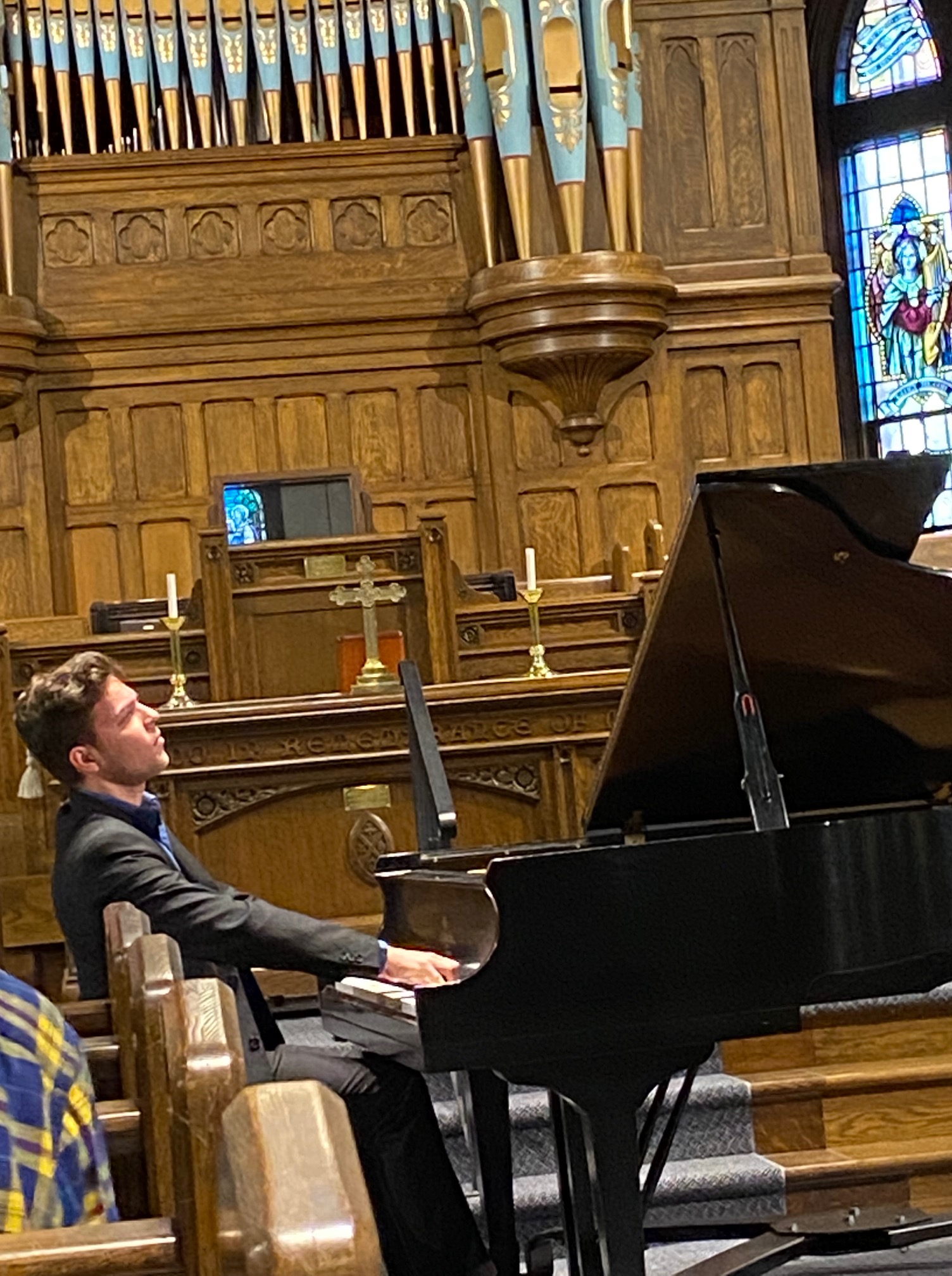


It was very nice that the small group of listeners wanted to show the pianist how much they enjoyed his concert and did everything not to stop clapping and almost forced him for a bis. He definitely gave us all big joy and pleasure. The pianist obliged and play a small piece of Robert Schuman’s music. Elegant but not empty. In times of Schuman, in between musical epochs, compositions had to be formed elegantly, while a good composer still could enrich them with true meaning, thought or emotion. Many things could be said about Schuman as a composer – but never that his compositions were not a good music.
Therrien recorded two CD that are worth mentioning: Piano Preludes by American-Spanish label Orpheus Classical ( Claude Debussy Book 1 of Preludes and Franz Liszt Symphonic Poem no.3, S.97 (nota bene: Liszt was the father of this musical form). Therrien arranged it himself for solo piano.
Second of these recording is a CD produced by French label Klarthe. It contains an array of fantaisies by many composers played by duo of Jean-Samuel Bez (violin) and Jean-Luc Therrien (piano, of course).
Of these two recordings, I particularly liked the ‘Piano Preludes’ produced by Orpheus Classical.
 > > Pogwarki < <