Bogumil Pacak-Gamalski
Of lovers and friends. Of the most unfortunate ones, who were friends and became lovers. Oscar Wilde once described that dilemma clearly. And trust me – he knew a thing or two about it. Yes, of course, I’m taking off that famous line from the Ballad of Reading Gaol. Yes, yes – that line: ‘Yet each man kills the thing he loves’, which is followed, by the end of that stanza, with: ‘The coward does it with a kiss,
The brave man with a sword!’[i]. The year was 1898, he was just recently released from prison in England. Went soul, heart, and financially broken to France, to try to re-established himself. Of course, too late. Just the Ballad remained, a shadow of a once proud, elegant poet, a member of society. With the misfortune of falling in love with some rich boy. Who, with tears or glee (who knows) sold him to the gallows trying to save his own skin (and father’s money, naturally).
Thus, boys and girls alike, for heaven’s sake – do not fall in love with your friends. Rather, become friends with your lovers.
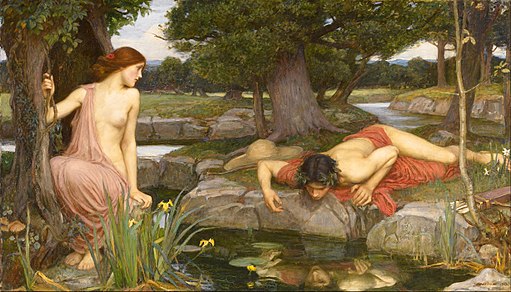
In the Prologue to the “Alchemist”[ii], Paulo Coelho writes beautifully the story of Narcissus’s death. Of course, Coelho would not have been such an amazing writer, if he had merely repeated the thousands years old story told already hundreds of times by others. No, he added a sweet surprise at the end. So humanely grotesque (as all Greek gods stories were): when the goddesses of the forest came to the Lake, where gorgeous Narcissus drowned, they asked the Lake: Why do you weep? and expectedly the Lake replied I weep for Narcissus. The goddesses were understanding, they themselves chased the boy through the forest, trying to see his famous beauty, the beloved of Apollo himself. And they admitted to the Lake, with a hint of jealousy, that although they pursued the boy, the Lake alone could see his beauty the best. At that moment the old story takes a different, shocking turn when the Lake replies: But… was Narcissus beautiful? A conversation ensues, as expected. The goddesses explained that obviously since Narcissus so often admired his own reflection in the Lake waters, the Lake must have noticed his beauty. The Lake paused, thought, and after a while replied: I weep for Narcissus, but I never noticed that Narcissus was beautiful. I weep because, each time he knelt beside my banks, I could see, in the depths of his eyes, my own beauty reflected[ii]. What an amazing twist to the old tale! I love writers and poets, who tell us: oh, come on! don’t be timid – allow yourself to dream, to tell the secret and true thoughts, and desires. Mirror, mirror – tell me if I am … . LOL
Thus, be a friend of your lover. Avoid the terrible pitfalls of friends, who become lovers. There are really very few brave souls, who survived the utter honesty of true friendship in forming eroto-romantic union. Poor Andre Gide felt forced to explain his “Immoralist”[iii] by the timid (and so obviously false, LOL) words in the Preface to his little, yet so sweet book. Thank God at the very end he was able to utter the most powerful explanation in the history of art: To say the truth, in art, there are no subjects, which only sufficient explanation is the art itself[iii]. O! Little critics with overblown moralistic egos – be quiet already. You are not a philosopher but a scribe jealous of a writer.
The dilemma of choosing if a friend could be a lover was a paralyzing complexity for Jean Genet in his amazingly honest story of “Prisoner of Love”[iv]. More so even, because it is intertwined with the love and passion for the Palestinian cause. Did he consummate his love for the Palestinian boy or was it just a Platonic passion? The powerful novel/memoirs, written in France (his last work, shortly before his death), were treated as not very important literary achievements. Au contraire, mes amis – it is one of his best. Powerful, very deep psychologically, insightful. This book and a little (in size comparison) booklet “Out of Place”[v] by great intellectual Edward Said taught me much more than any historian about Palestine and its tragic People ever could. But it is a different subject.
How can you write about friends and lovers without mentioning three amazing people: Polish writer/intellectual and modus vivendi of Parisian art circles – Konstanty Jeleński; his wife, famous Spanish-Italian surrealist painter Leonor Fini[vi] and Italian aristocrat, painter and diplomat Stanislao Lepri. All of them lived happily and joyfully in sexual and friendship union until their deaths. How did they survive all the pitfalls of such a union? I personally believed that that Jelenski and Lepri were the primary lovers most of all, and Fini was their artistic, crazy, and much senior femme fatale.
In 1995 Jelenski invited me to visit him in Paris. But, when I finally arrived – his sprawling and beautiful apartment on rue de la Vrilliere was a circus in full swing. Leonor was just preparing her special exposition in the Senate of the French Republic. Paintings were everywhere: on sofas, on beds, on chairs. And people were constantly coming and going. Friends from all over Europe. Poor Kot felt so bad, I had a chuckle. He quickly rented me a room in a small hotel nearby, on rue Croix des Pettits Champs. I was happy, telling you the truth. My gosh, I was young then, and Paris and her evenings and nights were so … appealing? Appealing, for sure, LOL. This way he had more time to concentrate on the crisis at hand (Leonor’s Exhibition) and I could concentrate on things (shall we say?) not only intellectual. Hmmm. After all – late evening walks along the Seine could be very … exciting? Enough said.
But back to friends and lovers – Leonor, Konstanty (Kot or Kocik in Polish – sort of French un minou, which definitely would be a much more proper name for Jelenski, who was truly a very sweet guy), and Stanislao. How did they survive for so long? Especially that at the beginning there was one more constant female shadow – a true femme fatale of their ménage à trois: Konstanty’s formidable mother. Madame Rena Jelenska de domo Skarzynska, from very old Polish nobility. Rena couldn’t stand Leonor. She didn’t mind at all (was actually fond of him) Stanislao Lepri. But that old crazy Spanish whore?! Poor Kot. Even more tragic because he actually truly loved both women: his mother and Leonor. But on the subject of staying together till death – I think that Kot, Leonor, and Stanislao could because actually, they all slept with each other (separately at the beginning, I assume) before they became friends. They were the happy part of the equation: lovers, who become friends.
Last but not least here is a more modern case of brilliant Irish novelist Colm Toibin in his multi-layered novel “The Story of the Night”[vii].
The novel is truly a masterpiece of combining so many complicated subjects and themes without losing for a moment the personal story of its protagonist – Richard Garay. Richard leads many lives: English, Argentinian, artist, businessman, even (for a brief moment) politician. But most of all – gay in a very macho dominant male world of South America. Another constant is the presence of his dear friends: Susan and Donald.
The writer (himself an openly gay writer) does not shy from describing many of Richard’s lovers and one-night encounters. But it is the brief encounter of sexual attraction revealed by Richard toward his straight friend Donald that warrants mentioning. Encounter – which is important to note – planned by Donald. He ‘just’ wanted to check if, as he suspected, Richard was homosexual … . No sexual encounter ever happened. But, yes – it couldn’t be denied that Richard was aroused and willing. Even the fact that the act itself was never consummated – it changed their friendship dramatically. In some way, it wounded it mortally.
Therefore, my dear boys and girls, please take it as the wisdom of almost god (meaning me, naturally). If you must experience the forbidden truth and fornicate, please choose a stranger rather than a friend. With a stranger, you have nothing to lose (other than your presumed virginity). If you are lucky the experience will bring you a lot of joy and satisfaction, at worst – it will be a disappointment (first times often are, nothing to be ashamed of). With a friend, the stakes are much higher and sometimes lasting lifelong bitterness or guilt.
And do read a good book before. Not really educational. A good literary book. Like one of these mentioned above.
[i] Selected Poems of Oscar Wilde including the Ballad of Reading Gaol, by Oscar Wilde; CreateSpace Publishing Platform, 2017; p. 56
[ii] „The Alchemist”, Paulo Coelho; pub. Harper One, 1993; p. 197
[iii] “Immoralista”, Andre Gide, by Wyd. Zielona Sowa, Cracow, 2006 (Polish translation by I. Rogozinska)
[iv] „Zakochany Jeniec”, Jean Genet; wyd. W.A.B, Warszawa, 2012; p. 486 (Polish translation by J. Giszczak)
[v] „Out of Place”, Edward Said; Random House, 1999
[vi] https://rynekisztuka.pl/2011/12/16/leonor-fini-i-konstanty-a-jelenski-portret-podwojny-w-warszawie/
[vii] “The Story of The Night”, Colm Toibin; McClelland&Stewart Inc., Toronto, 1997; p. 312
 > > Pogwarki < <