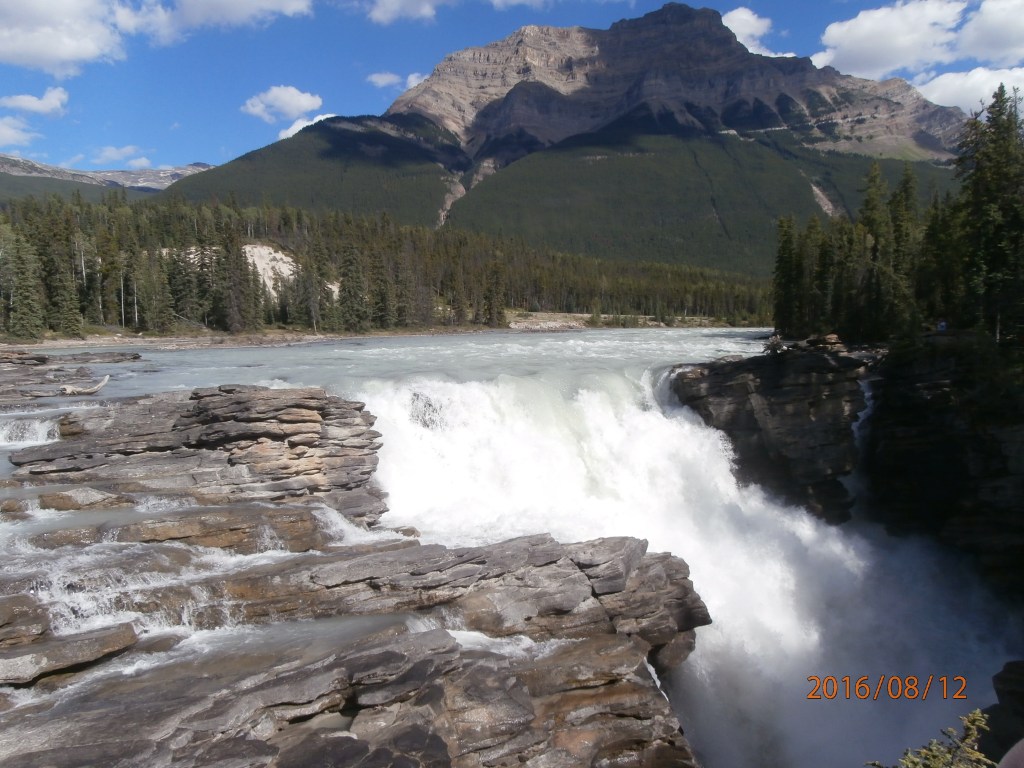
Canada Day 2021. Shame or pride?

Canada Day 2021. Shame or pride?

Bogumil Pacak-Gamalski

The chorus of voices behind each of the chosen answer is deafening. And probably each equally wrong. For – in my opinion – the answer is simple: neither. And that opinion is not based on moral, ethnic, philosophical or political reasons. I base it on … demographics.

Just few years after my arrival in Canada, in 1986, European immigrants formed huge group of roughly 70% of all people born outside of Canada; second  group, far behind, were immigrants from all Americas (15%); close to them were immigrants from Asia at 9%; people born in Africa represented 4%.

Now jump thirty years to the future, to 2016. Immigrants born in Europe were 33%; from Americas roughly unchanged, at 16%; born in Africa double in size to 9%. Asian born immigrants placed at record 40%, becoming the dominant new Canadians born outside of Canada.

Mind you, this numbers do not count Canadians of European, Asian or African heritage, who were born already in Canada. These are just first generation Canadians. Like me. Did you notice the huge change, though?

Yes, Canada is – and will become even more  in coming years – a different country than it was when you were born here, definitely different than the country of your Canadian parents and grandparents. That also has a statistical effect on how all Canadians perceive our Canadian past, our judgment of that past. Our expectation for the future.

We will never know it, but I will risk assuming that if in 1982 (the year I arrived in Canada) some Royal Commission or National Inquiry discovered and truly showed to the public the story of Residential Schools, the huge damage it has inflicted on First Nations – there would have been no Parliamentary or Government acknowledgment of the crimes, no national ‘we are sorry’,  as it happened in 2008 Apology delivered by PM Stephen Harper.  Why would I assume it? Because in 1982 Canada was a different country as far as the fabric of our society. In that country it would have been wiser politically not to fully accept facts and issue ethical response. Settlements probably would have been paid (probably smaller) because the courts and independent Commissions  would have established beyond doubt the harm and guilt of Canadian government and our Christian Churches. But the affair would have been called an old policy mistake, reparation paid, few still operational schools closed and that would have been the end of it. It was a different world. I remember it well. Not only in Canada.

But times changed. And so our country and the people, who live in here. This is not a judgment on descendants of French and Anglo-Saxon original settlers. Their values and their knowledge and sense of history was different, too. Their stories told by their parents and grandparents were the stories seen by their eyes, their understanding of the world around them, not by objective view. My story of my homeland, Poland, was different when I was 10, 15 or even 18 years old. Very different then my story of Poland now, 40 years later. Even those, who finished universities and colleges were taught from history books of previous generations. History glamorized, made heroic. It was needed to build and to make strong a very young nation. Nation, which just went through horrible experiences in First and Second world wars. How a nation that just sent thousands of young boys to die for freedom of nations far away, across an ocean, could have itself commit a crime against tiny nations of poor Indians?! That was beyond comprehension for many. It doesn’t change the facts of that terrible crime, doesn’t absolve the astonishing lack of morals of politicians and governments and Churches in good first half of XX century. But it was a time, when news and facts were not as easily noticed or reported as today. It does make it easier to understand the ignorance of that crime among general population.

And now, in 2021, on July 1, I am ashamed of the past of my history. My, because, as a Canadian, I have accept as mine also the history of my country. My country – Canada.  I have never stopped being a proud Pole. Who is ashamed of some parts of Polish history. Parts of very anti-democratic and xenophobic temporary, today’s Poland. Because of that old knowledge, I can say as a proud Canadian, that any form of xenophobia is the worst national feeling that can be. That we should always fight it within ourselves. That feeling of being better than others is not a good feeling. It is a poison that seeps into healthy patriotism and makes it bitter and sour. Having these two alter egos – the Polish and the Canadian – makes me very aware of it.

I like stories. Often tell them myself. Do you know the difference between ‘telling a story’ and reminiscing? Both involve past and often are of personal experience (although story could be of other people’s experience, known to the teller, or even be of fictional characters and place). The main difference is that a story has an informative and educational message. What it used to be called: a moral. Reminiscing is mostly of sentimental value and reason.

My story of today takes place in time long ago and of time present. A visit to an Indian Reserve in the middle of 1980’ and visit to reserve on July 1st, 2021. On Canada Day.

In the 80’, after working for few years I got restless with my job (well paid unionized position in Catholic School Board) and quit. Needed something new, more challenging. It was first and only time in my almost 40 years now in Canada, that I was unemployed. Still knew very little of the system, of how it all works. Being young and a bit of a ‘smart Alex’, I felt above asking anyone for good advice. I will find my own way! Or so I thought. I found some intriguing ad about some insurance/financial/investing company looking for new ‘ambitious’ people. Knew nothing about that field. Zilch. After all investing and finances in communist system were really a totally different concepts from another planet. And that’s where I grew up and educated myself. What an opportunity to try myself in a truly capitalist field, I thought seeing that add. Of course it was an absolute scam, as I learnt quickly.  The ’firm’ was telling us that the best to start and learn is through sales. Sales of anything. If you learn how to sell any product, you be good in selling serious product and services. Let’s go to do some ‘field work’. The manager and his assistant noticed that I have a new , good size car and suggested that they, myself and another promising applicant will drive to that experimental field.  Right away I didn’t like the fact of using my, not the company’s car for such trip. Perhaps that was also part of the test and building of trust and finding an unorthodox way? Who am I to judge? My trunk was filled with heavy bags full of stuff. We drove just outside of city limits in Calgary and parked by the gates to Sarcee Indian reserve. The manager instructed us that once we park inside the reserve, each will grab a bag and spread out to find any single (the best) or group of young people and sell our product.  Radios – 30 bucks, flashlights – 15, cassette players with speakers – 40.  All the best imported from USA and Japan. Who sells the most – wins a special gift and an offer of employment. Let’s go! My head was spinning as I started the car and crossed the gate. We parked in central place, close to the entrance. I opened my bag – full of cheap and flashy Asian electronic junk.  What the hell?! Did I move back in time and going to be traveling salesman with flashy junk to sell it to poor Indians?! I put the bag on the ground. The manager yelled at me – come on, faster, we don’t have much time before the Chiefs kick us out! That was enough. I threw the other bags to the ground and yell back: get the f… out of my car now. I am not a f… colonial trader in XVII century Africa. I am leaving now. He was shocked and confused. Locals started looking at us hearing my yells. He tried to calm me down and resigned said – ok, let’s go back to the office, we will talk there, I will explain it to you. I said that I am leaving. But alone and I don’t give a s… how they will get home. And I left.

That was my first encounter with Canadian Indian Reserve and Canadians perception of them. Today the Sarcee nation is known by their own historical name Tsuut’ina Nation. Since that time they have become powerful and resourceful tribe with strong social, economic and educational base. Instead of scamming traveling salesmen with cheap watches and other junk they are visited by Calgary’s mayors, premiers and economic ministers of Alberta, reps of powerful corporation, who want to deal with them and offers of contracts worth hundreds of thousands of dollars. But there are still, further form large urban centres, small secluded tribes living in abhorrent conditions. And still being subject to indecent and dishonest deals.

Few days ago I went again to First Nation Reserve. This time by myself, to celebrate Canada Day. How better to celebrate this country if not among it’s first, original inhabitants, guardians?

That decision came easily for me. Should I just pretend than nothing is happening, that there is an uproar of sadness, anger and discontent on this Day? What to do with it/ Some were cancelling the celebration, some were planning to organize protest, some wanted to say “I’m sorry”.  But sorry doesn’t cut it anymore. Burning old churches doesn’t cut it, neither. Just get together and talk. We leave together, on the same land, none of us will disappear anywhere soon. Get to know each other. Specially Canadian, who are not from First Nations, should really try to get to know indigenous people. Don’t be ashamed, or to afraid. We can’t re-write history but we sure can write a better, respectful of each other, future.

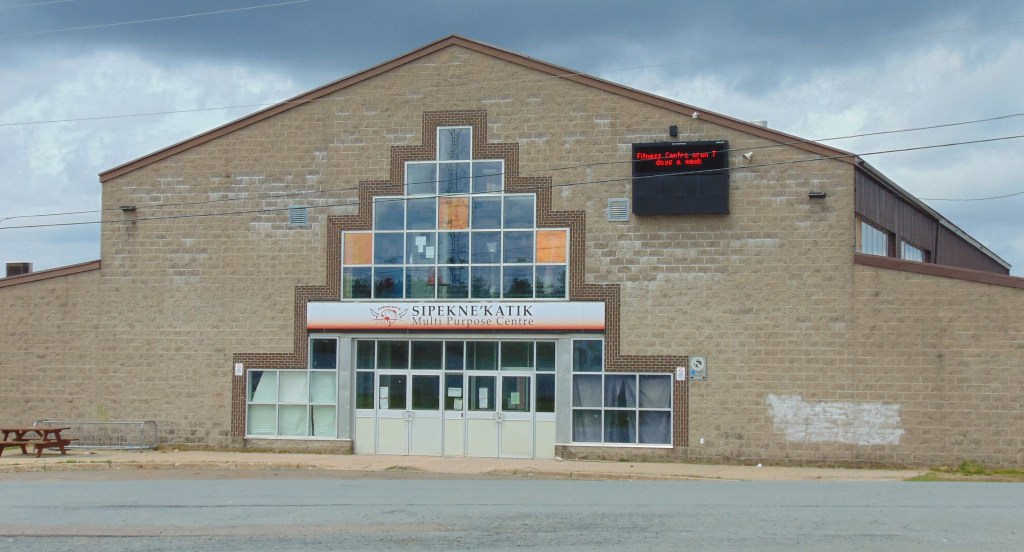
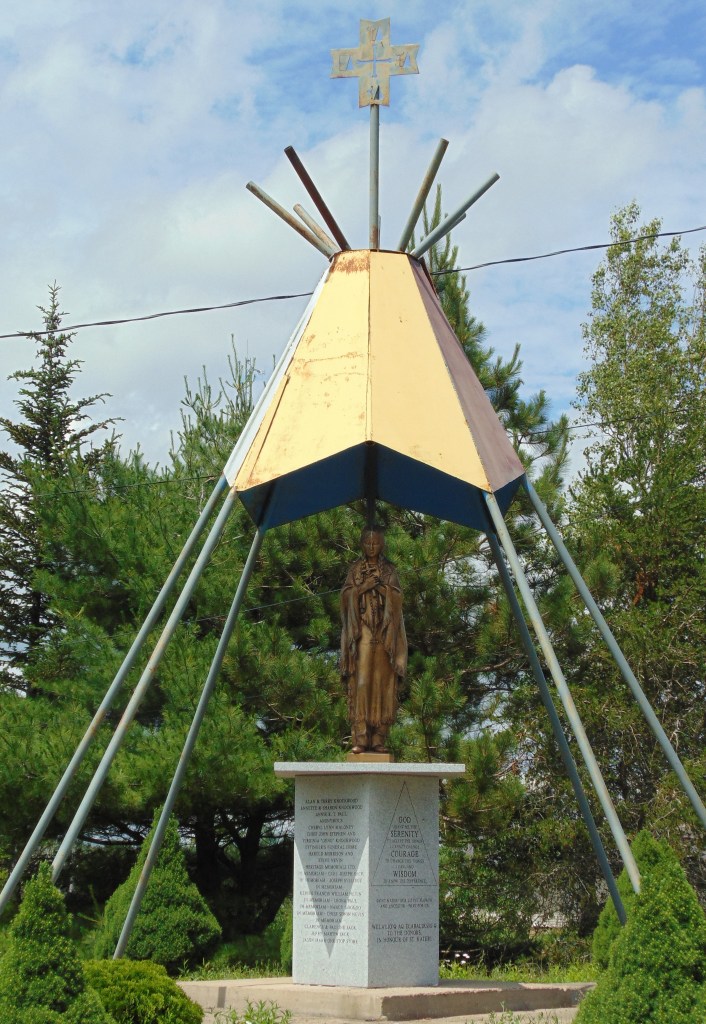
Went to the largest reserve in Nova Scotia, located between Halifax and Truro. What used to be called Indian Brooke Reserve, but is actually Reserve of a tribe called Sipekne’katik, that is a part of people called L’nu (popularly called Mi’cmaq). All this names, starting with the stupid name “Indians”, is also an effect of our total ignorance and arrogance, lack of basic knowledge.  All these tribes have names, they have history, language. Canada is a continent, for havens  sake! People in Europe are called sometime Europeans – but each nation has its own name and language, sometime more than one! German is not a Pole and Italian is not Swede. Just as Korean is not Vietnamese. Our Haida people on Pacific shores are not Prairie Blackfoots or Maritime Mi’cmaq. It is really not that complicated. No more than the difference between ‘British’, ‘English’ and ‘Welsh’.
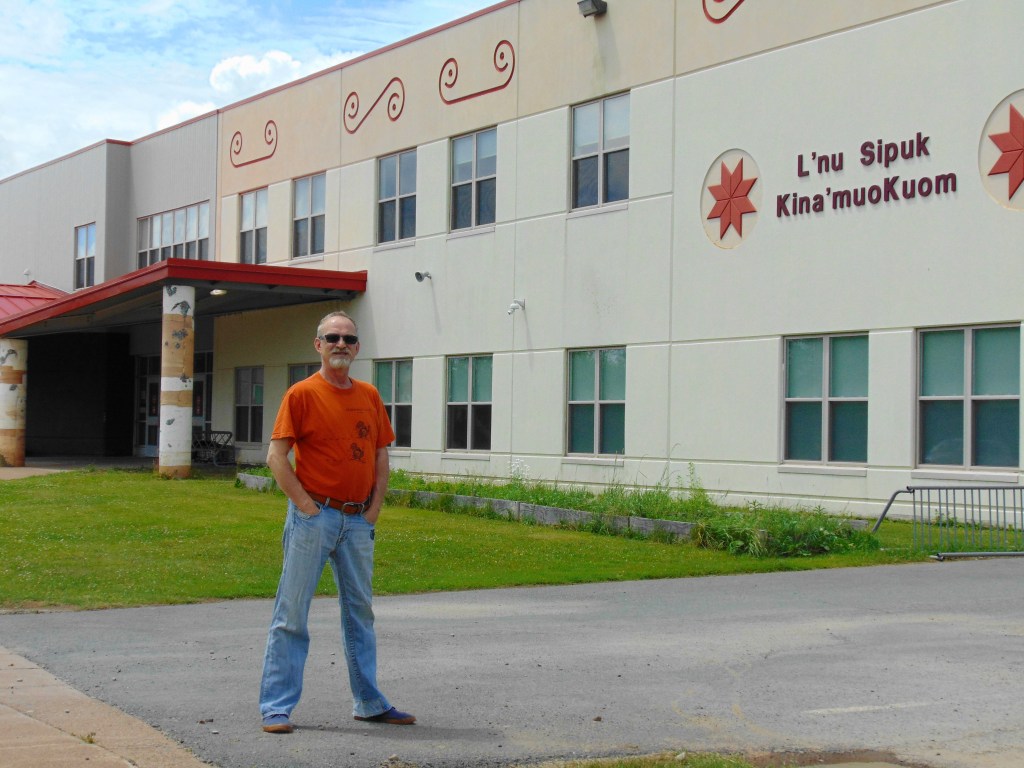
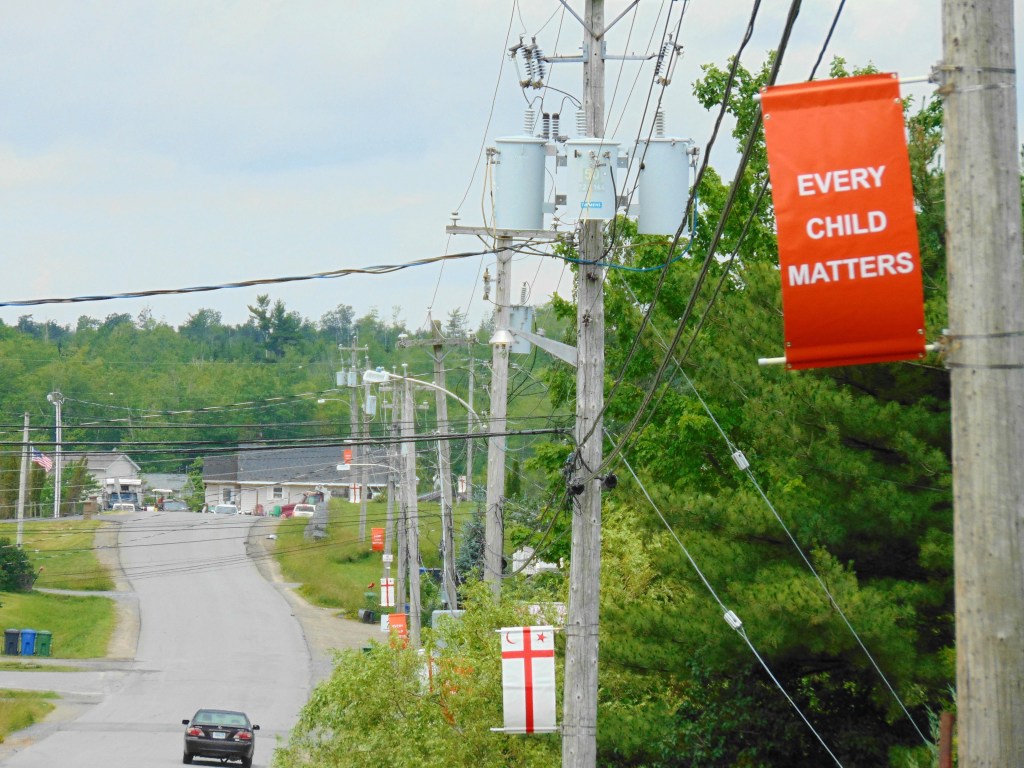
top left – author in front of L’nu Sipuk Kina School; entrance to the Village from Robinson Rd. ; Community Centre and Administration on Church St. ; bottom – St. Kateri Tekokwitha statue by the RC Church; view of Church Street toward Tuff St. and Sport Complex. (pict. by the author)

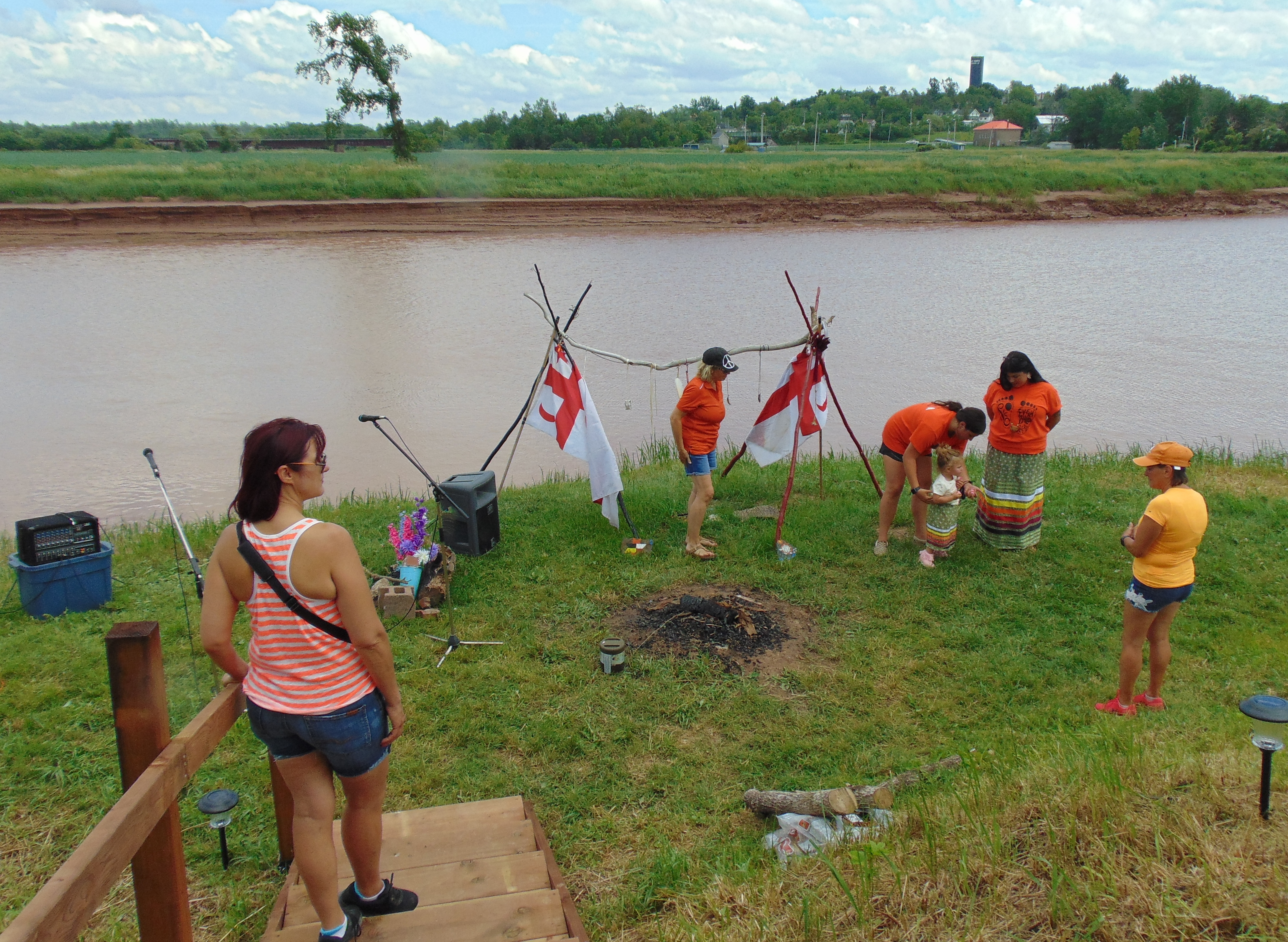
The Sipikne,katik village is large and well developed. Big church, large cultural and civic centre, beautiful school, few stores and businesses, relatively well maintained properties. One main road and few smaller ones interconnecting the territory. That special day was a huge motorized parade to remember the lost children –  these days subject on everyone’s mind and weighing heavy on hearts. There was a special gathering on sport grounds with music and children. Specially the beautiful children, all (as adults) wearing the dark orange shirts, were making me very happy and extremely sad at the same time. Just as, when I went later to visit the grounds of former Residential School to pay my respect. I watched from a small hill, were the school used to be, as one family were leaving their car: parents in their twenties and three small children. And I imagined how the RCMP arrived with some cars and were pushing away the screaming, horrified parents and taking away the crying children in a wagon to some far away school. For many years to come. Some never saw the parents again. That image brought tears to my eyes.

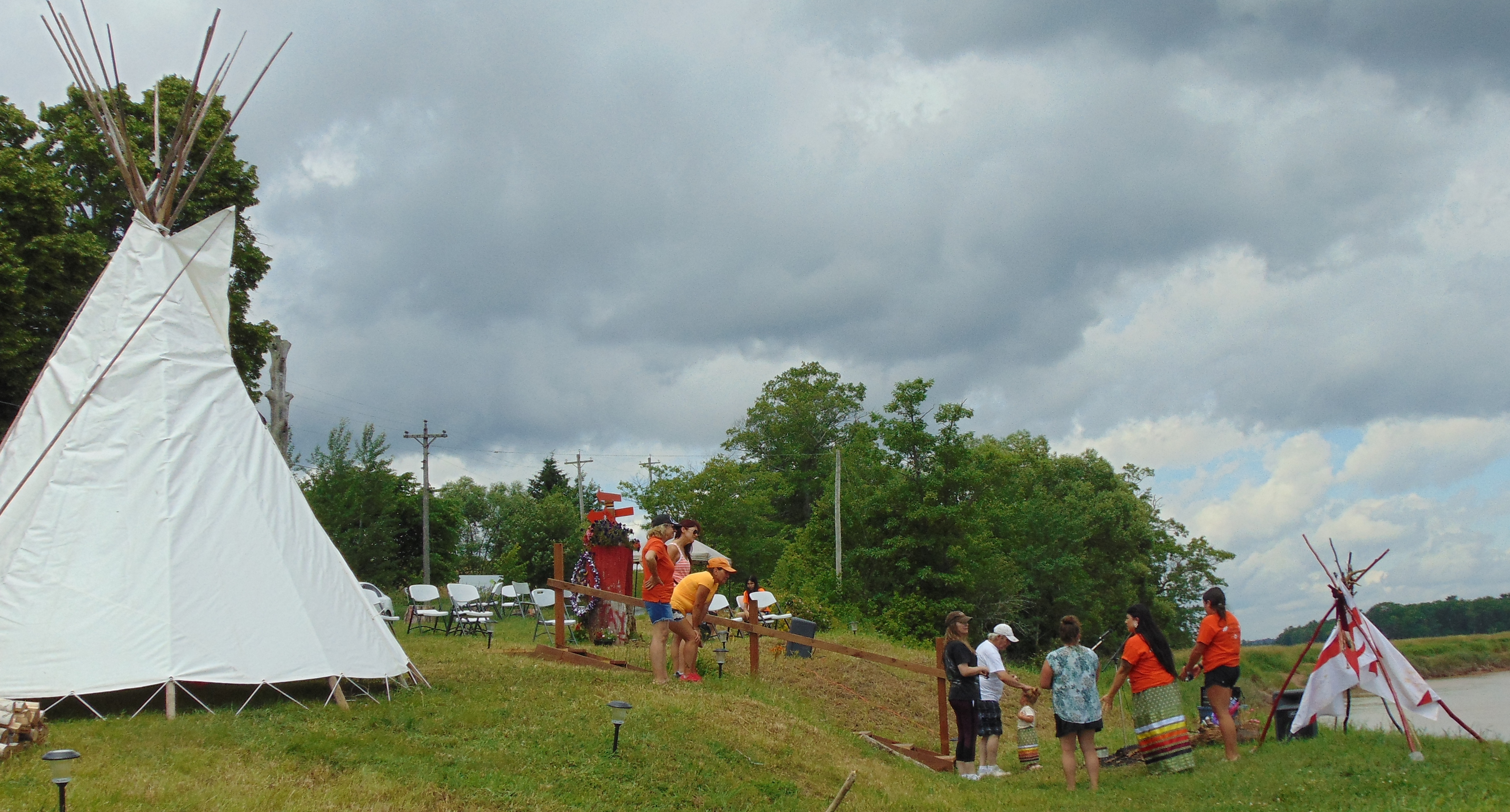
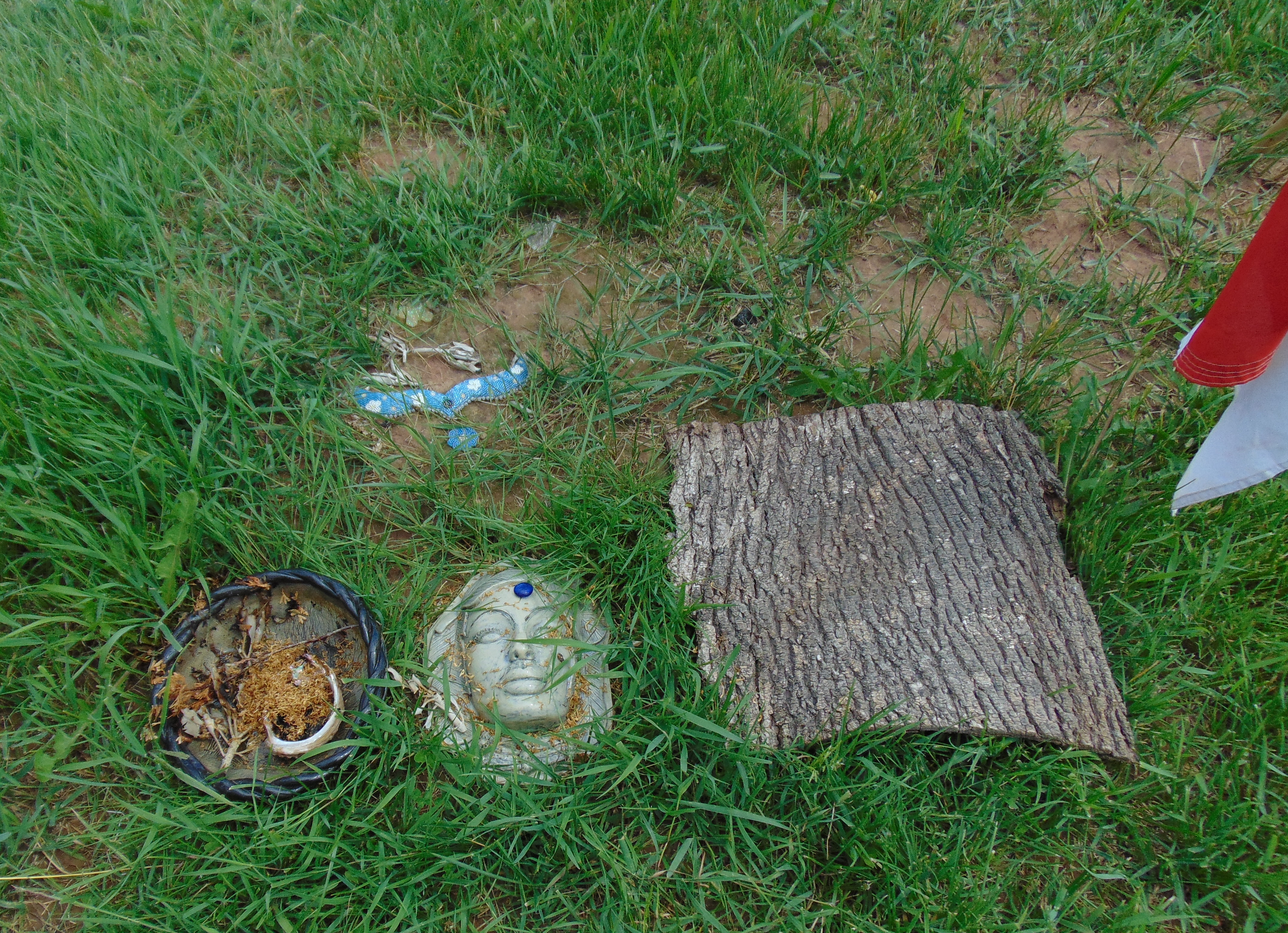
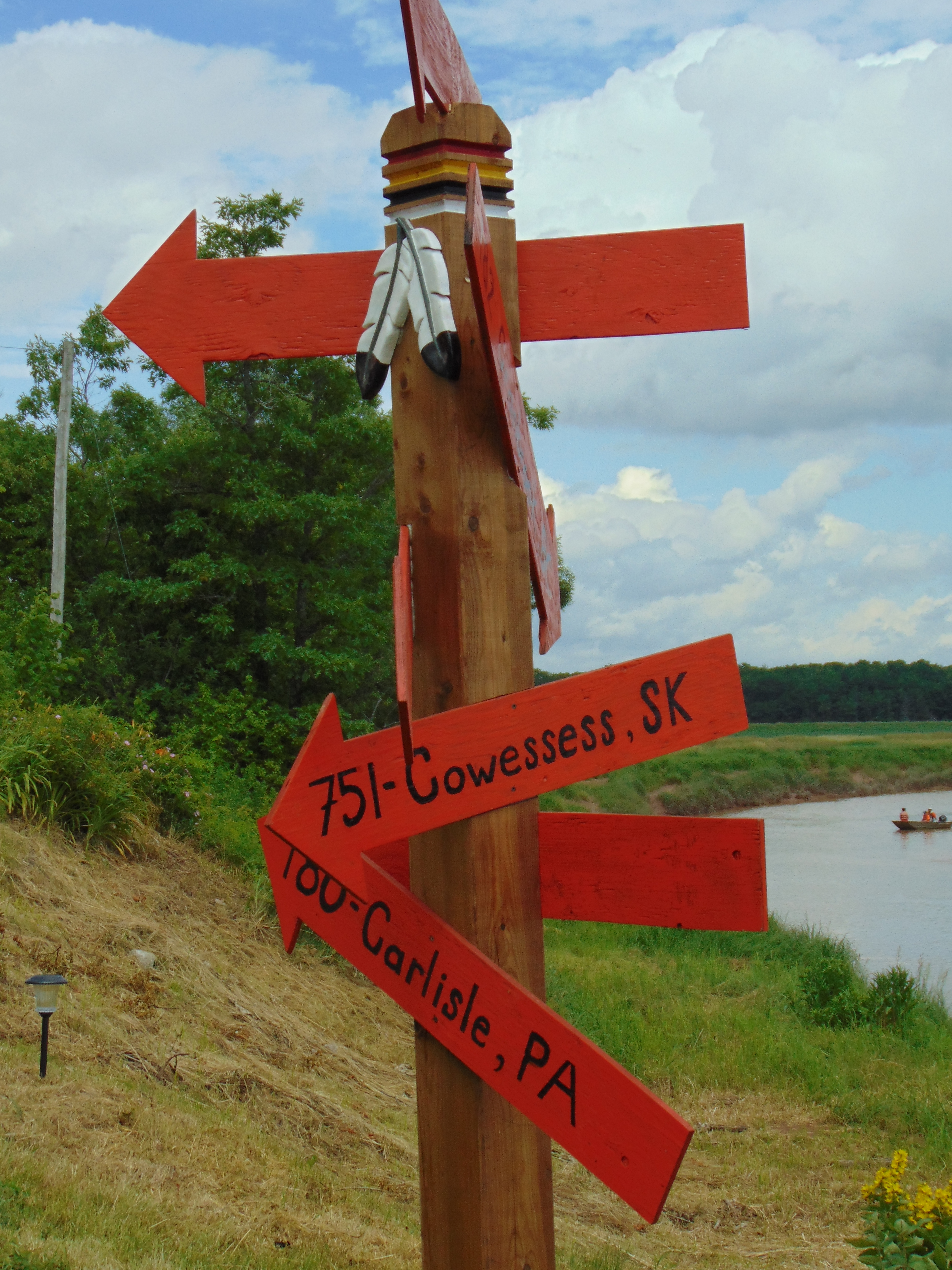
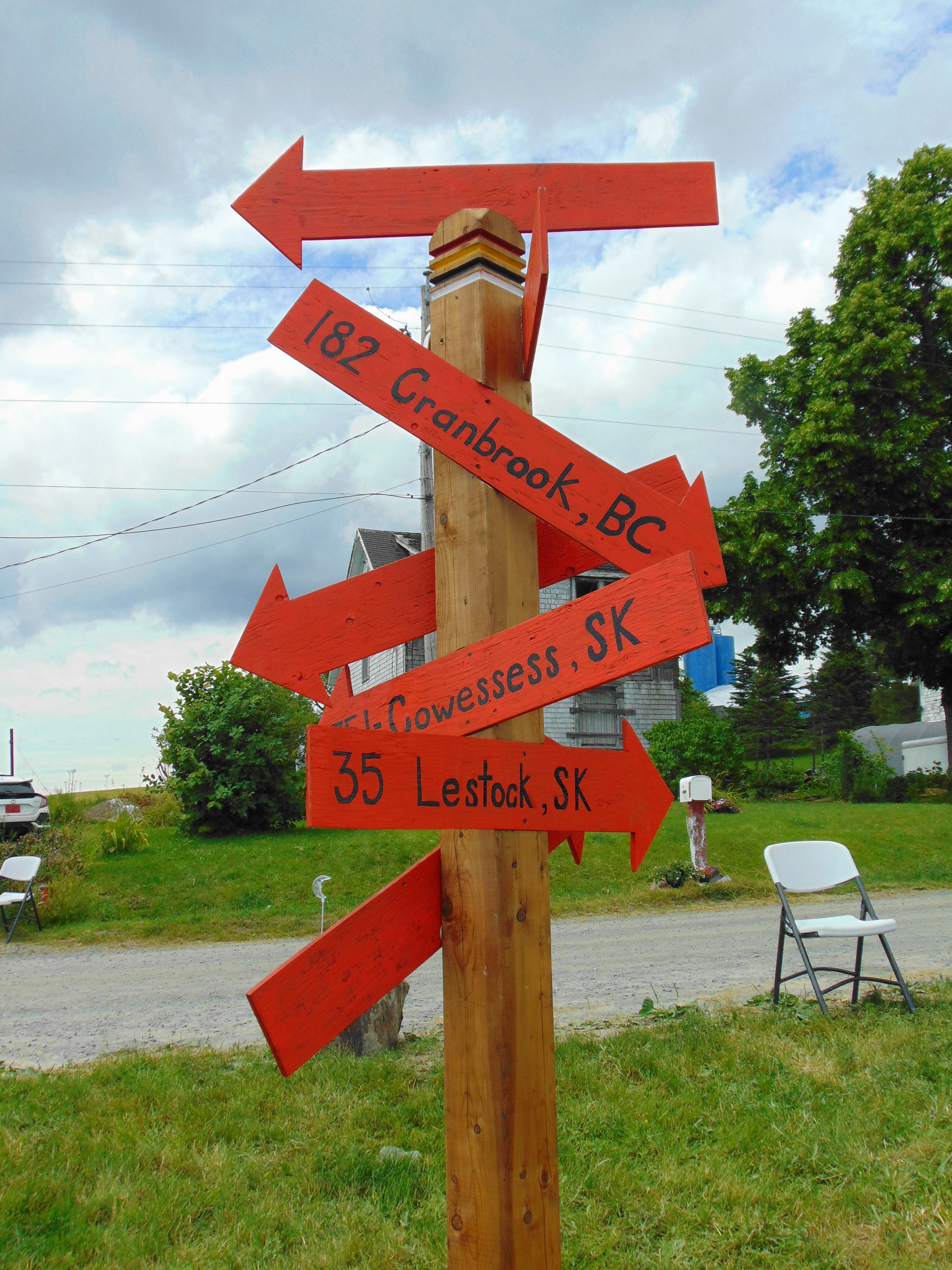
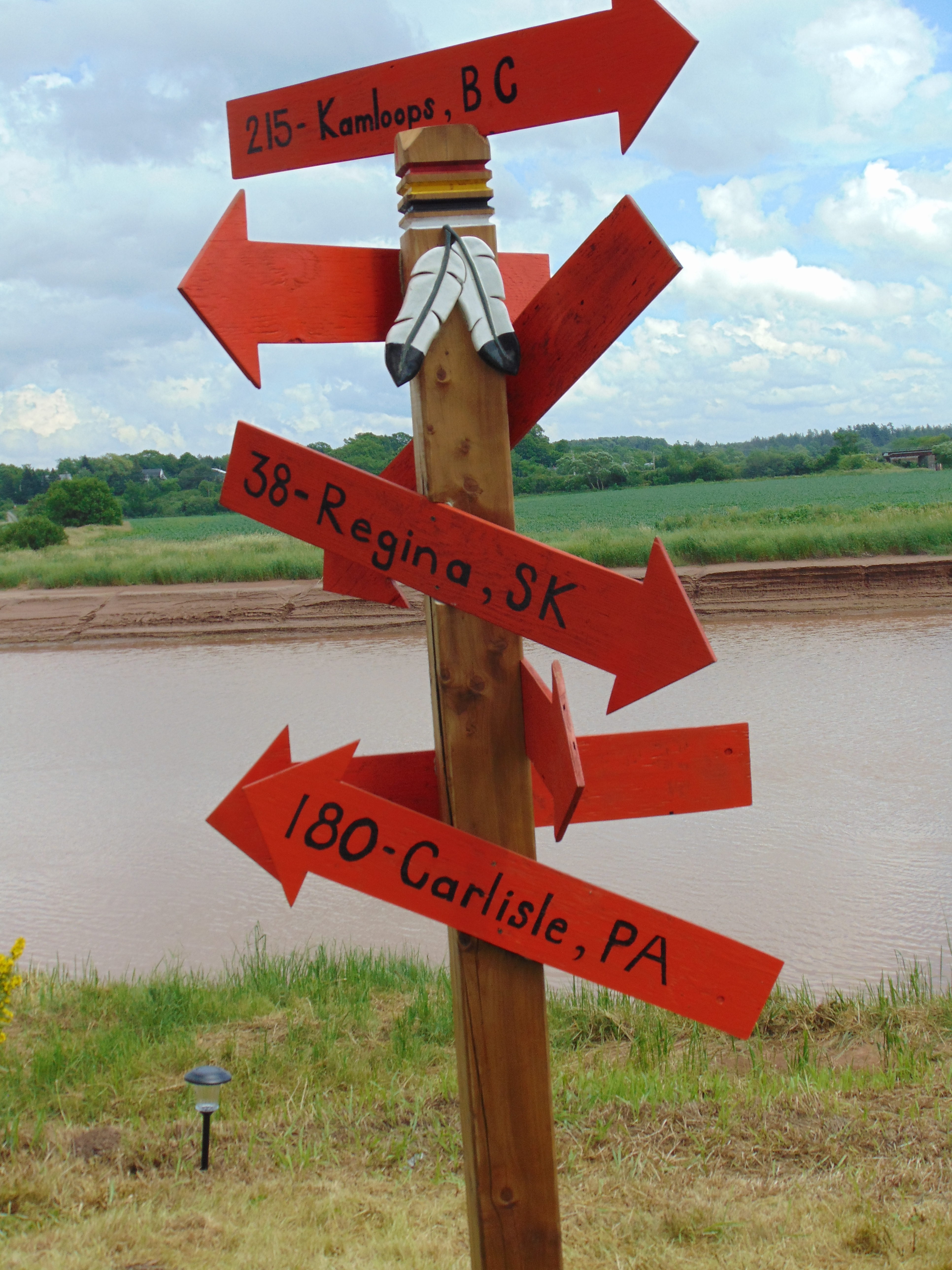
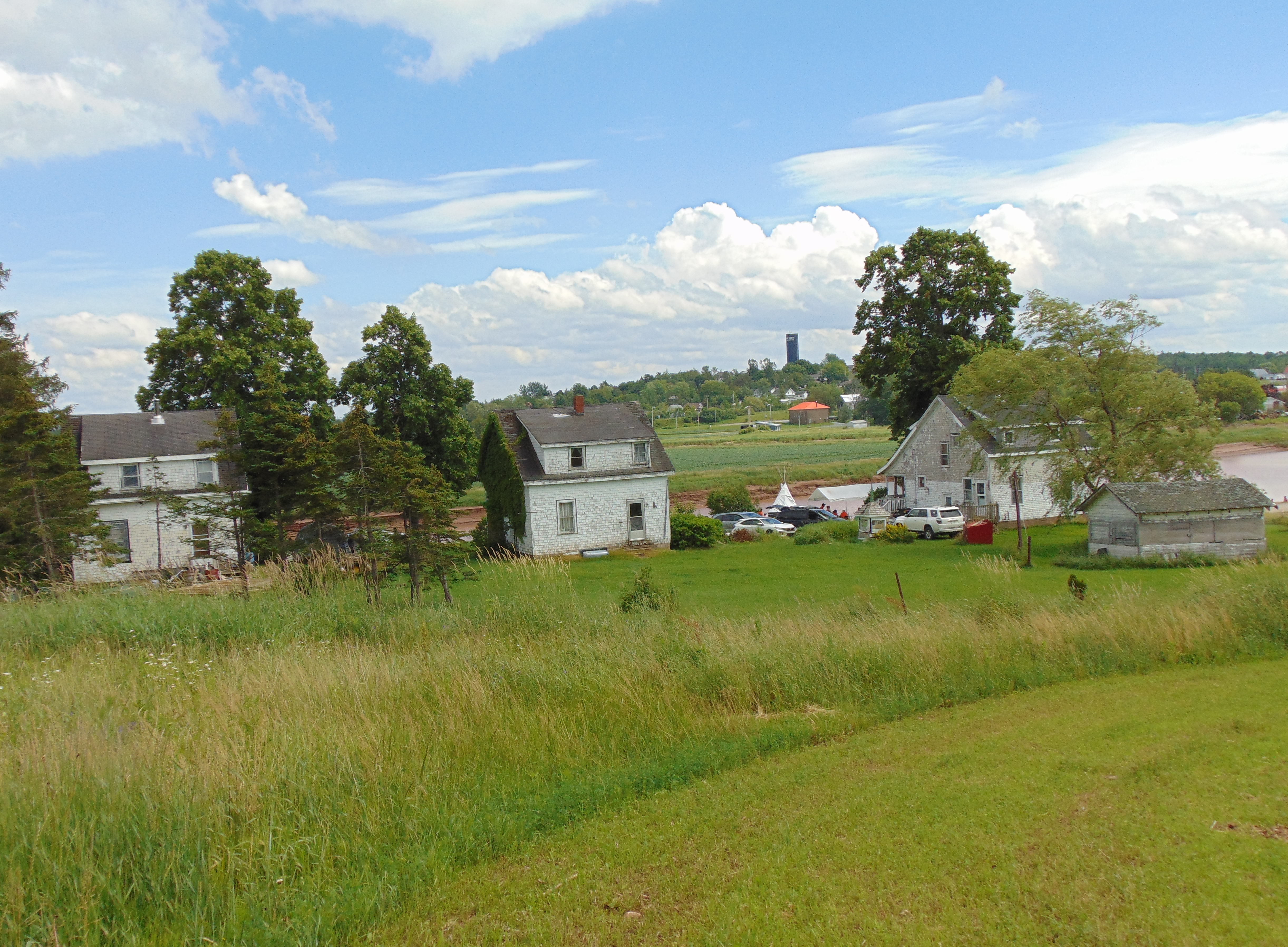
site of former Indian Residential School on the banks of Shubenacadie River (main building no longer exist, what’s left are three residential wooden buildngs of nuns, priest and caretaker). From top left – signs erected in of the old Nuns residence (#16 Indian School Rd); top two right pic – ad hoc prepared spot for burning of incent and sweet grass to honour lost children; next row – a place on the ground where you leave your offering and prayer; next three pictures of a post sign with arrows directing toward different locations of schools with recently discovered unmarked graves – notice the sign to Carlisle in Pasadena in USA, where number of boarding schools and number of Indian children confined to them is many times larger then Canadian numbers, yet the US Government never attempted a national investigation and full report of atrocities committed against US Indigenous People – ; bottom row: the only remaining part of the school building, a steeple from the school with one small room filled with children’s knickknacks; view from the hill were the school was toward the three remaining (unoccupied and in a state of disrepair) buildings; a young Mi’cmaq family on the nearby field (pic. by the author)

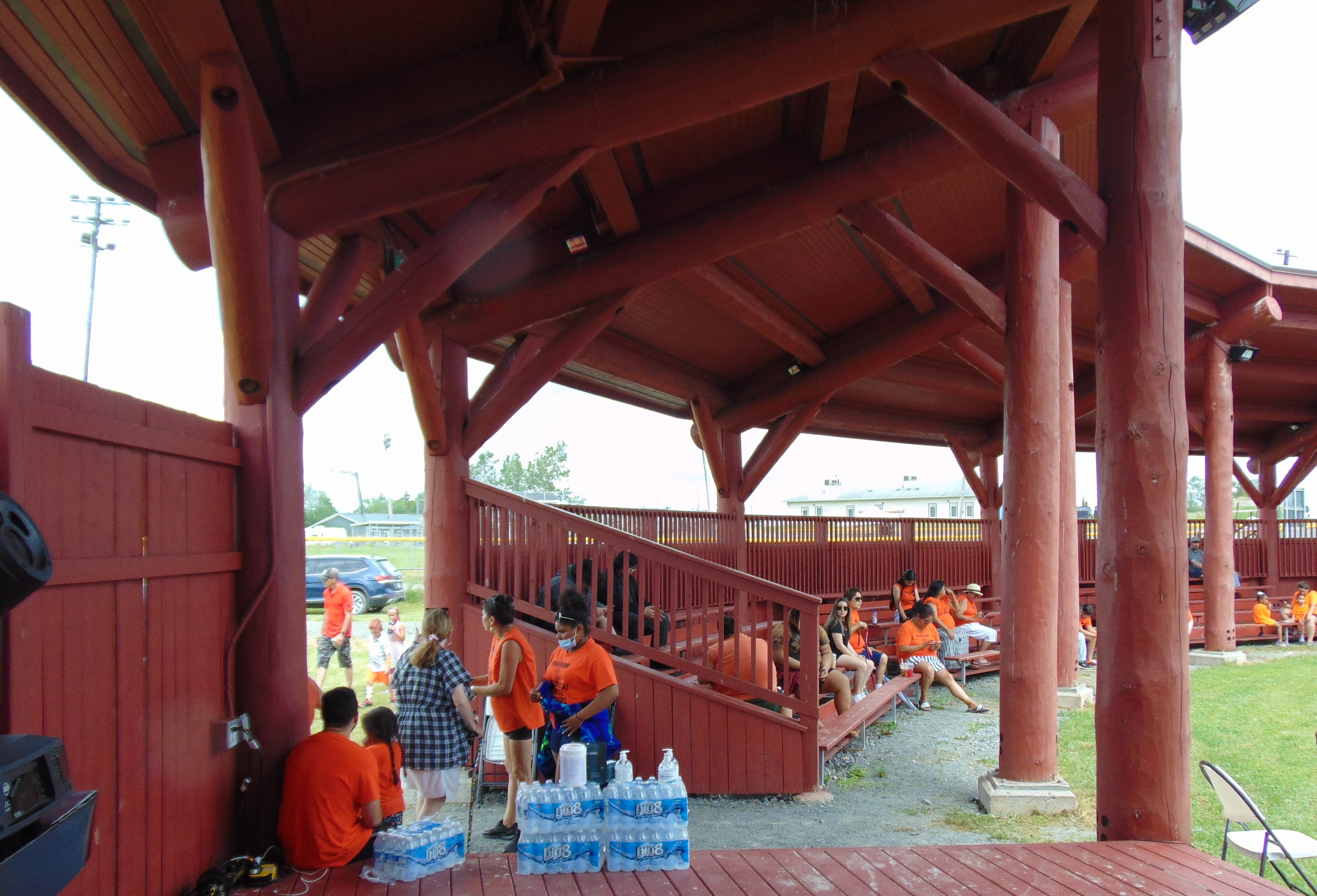
Back in the village, in the sport grounds, local young guys were sitting by a huge band drum. We exchanged few words, they gave me ‘v’ sign (when I was their age, we, “Solidarity’ activists in Warsaw, were giving ourselves the same sign full of hope and determination) and started playing the drum and sing.  Amazing concert, so powerful, so touching. I didn’t need to understand the words – they were so plain in emotion. As you listen sometime to some amazing operatic aria sung in a language you don’t know – yet, you understand it so clearly. Because emotions: pain, happiness, sadness, longing, caring, love and friendship need no translations, no explanation. That moment I shared their pain and their hope and their pride. Therefore yes, I can say that I felt proud as Canadian on Canada Day. By sharing and understanding very raw and very clear emotions of my fellow Canadians from Sipekne’katik tribe.

pictures form the diamond sport field and the band drummers and singers; flag in front of the School

I don’t know if I ever had a such good and really proud Canada Day. It was mixed with sadness and hope. Like a true, on epic scale, story of human condition. All humans. From the beginning of times.

A nation that can accept it’s dark past is on a good way to bright future. Feeling sorry for wrongdoings of one’s ancestors does not equal assuming personal guilt. It equals understanding of harm done and naming a crime – a crime. Making sure that nothing like that will happen again.

notes to ponder …

Every social unrest, every protest movement, call for justice, for equality, is a long and arduous way. None are easy and easily achievable. Even when the general political atmosphere is amicable and open to find a solution. If the political will is antagonistic – it could lead to skirmishes, prison terms, police and even army interventions, bloodshed. It could take years, decades to achieve measurable change. In a short time it could lead to worsening, persecution. Even provocations. Just look at the Black Rights movement in the USA. It started in the 60. of last century. And is still not finished. If not for people like dr. Martin Luther King and his non-violent philosophy (based on Mahatma Gandhi movement in India during their struggle for independence) there would have been rivers of blood flowing like a torrent. King’s and Gandhi’s movements take years, are slow and based on moral superiority of argument against the argument of brute force. They seek not retribution but recognisance, equality not superiority. And even that slow and non-violent way does not guarantee success. Or the success would be bitter sweet (India ‘s independence ended up in breaking up the country, mass exodus of Muslim citizens, their persecution and executions from fellow Hindu majority – despite the fact that both groups have similar ethic heritage). There is always a more radical, more impatient or revolutionary segment of disadvantaged group: Black Panthers versus King’s movement in US; Fathah versus Hamas in Palestinian cause; and one of the oldest scourge of social hatred: traditional white Christian antisemitism in Europe and countries where European powers established new colonies that later become new, independent states. Yes, main Churches in last almost hundred years, specially after the horror of Holocaust, denounced the old tradition. Popes decried it. But old official Church policy and doctrine doesn’t change easily. It always lurks in the dark places and dark souls. People were shocked, when few churches were burnt in Canada. I wasn’t. Did not support it but wasn’t surprised. Apart from the State, which is responsible for setting up the system of these horrible schools and is responsible for not checking regularly how were they run by religious authorities – the Catholic Church acted the worst in the way they run it and are the worst in the way they responded and responding to Truth and Reconciliation Commission Report. Not by what the bishops and clergy are saying in public but in what actually are they doing. So I was not shocked that probably some angry young individuals or organized group set the few churches ablaze. It is still possible that it was even done by not Indigenous persons but by provocateurs seeking a strong negative reaction from general public. Roman Catholics still form a majority of religious denomination in Canada. Yet, I didn’t sensed a strong negative reaction to the news. To the contrary – a muted understanding. Of course, if actions like that persist – the feeling might change. I don’t thing we will see more of these burnings, though. A statement was made and was understood. As for the the so called ‘profanation’ of church walls by painting on them hands of young children – I am shocked that the press and news even used that term ‘profanation’. Harming and killing children was profanation. The act of paintings their hands on church doors and walls in my view is totally acceptable and has a very deep, just meaning. I applaud it. Building in Saskatoon a huge new cathedral for quarter million dollars, while arguing in front of court (successfully, sic!) that the Church can’t afford paying 24 millions dollars as reparation to First nations is a profanation. It is worth noting that despite all of it, the Indigenous people are very religious and by large part Catholics themselves. But that’s entirely different subject.

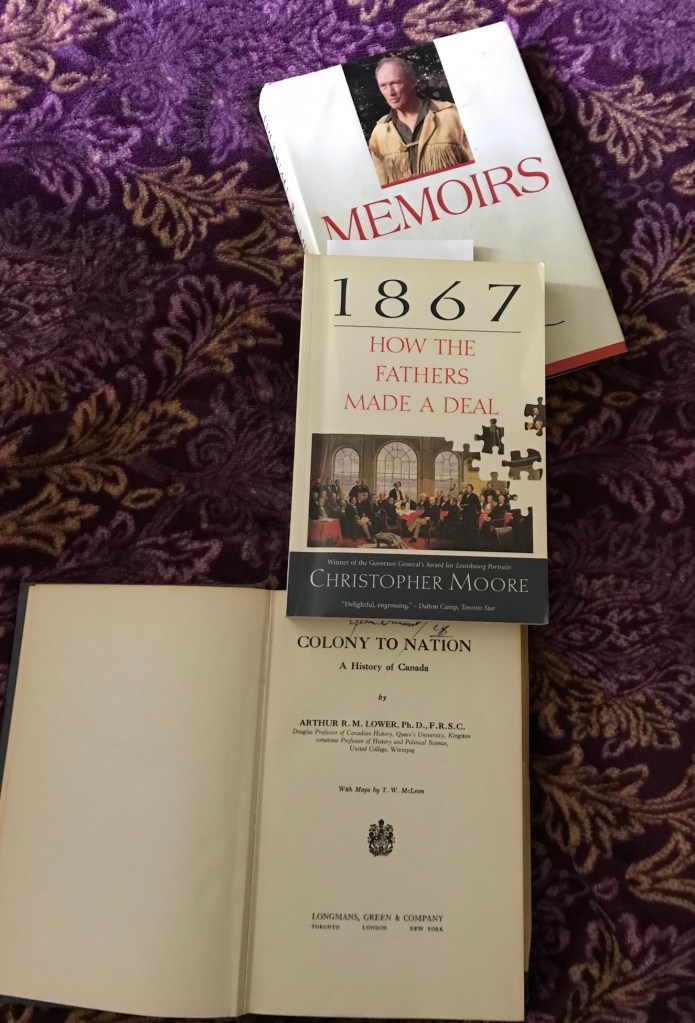
Residential Schools side discussion – John A. Macdonald: a national hero or villain?

by Bogumil Pacak-Gamalski

Residential Schools and modern day placement of native children in the care of non-native families and system (provincially  mandated but with tacit support of federal authorities) is a drama without comparison to none other in Canada’s history and Canada today. It affected and affects everything that happened and that is happening to all First Nations. Abject poverty, lack of resources, lack of education, high unemployment, pervasive alcoholism and drug addiction. All of it was almost (an argument could be easily made that it was indeed) planned, arranged by local colonial powers and even more so,  by the new Canadian Confederation. The country we call our own.  To say the truth, I am having a lot of doubt if that system of full cultural genocide would have happened if Canada remained a fragmented colony for fifty or seventy years longer. Separate entities of Upper Canada ( present day southern Ontario), Lower Canada (Quebec and Labrador) and three Maritime Provinces. That would mean no creation of unified confederation and no strong federal executive and legislative power. With much stronger oversight and decision making from Great Britain and it’s Colonial Office.  The precursor to our constitution and the still important core of it, the British North America Act would have not happened.

Our renewed  national discussion of our past ignited again the controversies of whom we admire, who is the hero of Canada’s history. More or less, who is the Father of the Nation? And centres very much so on the person of John Alexander Macdonald. Was he or wasn’t he? And if he was the Father – was he a good, wise father or a bully with drunken rages? Smart and competent to achieve his goals but bully nonetheless? Let’s go back a notch to remember what happened circa 1867.

Of course, as we know very well – history could be re-written many times but historical facts can’t.  Yes, there was a Maritime Conference in Charlottetown called by Tupper and Howe from Nova Scotia that was going to discuss possible unification of New Brunswick, Nova Scotia and Prince Edward Island. But delegates from Upper and Lower Canada asked for permission to come and observe. Such was granted and those guests quickly posed a question: why only Maritime Provinces? Perhaps we should unite all of Canadas into one confederation?  And that, ladies and gentleman, was the night that the conception of Canada happened.   

Why do I bother writing about the obscure tidbits of history if the text might suggest to be about the effects of Residential Schools and in general the planned and executed action of destroying political, economic and cultural base of First Nation? Also their biological existence, if not totally, than in numbers greatly diminished and easy to control.

The very recent discovery of hidden bodies of children buried deep in the ground by Residential School in Kamloops surprised and shocked many Canadians. Shook the nation to the core. A lot of us. Except … the First Nations themselves. They knew that many such hidden graves exist. They knew because that’s not an ancient history and old tales and myths. That’s now, very recent.  Their uncles, maybe even brothers and cousins, great aunts and great uncles. Those that everybody in the community knew they existed, were forcefully snatched  by raids from their petrified and crying parents, placed in the Residential School and never came back. Were never seen or heard of.  They were not the children of proud tribes  sought of, as a powerful allies, in the great struggle between the French and British empires and later in the struggle to maintain British territories during the US War of Independence. Those nations and tribes  the King and Queen in London signed treaties with. No, by the end of the first two decades of XIX century they become an obstacle to plans of the new settlers. The colonists, who wanted to wrestle more local control from the imperial Colony Office in London. These colonist had neither desire nor respect for the spirit and letter of these treaties.  The settlers wanted more land and control of natural resources and the religious leaders of these settlers couldn’t stand the savages, who would not recognize the new Christian god. The native gods and beliefs needed to be destroyed and the administration and interpretation of the Treaties needed to be wrestled from London political master and given to local legislative and executive powers in the new colonies.

Finally, the War of Independence, won by the new United States in 1812, forced the British and their Colonial Office to push for some form of political unity, some sort of federalism between separate colonies, hoping it will better protect the British territories and interests against the republicans from the south.  That push came in the form of uniting Upper and Lower Canadas into one Canada Province west of Maritimes. And in New Brunswick, Newfoundland, Nova Scotia and Prince Edward Island an attempt to unify them as one Maritime province or federation. Both interests – the Empire and the Colonist in North America – converged at convenient time at the very moment of history in the middle of XIX century.

On Canadian and Maritime side there were many politicians, regional or local leaders, opponents and proponents of unity in what become the Confederation. Almost all of them could be called Fathers of Confederation.  Generally we call it the Charlottetown Conference. But that was only preliminary discussion. It was followed by Conference in Halifax and Conference in Quebec, which by far was the most important. The Quebec accord spelled and crystalized the boundaries of political powers, the separation between British Parliament (and Colonial Office) and new confederation legislative, judicial and executive branches. And the ambition for importing from Britain the tenets of ‘responsible government’.  If Charlottetown and Halifax gave some general architectural idea of the new political structure – it was the Quebec Conference that produced first concrete drawings of the design.

All of it would have been in vain if there wasn’t a push for some sort of unification of the Provinces in Britain itself. The Colony Office in London could have and would have scuttled it at the bud. Probably without even a need for Parliamentary debate either by the Commons or by the Lords.

There were very few main architects of the entire project. Many others that helped and whose support was indispensable. But the main architects remained the true Fathers of Confederation.  Some of them, like Joseph Howe and  notably John A. Macdonald, were strong opponents to the idea at the beginning.

Other truly great leaders were  George-Etienne Cartier from Quebec, George Brown from Ontario and Charles Tupper from Nova Scotia. It was mainly thanks to strong support of Tupper, that Macdonald rose to prominence and took the reins of the debate (aside from Macdonald personal skills as shrewd politicians on almost Machiavellian scale). Tupper did not like George Brown (who was one would say the anti-thesis of Macdonald, as Brown believed in a democratic and ethical government)  and neither  liked nor understand Cartier and the intricacies of Quebec (Lower Canada) French culture and politics.

I would suggest that if not for the support of Tupper, it would have been very likely that Macdonald would never rose to the prominence that he achieved and that led him to become the first (and lasting) Prime Minister of the Canadian Confederacy.  In comparison to Cartier and Brown and their leadership – his star was of second category. Although it shone as superstar in category of shrewdness, lack of morals, thirst for power.

Enough of the annals and internal battles, debates of the articles of Confederation both in Canada and later in London, where the final birth of Canada happened. They were done, cooked and signed. New Federal Government of new (almost) independent state-dominion was formed. And victorious Macdonald become the first Prime Minister of Canada.  With the passing of times he become a legend. Monuments were build, streets and buildings of prominence named after him.  If there is a conscious afterlife – I am sure that John Alexander Macdonald soul is smiling in the glory.  But it probably gets a bit angry in the last decade or so.  Some begin to lose faith in that heavily colorized portrait.

After studying his life and carrier a bit more in detail and less from propaganda pages of some school texts and popular government pamphlets – I have some opinions and a bit more clear picture. Not a scholarly one by any means. I am not a Canadian historian by any stretch of imagination. Just a history buff at times.

Here is my sketch of Macdonald in a few movement of a pencil.

He was  a very intelligent and shrewd politician. Hungry for power. A good lawyer with ability to concentrate on minuscule detail to achieve the greater goal. Good debater with the talent to steal the moment and force others to notice him and pay attention to him. A drunkard, who could function rather well with his alcoholism. Scheming on the level akin to dangerous courtiers from a time of absolute monarchs.

His government introduced bribery, nepotism, patronage on a scale never repeated again in the history of Canada.  I would dare to say and dare to argue in any debate, that if John Macdonald won a majority in any general election in Canada in the past 30 years – he would end up in prison.  Or, at the very least – be kicked out into oblivion from political life. Even in the circles of Conservative Party. His great admirer recently, Jason Kenny of Alberta, would most likely scream in the Legislative Assembly in Edmonton: get him out of here right away!

Macdonald didn’t risk winning elections by giving people a chance to make their mind, by a true debate (in which he was very skilled after all). No. That’s like playing a roulette. A politician should not play roulette. So he would appoint every little government (state) position only to people, who would understand where their sympathies must stay. From every tiny post office, every railway station, everywhere that state employee or commissioner would and could affect the daily life of a citizen.

He would have been horrified of the Office of Election Canada and the fact that it is not stuffed from top to bottom with party patronages. In 1885 he forced a legislation that gave him (or any other Prime Minister at that time) the power to appoint (by strict party patronage) a federal Revising Officer to supervise elections in every riding! No wonder he could be seen by some modern prime ministers as a hero and saint – they could have only dream of it. He himself called it ‘the greatest triumph of my life’. Not the Charlottetown Accord and the British North American Act – but the obscene patronage that goes against every principle of good democracy. That also paved the way for party discipline and the death blow to parliamentarians independence. The golden standard of the day (in many ways still existing in many parliaments, including Britain) was a relatively broad independence of judgment of a single Member of Parliament . Governments did and do fall, when Cabinets fail to persuade their own party parliamentarians during a debate in House of Commons. Not in Canada anymore, thanks to Macdonald. Party leader is almost like a monarch itself. Members form the line or face political death. Some still valiantly protest. But very few survive the consequences.

 With one exception – Macdonald did resign as Prime Minister after the eruption of the details of enormous bribery scandal in giving the licence for Canadian Pacific Railway company. The amount of bribes his party and MP’s received and the bribes he took for himself is of no comparison to any other corruption scandal in Canada before and after.  

Many bad traits of today executive and parliamentary branches of Government in Canada could be traced back to John Macdonald.  As one British newspaper reported in 1891: “  For twenty three years, Sir John and his party had maintained themselves in power … by a colossal system of bribery”.

And since the Rapport of the Truth and Reconciliation Commission many years ago it become painfully clear that John A. Macdonald was the man responsible for creating the infamous system of Indian Residential Schools in Canada. Now we are just learning of even more horrid facts of these Schools.

Yes, the worst transgressions, crimes calling to Heavens, were perpetrated by  the Roman Catholic orders and clergy (overseen by Canadian bishops).  While Catholic institutions were the worst, other  (United and Presbyterian Churches) committed crimes, too. At least the others offered uncontested and unreserved apology and responsibility – the Catholic Church failed again. From the very top in Vatican to every diocese. In a way we are used to it – from scandals in Ireland, in Quebec in the 30., 40. and 50; in Newfoundland; in Poland; in the USA and many, many more countries. But here, in this article, I deal with the secular, the power that gives consent and institutes policies and rules.  And one particular, most powerful politician of that time.  The one, who factually could be called the Father of Indian Residential School System.  John Alexander Macdonald. Politician, who for a long time enjoyed the status of national hero, nation-building leader. Father of nation. Was he?

In my opinion not at all. In neither of these titles, epithets.  He does have a very prominent role in our history. Was a very skillful politician. But neither a hero nor a father. I will not miss his monuments, educational, cultural or administrative buildings named after him. He has a solid and permanent place in Canadian history. In history books. But it is not a place of great leadership and definitely not a place of public celebration.   

COVID anniversary. What next?

Bogumil Pacak-Gamalski

A year ago the World Health Organization (WHO) called the new pandemic in our world. This one was given the name Coronawirus-19, simply from the given name of the new, unknown to human organism, pathogen.

Now, after twelve months, we can come to some conclusions, reflections. It was the first world pandemic that truly and without any mercy affected every society, every corner of the world. It didn’t recognize any differences : alike to all humans. It is true, as we also learnt during that times, that certain groups of people were more likely to develop serious illness, that some were more prone than other to die from it. A lot still needs to be studied and decipher.  Not being an epidemiologist or even a biologist, I can rely only on the barrage of daily news and tidbits of scientific opinions offered to the public.

It was noticed, for example, that black and brown populations were more susceptible to it, also Native communities of North America. So far I take it with a very big grain of salt and think that some assumptions are way too hasty and unproven. Especially the ones based on skin colour (what used to be called ‘race’, which is false, for all human form one and the same race: the human race) or continental ethnicity. At the same time it was proven that old or very old people were the most likely to die from that illness caused by Covid19. Also proven more likely to fell ill, were people on the lower scale of economic ladder. Simply put it: the poorer you were the bigger were the chance of getting infected and developing the illness; and more infections in any particular group logically led to more deaths.

That, for me, suggest different picture, not based on the colour of your skin:  since  (on average) the brown and black population (also the Native one) in North America and in Europe has the largest percentage of underprivileged people – it seems clear that not a ‘race’ but poverty was the main culprit and ‘attraction’ for the virus. And, of course, very old age, which by itself makes us much weaker to combat the virus and much easier to succumb to it finally (death).

Argument that even wealthy black or brown or Native people got sick more often than white ones is rather unscientific. If you are black/brown/native you are much more likely to socialize with other people, who are black/brown/native, then an average white person. Therefor it is reasonable to assume that you chances of acquiring the virus are much higher.

The logical conclusion – again, for me – is that the actual predominant of Covid19 effectiveness was not ‘race’ but economic and social status.

And why that would be an important conclusion? Logic comes to guide me once more: that difference is possible to be eliminated or at least very effectively curbed by smart social policies and government actions. People are born black/white/brown because of nature, genetics. Any government or societal action can’t change it. The same people are born or become poor mainly because of lack of good social policies, not because of genes. And changing these policies would not only be smart but also economically good for society at large. I am not talking about lofty philosophical ideas: more education=smarter people; more business opportunities; less crime; wider horizons. No, very simple fact – poverty is extremely expensive for economy and society. Especially the latter. If majority (apart from very old residents of Seniors Care Centres – but that’s a subject I will return to later) of hospitalizations came from poor people – it translated to easily hundreds of millions of dollars in health spending. Just in Canada, a relatively (by population) small country.

If we want to avoid such catastrophic costs in the next pandemic (and it is coming soon, as all scientists in related fields are warning), we must fix that problem as soon as possible. Or we all are going to be left with the astronomical bill again.

The insanely low wages for menial or entry jobs (for poorer people the ‘entry’ is also their ‘exit’ job as they are unlikely to get much better one in their life); perennial lack of good social housing; increasingly higher prices for private rental apartments; still largely underdeveloped accessible and not overpriced public transport, makes their chances of escaping poverty even more elusive.  Totally different subject is the abnormal value of real estate properties (own house or condo). The four/five and seven hundred thousand dollars for home or condo in Halifax is just as big an absurd, as one/two or three million dollars house in Vancouver or Toronto. These are averaged prices, not the so called high value properties. When you compare what Vancouver has to offer vice versa the same offer in Halifax – both of the real estate markets are not based on reality. That market will collapse, sooner or later. And we will have another, not a biological but economical epidemic. But that’s a separate subject. Related but not entirely. After all, really not all people want to own a property. But all need affordable and safe housing.

That was my view today on that one year ‘pandemic anniversary’.  It has shown the true cost for society in economic terms. And the root causes of the cost in dollars and lives lost. Lost, in part at least, because of economic inequalities. Inequalities that could be fixed or better controlled. Again – the cost will fall on all of us. In that, I’m in full agreement with famous politician (very disliked by me and the one partially to be blamed for raising poverty in all western countries), Margaret Thatcher: the government uses your money, it doesn’t have any of its own.

I have written here few times in the past about the incomprehensible tragedy that happened in Seniors Care Centres. Not only in Canada. In many, if not all, developed countries. The Care Centres become the killing fields for Covid. People were not only dying en mass – they were dying in horrifying, hair raising circumstances. Sometimes from hunger, malnutrition, in their own feces. Forgotten by the world. By us.

As we were slowly becoming aware of it, our horror gave wave to our anger. The governments noticed. Help from outside was given, sometime in the form of Army personnel. At moments, I was comparing it to the dire situation of Jewish ghettoes in German-occupied Europe during last world war. I know, it seem like a stretch. But the pictures we were given, the stories we read or heard were just too much to understand. How did happen? How was it possible?  How can anyone explain it to us? They were our mothers, grandmothers, fathers,  our wives,  husbands, friends.  They were people. Old, fragile, often fragile mentally and not able to understand why it is happening to them, why no one helps them? I still can’t think of it without anger, without shame, without  overpowering sadness.  But we were told things will change. Only once we get a hand of it, once we start to control it. Once … . Few months later, when the second wave came it brought back the same terrible misery to many of the same places. Truly, I can’t comprehend it.  What the hell happened to the provincial governments, the ministers of health, social services, seniors services?! Have the old really become dispensable? Like a piece of old furniture left to elements in the shed or in some dark corner of the courtyard? I am still waiting for full public commissions of inquiry. Heads should roll, fines should follow (to private operators) and laws must be changed and applied (!). Effective controls established with strict follow-ups. Perhaps the time has passed to allow for profit Care Centres to operate at all? I think it did. But even if they were going to remain in that field – there has to be a fully new arrangement. And, of course, it goes back to the issues of economic  and just employment, of not paying low wages for staff tasked with the care of our old generation of Canadians. The overworked, underpaid people, who bath, change, feed  and give medicine to our parents and grandparents. For this we should insist on judging our provincial governments and our premiers. As they like to say: the buck stops there.  It does. That’s the price of leadership. Or the cost of lack of leadership.

A year after the start of the pandemic, we can finally see the beginning of the end of it. A very, very long and difficult year. Like no other for most of us. The vaccination arrives every week, massive inoculation will follow anytime now. Some provinces might see a big change even before summer ends. But we must, before we run to beaches, airports, restaurants, we must follow up on our collective resolve to fix things. To make it better. To be ready, when the next big one comes. We must demand that all governments do what is absolutely necessary to change things, the things that can and should be fixed. Or change the governments.  After all is said and done, we are still in our country the masters, the owners and the employers of all elected politicians. And we pay them much more, than they pay the caregivers of our parents, grandparents and old friends.  Perhaps we should offer them new pay scale, at par with the caregivers.

I do. Did you, Mr. Premier?

by Bogumil Pacak-Gamalski

This is the third article on almost identical subject.  First was published on  April 2nd. It summarized uneasy feeling: are we doing right by our seniors? Especially the ones totally helpless, confined to places called Long Term Care Centres.  How, as a society, we do really care about them?  Does what we preach reveals itself in what we do? And if it doesn’t – if our values have no meaning other than making us feel good about ourselves?

On the 16 of April, I published the second article. We were just beginning to understand the horrific scale of the tragedy that was going on behind the closed doors of many Long Term Care institutions. The ‘care’ was fully missing from them, the ‘long term’ was being shorten in a dramatic fashion.

In some provinces the percentage of all Covid-related deaths was in sixties, seventies and even higher percentage among the Long Term residents versus the entire provincial populations of Covid deaths. People were even dying not being infected but simply from lack of basic health. From abandonment.

There is a)moral culpability; b) political guilt and blame; and c) criminal negligence.

First (culpability) is the most important, although not punishable by law. In criminal cases the term ‘culpability’ is not the same as ‘guilt’. But we are not taking about law. We are talking about morals, ethics. An entire society (state) cannot punish itself. We can’t be a judge, a prosecutor, an accused, a defender and a jailer at the same time.  But it is the most important one. It does give credence to political and legal actions.  Moreover – it creates a path to action of all societal and state institutions.

Therefore without a tacit (at the very least) nod from us, from society – the state would not allowed things to disintegrate as much as they did. The state itself is void of morals. It professes them very often in its highest form, like Constitutions or Charts.  To a lesser degree in criminal and civil codes. But the state is not run by this high documents (except in very rare cases and most of the time it would be because of citizens appeal to a Court for remedy against actions the state) – a government and state is run every day by regular acts of parliaments, by decrees of government and (most often) by internal regulations of different ministries and state agencies. In that, the Government and Administration takes a clue from political measurement of the will or sympathies of electorate. Here comes point ‘b’: political guilt and blame.  What the government does in gauging the sympathies of electorate is a risky business. But you can’t govern without taking the risk. Generally speaking the government gets ‘away with a crime’ (in a manner of speaking) most of the time.  It is a game played in every state, democratic and authoritarian alike. In a democracy the government is more timid and careful with it. By judging the society feelings mistakenly – it would be judged severely by next election, which is never very far.  In dictatorships, the government can get away with a lot more – the only risk is a revolution, usually bloody and very dangerous, therefore very seldom taken up by society.

But the ‘guilt’ and ‘blame’ is something that every politician tries to avoid as much as possible. Careers and prospect of losing power is very real.

Last one is ‘c’ – criminal negligence. It happens very seldom in case of Government actions. But it can, by individual minister or high ranking administrator. In this case the price is political and criminal case, almost always supported by the State itself. This way the State (government) acts not as perpetrator but as a defender of morality of society and defender of the High Acts (Constitution, special Charts that are treated the same as the Constitution). But most of the time criminal negligence is a result of either private, individual citizens or private businesses, agencies. In both cases the peace of the state, the agreement between Society and the State is maintained. We, as a society, have manifested to the Government that such actions are not tolerated by us and the State instituted legislation and rules that prevent others from  breaking such rules. Under the duress of punishment, of course. Therefore we all can attest that there is ‘nothing rotten in the state of Denmark’. Or can we?

I think that all points (a, b and c) rise up to crimes (moral, political and criminal). Yes, it is true that we profess the dignity and care to all citizens; more than that – to all that reside even in a short period within our borders. We profess that the care of vulnerable and weak one among us deserve special care and help from the State. The tacit understanding is that the most important among them are the very young and the very old.

Then comes a test. Like a school exam. That test came to us in a form of pandemic of new, unknown and dangerous virus – coronavirus and an illness called Covid-19.

And we all failed miserably. But especially provincial governments. Of all and different political stripes: conservative, liberal and NDP alike.  I am not trying to absolve the federal government from all and any responsibility. But the simple truth is that these facilities and entire management of health system lies strictly at provincial doorsteps. With no exception. And it is guarded by them very jealously from interference of federal power.  After all, it costs enormous amounts of money that they must receive from federal coffers. And money is power in politics. Well, such is our constitutional devolution of power. 

But, specifically about long term care for seniors, our subject.  They too, like hospitals, fall under provincial jurisdiction, regulations and control. The institution itself is rather old. After the 2 world war they become regular part of our society. People lived much longer,  not only men but also women become regular part of workforce, therefore their time at home was very limited. More and more people moved to larger cities and old communal forms of help and looking after each other changed and become harder to come by. But the last 25 years skyrocketed in opening more and more of this institutions. Mainly because of the almost pandemic in itself spread of different types of dementia, with its most dangerous form: the deadly and untreatable Alzheimer disease.  We all become very familiar with them, if not our own mother or father, than someone we know ends up in these long term centres.  Something that a lot of us is not aware of, is the fact that there is growing number of residents there, who are much, much younger than typical seniors. Some in their late 30. or 40ies even.

Such a large number of this centres become a financial burden on provinces. As very intensive and specialized medical care is not really part of their operations, the governments decided to let them be owned and run by private businesses.  Of course, most of funds for the centres do come still from the provinces as the monthly rate usually is much higher than ordinary senior can afford. In most cases they do offer much safer and better setting for our seniors than would be possible, even under very  good conditions, at home.  Looked like we all stuck a good deal. Provinces still safe money than running their own care centres and we (society) had our parents and grandparents in safe place. Of course, over the course of many years we all have heard awful stories of bad care, lack of services, appalling conditions in some of them. That was not the norm, though.  Not uncommon, but not something we expected as a norm.  If we complained loudly and persistently enough – things get better. Maybe not for all, but at least for our close one.

My Mom spent last years of Her life in such a Centre. Can’t even imagine Her and mine horror if she would be in one right now. I dedicate this article to Her memory.

But we always believed that there is (perhaps not very rigorously applied) a strong provincial oversight.

Especially if something bad was going to happened. Like, let say, pandemic or epidemic for example.  How could there be not? Yes, there were signs. Remember, very recently, Baptist college educated nurse Elizabeth Wettlaufer, who murdered eight and seriously injured six (that we know of) senior residents in the long term centres she was employed by? Her murders went on for years. Yet, nor serious investigation was ever (until  the last one when police was called in) conducted. If not for her ‘bad luck’, maybe she would have been working still and continuing her murderous calling?

But back to Covid.  At least very early in February everybody federally and provincially knew, that the new strange coronavirus seem to be particularly deadly among old people. Everybody working in the field of medicine and care. And administration of such.  What type of plans were prepared and issued to the care centres? How many detailed and practical seminars were given to administration and employees of these centres? How many special provincial watchdogs were given orders to regularly oversee each and every one of such centres?  Check documents, staffing level and preparedness of staff? Offer them the same, or similar, PPE for use?  Made sure that regular testing for virus by mobile units were available more or less day and night if needed? Required a full and immediate death certificate on any death in facility to be examined if it could have been due to a coronavirus? Made preparations for supplementing and augmenting existing care workers in such facilities in case of shortages ? Any? Seriously?  O, yes. We locked them. This way no one could have seen … .

Let me make a confession. Being, as millions of others nowadays, at home I watch a lot of TV. Mostly news, as I always was a news addict. Political junkie almost.  So I watch, day after day, week after week daily conferences of Prime Minister and Premiers of all provinces (Yukon and Nunavut – thanks Almighty! – do not hold them on national news). And listen to them. And listen.  We are not doing, as far as the illnesses and deaths are concerned, too bad in Canada with the pandemic. Not so good economically, psychologically but not very bad in strictly medical terms. The governments seem to be doing actually a good job. Starting with the right approach by Prime Minister and by far by most premiers, also.  Generally speaking.  We, Canadians.  Unless we are not weaker, often confused, oldest generation locked in the Care Centres. If we are – we are doing absolutely awful. Tragically awful.

So when I listen to the conferences, every day I’m waiting for the premiers, any premier, to actually admit and say honestly: ‘we have failed our seniors and I, as a Premier of my province, am very sorry for failing to do the job that I was entrusted to do. And I promise you all that as soon as the pandemic will end or would become manageable, I will order a full review of all regulations and laws governing Long Term Care Centres for Senior and undertake serious overhaul of the current system. Because the system has failed you’.  So far – none was issued. Instead, I listen as the premier admonishes me to stay at home, maintain social distancing and to remember that I have to protect not even myself but the most vulnerable in our society: the sick and old ones.  And I do. But you didn’t, Mr. Premier.

Remembering – to Nova Scotia / w pamięci – dla Nowej Szkocji

(in English and Polish)

Yesterday was a very moving and touching Moment of Remembrance from Nova Scotia and from Canada for Nova Scotia. From us to the families and friends of 22 victims of terrible gun massacre last weekend.

From dignitaries, ordinary people, artists, religious leaders. And it was organized not by governments but by grassroots group of private citizens. We all had a time to held the memory of the Victims in our thoughts. Needed time. And helpful for their close ones, who must go through unspeakable terror of coming to terms with what just happened.

Because of the pandemic and very strong restriction on any movement of people and cars through the province and indeed entire country, world – many of us, who would have gone to their places , churches and halls to give them a hug, a good word and promise that they are not alone in their grief – did it that way. In front of our TV, radios.

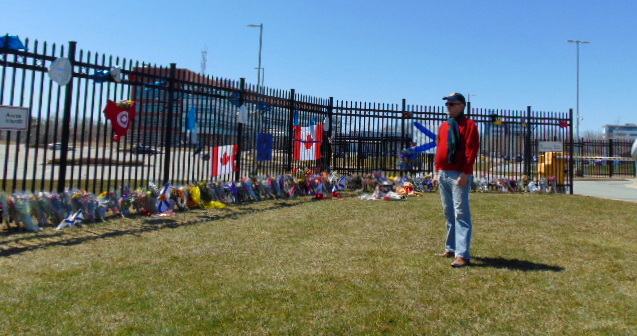
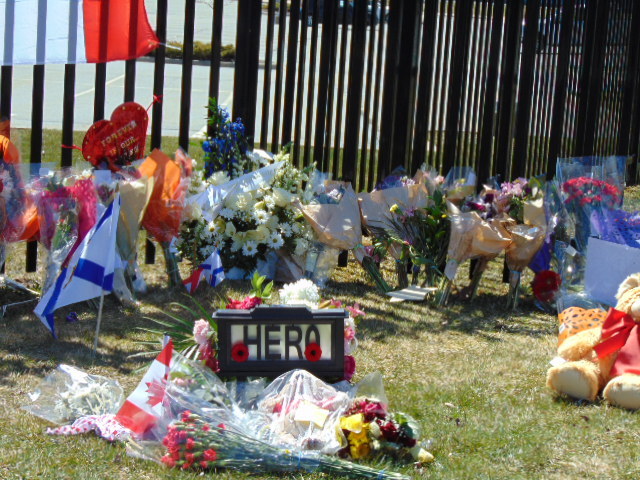
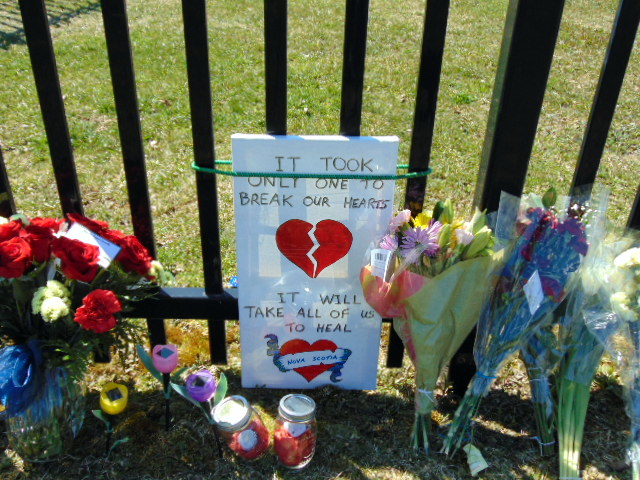
I wen today to the place were the facts of the shooting is being gathered, analyzed. Place were people already made a quick memorial to fallen RCMP officer and by natural extension – to all the victims. Therefore, in a symbolic way, a Memorial to all victims, a place we can say goodbye to them and we can say ‘Im sorry’ to all the grieving families. To ourselves as a grieving community. Silence, respectful, individual visitors. A teddy bear, two red hats, plenty of flowers, signs, candles…

The pictures will give you a glimpse of it, hopefully the silent atmosphere of sadness and sorrow. The Provincial Headquarters of RCMP in Nova Scotia.

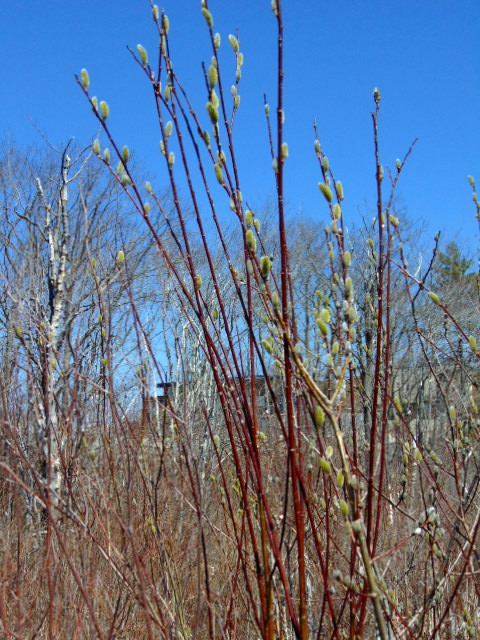
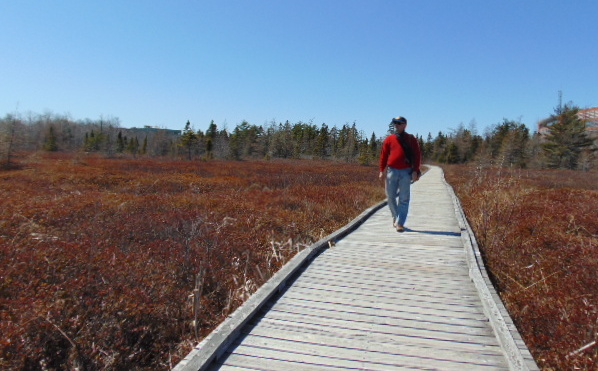
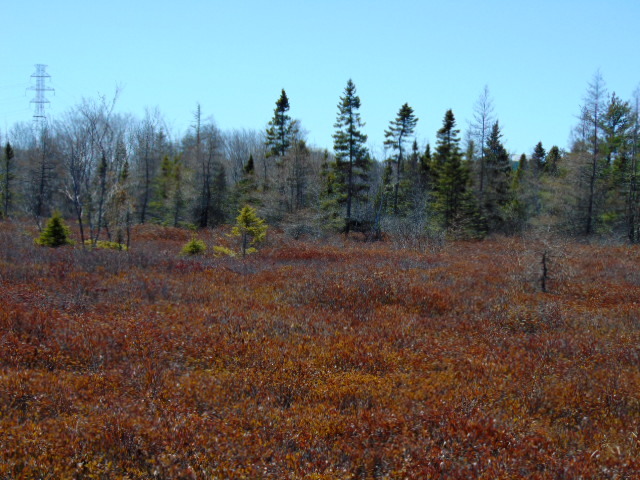
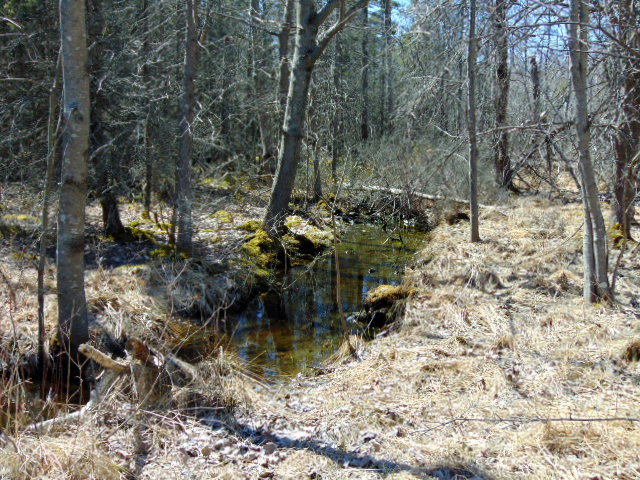
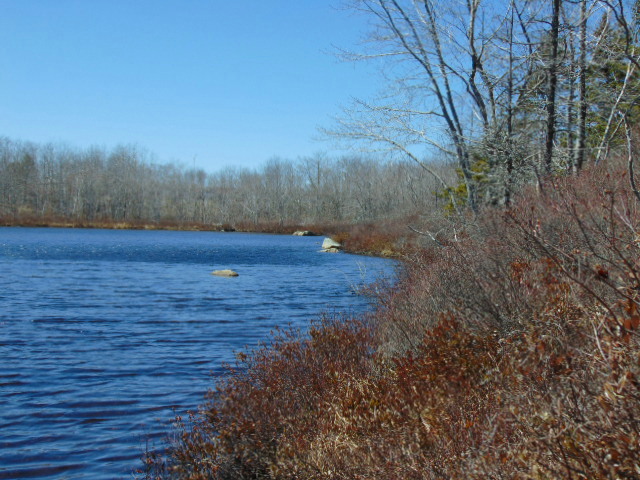
Right by the RCMP massive building is a small enclave of natural marches and little Spectacular Lake in the middle. I walked through the empty trail, surrounded by the eerie colours of the marshland, the green tops and branches of trees, the quite water of the pond. All in silence. It felt like a walking in a funeral march… Yet, tiny new buds on bushes, few birds surprised by my presence, a microscopic brook between trees – were alive. Or were waking up. So will we. And so will, in time, the Families of Victims. Life will go on. But we will remember.

(in Polish) Wczoraj nasza Prowincja wraz z całą Kanadą obserwowała wirtualny Moment Pamięci Ofiar strasznej zbrodni na 22 mieszkańcach małych wiosek i osiedli w północno-zachodniej części Nowej Szkocji. Czyjeś matki, żony, córki, mężowie, ojcowie, bracia, kuzyni, przyjaciele. Niepojęte i obezwładniające w czerni niezrozumiałego zła. Wszyscy w czasie tego Momentu Pamięci łączyliśmy się w smutku i obietnicy wsparcia z Rodzinami tych Ofiar. Bo zakazy pandemiczne nie pozwoliły nam na fizyczny dojazd do tych miejsc, do ich domów, kościołów, hal komunalnych.

Więc dziś pojechałem w miejsce , gdzie dojazd był możliwy, a które jest poniekąd symbolicznym centrum tej tragedii, miejsce gdzie ludzie od kilku dni zbudowali małe upamiętnienie ofiar. Do Głównej Komendy RCMP (Królewska Kanadyjska Policja Konna) w Nowej Szkocji. Na moment ciszy, skupienia. Trwania. Pluszowy miś, kwiaty, napisy, dwa czerwone stetsony (jedną z ofiar była oficer tej Policji), flaga …

Dzień był słoneczny, ciepły. Obok gmachu Komendy znajduje się mały dziki park bagienny z małym jeziorkiem w centrum. Z dala od budynków mieszkalnych. Cichy, samotny. Poszedłem tam na swój cichy spacer, na moment refleksji, na myśl o tych, którzy tak niepotrzebnie zginęli. Bagienne torfowisku sprawiało swym charakterystycznym rdzawym kolorem wrażenie jakiejś smutnej procesji orszaku pogrzebowego. Ale zaraz gdzieś pojawiał krzak świeżych bazi, ciemnozielona gałązka sosny i modrzewia, poderwał się z gałęzi zaskoczony moją obecnością ptak… Życie z ciepłem wiosennego słońca wracało na moczary. I wróci ono do bliskich tych ofiar, choc wydaje się to dziś niemożliwe. Ale nie zapomnimy.

Horror of Long Term Seniors Care Centres

by Bogumil Pacak-Gamalski

In my last article I have shared my reflections on the situation of seniors in our society during the coronavirus pandemic. How we, as a society, have to or ought to revise our responses to it; re-examine our ethical compass. More or less, I have challenged us to check if our own beliefs in our own societal, (but also individual) set of ethical and moral values holds the water. Or is it just a lofty goal fare removed from reality. The weakest are often the first ones we shamefully discard from our Decalogue of ‘do’s and don’ts’.

That was at the beginning of the epidemic and just on the edges of a serious crisis, when we heard of the tragedy in North Vancouver’s senior care home. And the full closure of all of them resulting in a practical lockdown.

But that was than. What followed in ensuing weeks, is just a full scale tragedy and collapse of the system. As Doctor Theresa Tam, our Chief Medical Officer, noted – almost half of our reported deaths were linked to care facilities or seniors homes.

In Quebec and Ontario we have learned of appalling, almost concentration camp-like lack of care and, practically speaking, an abandonment of the seniors by the operators of these centres.

There is no reason to hope that in other provinces the situation is very different and drastically better. To the contrary. Just today we learned of many cases and deaths in Nova Scotia seniors care centres.  There is very strong argument to expect the same everywhere in these type of centres. If not worse. Why? Because it didn’t happened in a vacuum. It happened on our collective watch. Under the eyes of provincial regulators and government. As we found out, but should have known much earlier, these controls and ‘eyes’ of public health were most of the time closed. Or wilfully blind by design. Don’t see – don’t know. Therefore: if I don’t know, I can’t do anything about it nor to feel guilty or at fault.

But they should feel guilty. They are at fault. We all are. 40 years ago seniors full care centres were little known and not very numerous.  But with the advance of modern medicine, extended life spans of all of us, that changed.  Some of us (before we die) in an advanced old age loose gradually a lot of physical abilities to be independent or to require only basic care and help from family and friends. Some loose  gradually mental capacity to take care of ourselves. That is even more dangerous.  Advanced age means also that all of our children (if we have any) are not young either, by the time we become very old and in need of help. Majority of advanced age seniors children are … seniors themselves.

And let us not forget the various types of dementia, with Alzheimer being the most dangerous of them, that seem to spread like a wild fire in recent decades. These conditions and ailments require a specialized, non-stop medical and household care. The word ‘medical’ is paramount. Dementia and Alzheimer are medical ailments that require medical treatment. Not just the mundane cooking and laundry and help with personal hygiene.  A progressive disease with no cure. Lethal.  But the length of it often is very long – from mild form to  almost  vegetative state in some cases.  Ugly. Robing the person of almost every shred of personal dignity. Shall I go on? No. A lot of you knows it, because someone close to you is going through it or went through it before dying, when one by one, every organ of your body stops working. Not like in a heart attack. That would be considered almost merciful.  A majority of you, who never encounter it in a family setting – will know it.

Why am I writing about it in painful detail almost? To make you understand, that if not majority, a very sizable number of full care Centres they are there because they have no other choices. Not because it is just more convenient for them. You know – the food that someone else shops for and cooks, the plates and dishes that someone else cleans after you, the laundry, the cleaning of your room, changing of bedding, doing your hair, your nails, your showers and baths  (at the end it is just wet sponge and wipes ), the moving you from bed to wheelchair and back. The list goes on. It is medically necessary. Like a hospital is not a hotel we choose to go to for fun. Like a hospital. That is another term I want you to remember.

 So we have two terms now to pay attention to: 1) the reason  for senior being in a centre like that is of medical nature, not simply an age or convenience;

2) the care, nurse and doctors check offs, adjusting and giving out medicine (pills, shots and the likes), medical treatment in general. At the end it also serves as a palliative care institution.

Again – as in hospitals. The difference is that hospital is an active medical trauma treatment centre, with vast array of diagnostic tools, and possibility of very decisive medical intervention. By nature designed for relatively short  stay.  Full care senior’s centres are designed to be a residence. Usually extending beyond one year, or close to it. Regular hospitals would be absolutely way too expensive to operate under such conditions. Hospitals offer acute treatment, with a goal of a cure for patient. Seniors homes offer light medical treatment (with no practical nor even idealistic goal for curing residents), safer environment and at the end of resident’s stay – palliative care. Unless when there is an unexpected accident that require hospital intervention or specific family’s requests for transfer to a hospital for more active intervention.

But let’s not make any wrong distinctions: both are of medical nature.  One short term and expectation of curing patient (hospital); the other very long term stay (by nature – final) and no expectation of curing patient – just making her/him safer and relatively comfortable.  Neither is an extension of home.   They try to be as much as possible – but they are not.  Governments spent huge amount of money to subsidize most residents stays there. Some can afford to pay it themselves, but it would be a minority as the costs are in thousands of dollars every month.  All provinces decided many years ago that it is more economical to let the centres be in private hands, run as businesses, then in governments hands.  And we let them.  Yes, it would have been more expensive to run them by government.  Just the labour cost by itself – in hospitals professionally trained staff is paid much higher rate, than similar staff in the centres. Of course other costs, too. For example continuing training and education of hospital staff versus very limited training of similar staff in the privately run centres. Hospitals are not run on a business model. And they shouldn’t be.  The Centres – are. The operators/owners are running a business, not a charity.

The results, in an emergency situation of even lesser magnitude than the pandemic, are the way they are. Tragic. Shameful. Incomprehensible.  Existing model is wrong and is not working under stress. Barely under normal circumstances.  We are left powerless, not even knowing what is happening to our parents, aunts, family members and friends, who are locked behind these walls.

This can not be put squarely at the operators feet. It is a fault by design and if not equal, at least a partial blame is on the side of the government.  The regime set-up to control and supervise the centres by province’s Health Authorities failed. Again – be design. By not making it robust and strong enough. By not following own rules, which by themselves are minimalist and weak.

If the provinces can’t guarantee a fast and permanent fixing of the oversight – it should take over the running of the establishments under its own umbrella and ownership. It is an extension of medical care.

If the model of having them in private hands is honestly believed as a more efficient one and better – than an extensive overhaul of the Health Authorities effective control and oversight needs to be undertaken almost immediately. With the public being clearly informed of the process, it’s goal and timetable for conclusion.  Proper staff-resident ratio must be established by the province and remuneration for employees should mirror the importance and the professionalism that is expected of them.  You can’t expect the staff to be paid near minimum wage and do properly the extremely hard work they do. Extremely hard and difficult – of that I know, for I have spent hundreds of hours in such facility. During daytime, at night, mornings, evenings. On purpose, as I wanted to make sure that ‘good’ things are not happening only during typical visiting hours. Helped them wash residents, change them, feed them. I can’t say: I wouldn’t do it for any money. No, I have done it for free. But if I was to work there, I wouldn’t under any circumstance be paid less than minimum twice as much as they were paid.  None of the blame could be placed under their feet.  Of that I’m certain.

The pictures in my mind of the neglected and left to their own inability to do almost anything residents in some of the Homes in Ontario and Quebec (I am also certain that they are like that in every other province) are seared in my brain and heart.  Most of you probably listened or read the recent stories. I will not repeat the details here. Sufficient to say, they are horrific, inhuman pictures.

Something must be done and we (that means you too, dear Reader) must make sure that it will. Call, write to you MP, to your premier, minister of health, minister of social services, senior’s advocate. Please, do.  Our mothers, fathers, aunts, uncles, cousins, grandparents, our friends – deserve better. You deserve better in the future, when you might (which is becoming increasingly common) become a resident in one of them.

Memento mori in pandemic or uneasy times

In North Vancouver, in Lynn Valley  Seniors Care facility we heard it first. First sample of what was going to come. Covid-19 infections among staff and residents. Later came other Homes like that. In Ontario, Nova Scotia, New Brunswick, Quebec.  Vancouver was first, before the epidemic spread all over Canada. We were still innocent, still reading about far away places. Life was to a large extend normal. Comparing to today—life was as nothing was happening. We were still innocent … .

People at the end of their long life. People, who’s life expectancy, at best, was maybe three years, maybe five. If they were lucky maybe 7 or 8. A lot of them wouldn’t last even the three years.

We all are going to die, if we are lucky at an old, ripe age. But for some of us, increasingly more, as society evolves, that wont be the worse. Some of us will not only be old and weaker. We are going to be in a state of health, mental and physical, that will rob us of independence. We will become dependent on others, not only in tasks but also in decision making. And it will rob us off a large portion of our dignity. And it is a lie, that those of us who will have dementia, advanced Alzheimer, will not feel it, recognize it. They will. And they are. In different way, but they are.  They know that they are constantly being told what and how to do, being washed, dress, undressed, whether they want to or not. They are being moved to places and spots they don’t want to be moved at that moment.  I know that. My Mom was one of them.  I spent  most of my free time with her at a Home like that for almost five years. That’s a long time.  She wasn’t abandon or ‘dump’ in there. I couldn’t provide her the absolute care and safety, she needed.  Even if I was a very rich person, it would require a non stop 24 hours care, special facilities.  She wasn’t a nuisance in my life, nor inconvenience. To the contrary—she enriched our life every day.  There was just no other option. And it was a right decision. She felt almost right away safer and comfortable . I could see it in her eyes. The fear disappeared. The fear that that she needs to go and do something and wont be able to find her way back.  That there were people around her all the time. And there was no demands on  her to do anything, to remember anything. Somehow she sensed it and it must have been a relief.  She didn’t have to pretend anymore  that she is OK. She knew she wasn’t.  And that was OK. Of course, her situation was very different from many other residents—we still were spending many, many hours together. I was almost a resident there, myself. We used to go still for long walks, long drives, to familiar parks. Sometimes, as in older times, we wouldn’t come back until very late, as she used to laugh about it: ‘in indecent hours’.  A lot of dinners, suppers were still at my place were she felt comfortable.  She even slept sometime in our home. But she didn’t like it too much. She preferred to go to ‘her place’, back to the new Home, were she always had a separate room and everything become very familiar. Home.  It become her home.  And, after years in this new home, her time has come to say goodbye.  I was with her the last few days and nights constantly. Touching her, talking to her.  I don’t know for sure whether that made a difference  for her in the last hours. I would like to think it did. She seem to be relaxed while I touched her, she tried to squeeze my hand, open her blue eyes.  I didn’t see any panic in her, paralyzing fear. But that is what I think. She wasn’t able to communicate with me anymore.  What I know is that it was extremely important to me.  That I couldn’t leave her in that moment, that she shouldn’t be alone. 

That was in a different world. That was a time before the pandemic.  What would I have done today? I don’t know.  It is a horror. Horror to try to think about it.  A time when we, as a society, allow ourselves to make such a terrifying decisions.  And we find for it every possible rationale, every lofty ideas. But it doesn’t make it right. We know it doesn’t.  Yet, our safety mechanism  tries to protect our sanity and our sense of morality by invoking such explanations, such excuses.  Few for the benefit of entire group; individual for the good of society.  This heroic choices we read about in books, in myths, in legends.  Sacrifice.  The word does have a powerful, uplifting, albeit tragic, feeling.  Except … except when someone else makes that decision for us. When the sacrifice is given as an order, as a decision taken not by the individual, but by some mysterious collective.  Society. As in the case of this pandemic.

I listened the other day to a doctor, who was commenting standing in front of one of these Senior Care facilities, where the virus spread. She was sad,  and probably uneasy about it.  And simply stated: “I hope they will not all die’.  That was all she could offer: I hope they will not all die.  The way she said it, the entire situation and a way we comment about it, report it, struck me. It sounded like we are all standing in front of burning library, we are all resigned that there is nothing we can do but just let it burn. And with a natural sadness we take a sigh and say: we hope that not all of the books will burn.

Yesterday it would have been, I think, possible to expect that someone, one of us, maybe even entire group of bystanders, would rush to the inferno trying to safe the books. Risking their own life. And that would have been seen as a nobler action.  Not common perhaps, but noble nonetheless. These thoughts, this ideas about society and individual are becoming the silent victims of the new world in pandemic. They are very disturbing victims.  It will take a while to assess the impact of such actions, such permissions.  I would rather not have been a witness to these choices, these re-evaluations of human condition and humanity. 

There were crazy times in Western (not only) Civilization, when the common motto was a Latin saying ’memento mori’. Remember about death. Remember that you will die.  Sort of apotheosis of death. More important and more powerful than life, which had no other meaning but to lead us to that threshold. Recent centuries led us to abandoning this concept. To the opposite. Remember that you are living. Life is the most precious thing.  The new omnipresent god. Are we starting to burn on the altar of this new god new sacrifices?  Have we given it a deep thought and ethical exam?

These are the disturbing thoughts that have given me first sleepless nights since the pandemic begun. The lonely, tragic deaths in facilities that are being call “Seniors Care’. Care.  Is it  always in the new world? Or the meaning of ‘care’ become ambivalent, not set in stone, changing? How far are going to change these notions? At what cost to the society? What is decency? Sacrifice?

I don’t know the answers. But it makes me very uncomfortably, when the answers are provided ad hoc, as an edict, by some Administration Body, some centre of local administrative power. No matter how good the intentions are. Because I am not sure that the Administration knows the meaning of the word “good”. It is  much more than ‘good car’ or ‘good dinner’.  The word has immense value, is a cornerstone of our foundation.

Historia murzyńska Kanady

cz. 1 / part 1 (English summary at the end)

by: Bogumil Pacak-Gamalski

ewolucja społeczeństw/evolution of society; by B. Pacak-Gamalski

Największe imperia starożytnego i archaicznego świata przetrwały setki, czasem tysiące lat, głównie dzięki temu, że nie opierały się na etnicznej (lub, jak wielu by dziś powiedziało –  narodowościowej) asymilacji podbitych ludów.  Wielokulturowość nie jest więc, jak błędnie zakłada się dziś, wymysłem XX wieku. Były –naturalnie – odosobnione  wypadki siłowej próby pełnej asymilacji – na ogół kończyły się albo na biologicznej zagładzie tych podbitych ludów (co dziś określa się mianem ludobójstwa w prawie międzynarodowym), ewentualną pełną asymilacja i utratą związków z własnym językiem i tożsamością etniczno-kulturową albo stosunkowo szybkim upadkiem takiego imperium.

Z tak rozumianą ‘wielokulturowością’ w kontekście historycznym nierozłącznie wiąże się kwestia tzw. rasowości, czyli koloru skóry. O asymilację pełną i powolny zanik wszelkich tradycji kulturowych łatwo przy integracji ludzi do siebie fizycznie podobnych, niemal identycznych.  Kwestie religijne są tu mniej istotne, bo można nie tylko tolerować wieloreligijność (politeizm), może być ona de facto polityką władcy/państwa, jak miało to przykład w większości imperiów i terytorialnych podbojów świata antycznego (kultura hellenistyczna, staro-rzymska i wcześniejsze lub im czasowo zbliżone kultury basenu rzek Eufratu i Tygrysu). Religijność można też zmienić zdecydowaną i bezkompromisową akcją karno-policyjną poprzez fizyczną likwidację kapłanów, spalenie świątyń i miejsc kultu i zakaz świętowania takiej religii – tu przykładem najlepszym jest chrystianizacja Europy Środkowej, Północnej i Wschodniej. Konsekwencją będzie po latach albo owa pełna asymilacja albo pełna fizyczna (ludobójstwo) likwidacja ludów podbitych (przykładem znowu posłużyć może historia ludów bałtyckich: Prusów, Galindów, Sambów i in.). Wszystkie te procesy możliwe są jednak jedynie wśród ludów identycznych lub bardzo podobnych fizycznie.  Po jakimś czasie proces asymilacji uniemożliwia odróżnienie oryginalnych ‘swoich’ od ‘innych’.  A potomkowie ‘innych’ tracą sami świadomość ich ‘innego’ pochodzenia, obce są im też i nieznane tradycje, religie i odrębne języki ich przodków. Co stało się generalnie wśród ludów celtyckich, germańskich i słowiańskich.  Słowem – jakkolwiek okrutne to zjawisko – taka asymilacja jest możliwa i jest doświadczeniem większości grup dziś nazywających się Polakami, Francuzami, Włochami czy Niemcami.  I większością innych narodów świata, które u zarania były luźnymi, często zwalczającymi się plemionami,  na ogół zbliżonymi jakąś prastarą jednotą i pra-kulturą. Ale też i zlepkiem grup etnicznie sobie kompletnie obcych już od pra-dziejów.

Ale jak taką asymilację, taką ‘nową jednotę’ stworzyć przy kompletnie odmiennych i jaskrawych różnicach zewnętrznych? To pytanie daje początek koncepcji rasizmu. I choć historia starożytna rasizmu nie znała, a z geograficznych przyczyn (pierwsze imperia powstawały na skrzyżowaniach ras żółtych, białych i czarnych) różne kolory mieszkańców i sąsiadów ówczesnych państw i imperiów były stanem naturalnym – późne czasy nowożytne i współczesność stworzyły rasizm, jako jedną z najpotężniejszych motywacji w formacji państwowości, rozwoju (grabieży) ekonomicznym na szczeblu państwowym i jednostkowym.

Stąd, dla jasności wywodu i ze względów leksykalnych używać będę typowego i dla historii i dla lokalizacji określenia ‘rasy ludzkiej’ i pochodnego od tego słowa pojęcia ‘rasizm’ – mimo, iż są biologicznie i filozoficznie błędne – de facto istnieje tylko jedna rasa w naszym gatunku, a kolor skóry (odcień raczej) jest drobiazgiem genetycznie nieistotnym.

Kończąc ten wstęp warto oddać się kilku refleksjom.  Nie ma bodaj kraju na świecie, ani współcześnie ani w przeszłości, który nie ma ciemnych plam, gdy chodzi o prześladowania mniejszości rasowych, religijnych, społecznych. Czy będzie to głęboko zakorzeniony antysemityzm narodów cywilizacji europejskiej i jej przedłużeń w Amerykach (tam zwłaszcza, gdzie biali koloniści stanowili i stanowią większość) i Australii i Nowej Zelandii; dyskryminacja wobec tzw. rasy żółtej (głównie Chińczyków, Japończyków i Hindusów) i kolosalna dyskryminacja wobec ludności autochtonicznej, nazwanej z czystej arogancji i ignorancji ‘indianami’. Do tego włączyć należy cała masę uprzedzeń i prześladowań w historii wszystkich państw i narodów wobec lokalnych, specyficznych mniejszości: religijnych, etnicznych, seksualnych. Nie brakło tego bez jakiejkolwiek wątpliwości w historii Polski – starej i bardzo współczesnej. Nawet okres świetności Rzeczypospolitej Obojga Narodów (właściwiej by było określić tamtą Rzeczpospolitą – Rzeczpospolitą Obojga Państw, bo narodów było w niej zdecydowanie więcej niż dwa, zwłaszcza na terenie Wielkiego Księstwa Litewskiego, które etnicznie zdecydowanie nie było litewskie) mimo stosunkowo dużej tolerancji i uprawnień wobec różnych grup – był okresem licznych dyskryminacji, a nawet prześladowań wobec ‘innych’.  II Rzeczypospolita (1918-39) była tyglem niesprawiedliwości etnicznych, religijnych. Okres straszliwej wojny totalnej to przykład szlachetnych i heroicznych ofiar etnicznych Polaków i instytucji Podziemnego Państwa dla ratowania żydowskich współobywateli. Niestety to też przykład, gdy stare potwory antysemityzmu wykorzystały hitlerowski aparat przemocy w aktach najgorszego okrucieństwa i barbarzyństwa (często związanego z chęcią ordynarnej kradzieży i grabieży mienia żydowskiego) wobec żydowskich sąsiadów.

Ze względów oddalenia geograficznego i – nolens  volens – politycznej niemożliwości (zabory) ominęły Polskę fale rasizmu wobec Afrykańczyków i sam tragiczny okres niewolnictwa murzyńskiego. Nie ominęło jednak generalne, eurocentryczne, poczucie wyższości cywilizacyjnej, kulturowej, rasy ‘Białych’ wobec rasy ‘Czarnych’.

Dziś, w XXI wieku, Kanadę uznaje się generalnie, jako jedno z najsprawiedliwszych państw świata, jako przykład sukcesu wielokulturowości, wielorasowości. Jako przykład dla przyszłości państw i ludzi. I to chyba słuszna (nawet jeśli trochę przesadzona i oparta na prostych mitach) ocena. Choćby dlatego, że pojęcie „Kanadyjczyk” nie zakłada z góry pewnej etniczności.  W każdym razie od końca XX wieku Kanadyjczyk to już nie synonim Anglosasa/Szkota lub Francuza. A od początków XXI nie jest to już nawet synonim potomka Europejczyków. To po prostu obywatel Kanady.

Ale by kraj ten stał się jednocześnie krajem autentycznej równości, zgody społecznej i wysoko zakorzenionej tolerancji wobec wszelkich mniejszości (a takim dziś jest uważam) musiał przejść przez trudny kurs własnej historii. Własnych uprzedzeń, niesprawiedliwości. I zbrodni. To kurs trudny. Wiele narodów się go podjęło. I nie wszystkie zdały egzamin. Polska usiłowała po 1999 ten kurs zacząć. Niestety, nie tylko egzaminu nie było, kurs definitywnie zamknięto po 2015. Z tym większą stratą dla Polski, z rosnącym zapóźnieniem kulturowym, cywilizacyjnym. I z ceną, jaką bez wątpienia trzeba będzie w przyszłości zapłacić.  

Pisałem już kilkakrotnie na tym blogu i w innych wydawnictwach o prześladowaniach i rasizmie Kanady wobec jej ludów autochtonicznych, tzw. Pierwszych Narodów (First Nations).

Dzisiaj o rasizmie i dyskryminacji rasowej wobec kanadyjskiej ludności czarnej, murzyńskiej. Wiąże się to w Kanadzie z lutym, Miesiącem Historii Murzynów ustanowionym przez Parlament w 2008 i powiązanym z tym Miesiącem Afrykańskiej Historii w Nowej Szkocji.

Chronologicznie temat ujmując można powiedzieć, że historyczne centra osadnictwa murzyńskiego w Kanadzie to Nowa Szkocja i Górna Kanada (dzisiejsze Ontario). Mówimy głównie o okresie XVIII i XIX wieku. W dużo mniejszej części Dolna Kanada – Nowa Francja, dzisiejszy Quebec. Pozostałe skolonizowane tereny były miejscem bardzo nielicznego i sporadycznego osadnictwa uciekinierów-niewolników ze Stanów Zjednoczonych (Victoria i Esquimalt na Wyspie Vancouver i jeszcze mniej liczne grupy w Albercie (m.in. w Edmonton). Niewątpliwie nieliczni Murzyni pojawili się już w samych początkach w Nowej Francji i w Acadii (dzisiejsza Nowa Szkocja i Nowy Brunszwik), tak jak tłumacz kilku wypraw francuskich, Mario da Costa. Byli to zarówno wolni, dobrze płatni urzędnicy francuskiego monarchy, jak i niewolnicy na służbie europejskich kolonizatorów. Ale o autentycznych ‘falach emigracyjnych’, które miały wpływ na kształtowanie si Kanady i jej społeczeństwa można mówić dopiero od roku 1775 – wojny amerykańsko-brytyjskiej o niepodległość i osadnictwie tzw. lojalistów (zwolenników monarchy brytyjskiego) i niewolników z Ameryki, którym obiecano lepsze życie w Nowej Szkocji, pod panowaniem brytyjskim. Tą historię i reportaż fotograficzny zamieszczę w cz. 2, w kolejnym poście tutaj.

Short summary in English:

The most powerful imperia of the ancient world lasted hundred, if not thousands of years, because they did not try to forcefully assimilate ethnically conquered people. One would say that their concept of good governance and stability laid solidly in the form of (as we would say today) multiculturalism. There were those, who tried quickly assimilate the smaller (or weaker) groups, but it would mean always either total annihilation of such group by genocide; military displacement/banishment beyond borders of the empire state or partial genocide (cultural genocide) by killing the political and religious establishment and destroying material witnesses of former, conquered territories. The assimilating version usually proved short-lived and the new empire did not last for very long. There are, of course, exemptions to this scenario – but, as often in life – exemptions are just that – exemptions, not a rule.

The second form (cultural genocide) is the most common and lies at the foundation of most modern states, specially in the Old Continent. There is no factual anthropological reasons for existence of Poles, Germans or French and English (British) nations – they all are modern concepts and result of cultural destruction of former and separate entities. What was left from the original Slavs, Galls, Celtic or Germanic people after forceful christianization become a building stone of today’s nation. It wasn’t by any means a natural process or some form of evolution. It was a skilful political and military process.

That process is possible only if you are faced with different culturally but similar physically population. And by large extent the entire population of Europe in the entire Middle Ages looked very similar – white (or whitish, if you will). So after merely few generations you can create a new ‘ethnic’ construct: a people, who pray to the same god/s, speak the same (with regional variants) language. Beginning of a nation. In processes like that it is hard to developed racist attitudes, or hatred based on race. Hence the first objects of persecution in Christian Europe was two-fold: Jews, as recognizable minority and always living communally (in groups, not as individuals) and remnants of non-Christian Europe: tribes and people belonging to a group called Balts, in the north-east corner of Europe. As religion was, from archaic times, the fundament of laws and behaviour – they couldn’t be tolerated or fully accepted. Unless they agree to condemn and leave their old religion. Hence some old Baltic tribes were fully annihilated by German Order of Knights of Holy Mary, with the support of Polish Prince of Masovia. The Jews in Europe, from the times they moved to Iberia (today’s Spain), were not really of such threat, as they never own or rule over any territory. Their annihilation was not necessary – nonetheless, they were very much an affront to Christian faith for not accepting Jesus as the Messiah. And so antisemitism was born. And survived to this day. Reaching it’s monstrous apogeum during Holocaust.

Racism, in a form we understand today, had no place in the ancient empires, neither. All of them were based on territories more or less straddling lands between the valleys of Tigris and Euphrates, Asia Minor, southern tips of Europe and Northern Africa – a land of all three races. In imperial courts of Babylon, Persepolis or in Egypt you could daily see black, white and brown faces. It was normal, common. After the collapse of ancient order, specially in the Western Holy Roman Empire, Europe cut itself off common borders and neighbourhoods with Asia and Black Africa for all practical purposes. It wasn’t really until the end of Middle Ages and beginning of European colonial expansion into Africa and Asia that it begun. Specially toward the black Africans, who were by large technologically at a huge disadvantage and mostly pagans. The fact that slavery among Blacks was more popular than slavery among whites (there was such a thing in Europe but it related mostly to captured during warfare combatants and by the time of Renaissance – almost non-existent and, lets be honest, servitude of own peasants was enough to substitute the need for slaves) helped to sharpen the appetite for cheap labour among white masters. To build the case for buying humans as a property in Africa, Europeans begun to dehumanize Black Africans a bit, make it almost a subspecies, a subhuman. That’s how a true racism was born. That’s how it all begins. Bit by bit, word by word, joke by joke. By the end of XVII century slavery was fully accepted, flourished and in high demand. In continental Europe there wasn’t even really a high demand for cheap labour. Even after industrialization. There was plenty of cheap labour from countless underprivileged class. One could argue that it would have been more expensive actually to fill the factories and fields with actual slaves than with destitute free working class. But in the new colonies, especially one sparsely populated – the need was great. Hence – North America and West Indies. Slave owners paradise.

The first documented Black person, in what is known as Canada today, was Mathieu Da Costa, official and well paid translator for French rulers in their colonial expedition to New France (today’s Quebec) at the onset of XVII century. Certainly there were others, at that time probably free people. But that is only of historical concern. The actual Black immigration and settlement didn’t start here until XVIII century, while gaining strength in the following one. It contained both free people and slaves. Originally the main centres of Black settlements were in Nova Scotia and Upper Canada. Some in Lower Canada. Instances in Vancouver Island or Alberta were not until decades later and not very large as to make a social difference.

But that pivotal settlement of Black people on Atlantic shores and in Lower Canada is a very important part of Canadian history. And the history of racism and oppressive attitude by both, government and society at large, in Canada.

Canada today and Canadians are not the same as Canada 100 or even 50 years ago. We know ourselves as people living in a country that is the envy of the world, as far as being tolerant and equal in treatment of all Canadians. But it wasn’t always the same. In order to be the way we are now – it was necessarily to deal with the difficult history, difficult past. Every nation inspiring to be better, to grow – must take that hard lesson, swallow that bitter pill. To own our own mistakes and, yes, crimes even. As in treatment of many minorities – and none worse than that of Aboriginal People and Black people in Canada. I think that, to a large extent, we – Canadians – have done it in the past 20-30 years. Specially since the dawn of XXI century. The road is not finished , yet. But we are well on the way.

In the next , second part, I will write here more about the history of Black Canadians. Specially the one in Nova Scotia.

Alberta and Saskatchewan – how do they fit in Canada?

In 2016 I went to Calgary for a family visit. It was one of the last visits there, since I moved to the East Coast. And that time, as sensing that not that many more of these visits are ahead of me (but not knowing that as matter of fact), I gave myself permission to a lot more private, solitary time to walk through the city, in many ways city of my youth.  I have lived there, in earlier times, close to 15 years. The city has changed a lot since. Not much for the better – typical spreading with mostly ugly neighborhoods that were taking over grasslands, fields on the outskirts and close by rural communities. But the Downtown was reinvented and re-invigorated nicely. I stuck mostly to the old Calgary – familiar and full of memories. Some were bad – but, as is in life – bad memories fade with time, good ones – remain.

During one of my evening walks on the southern part of Downtown (close to 4th Street SW were I had my very first apartment in Calgary) I noticed very disturbing occurrence. It was a time of some sort of election, I think provincial. As in any other community, there were election signs of candidates, parties. Right on the edge of an old, small park with Calgary’s Cenotaph was a sign of NDP party. Not the most popular in Alberta – but an established and strong political force in the city and province for as long as I remember (much stronger then Liberal Party, traditionally very disliked there). A very young, in their twenties, couple walked by. It was obvious they were not poor or from shadowy element. They were loud, happy. An evening revellers. Suddenly, they stopped, he talked something to her. She stood aside and carefully looked around, than  gave him a nod and the guy just ripped the sign off, broke it into pieces and threw to the park bushes. They walked quickly off. I was a full intersection away. Should I run after him, yell? Pointless. The crime was done. Calling police was too late, as they quickly disappeared into next street. It angered me. And reminded of that nasty element of political intolerance that always existed in Alberta. The right wing feeling of entitlement. To what? I don’t know, nor understand it. But it was present there in the 80ies, when I settled there. To some point as the reaction to Pierre Trudeau’s plans for the abandoned National Energy Plan – an idea hated in the Prairies.  As a side note it is worth noting that just few weeks ago, in National Election 2019, no other but the Conservatives flaunted the idea of Trans Canada Energy Corridor … . Hmmm, funny how ,principal views’ are dependent on political expediency … . What was once (still is) viewed as an assault on provincial jurisdiction, now is being proposed as wise and beneficial to all.

But back to memories of political climate in Alberta. I think it got worst after the passing of political leadership of Peter Lougheed – a staunchly protective premier of Alberta, but even more staunchly Canadian. I think he was the last premier of that province, who truly and unwaveringly believed in the supremacy of Canadian unity over any separatist sentiment of ultra-right Albertans. During our just finished National Election, that spectre of Western alienation and separatism was mentioned as a warning many times.  And was stressed that the Liberal government of Pierre’s son, Justin Trudeau resurrected that feeling in the Prairies. That is a blatant lie. A lie repeated every time there is a Liberal government in Canada. That feeling always existed there and was always used to blackmail Ottawa. I remember very well times, when Alberta’s conservative governments did not shy to form close ties with Quebec separatist governments of non-other than staunchly separatist’s Quebec premier Levesque to plot against Ottawa. When it was convenient to force their hand against Ottawa. All of it came back to me as I listened to stories from this election of Albertans, who were afraid to post any sign on their property for either NDP or Liberal parties. They were actually afraid. Physically and psychologically. And it is disgusting. It never went that far in my memory. It would be probably a challenge to find a time, when both Alberta and Saskatchewan did not elect a single MP not from conservative party. It all changed after forming of Reform Party and destroying the old Progressive Conservative Party of  MacDonald. The new conservative party, formed by Stephen Harper, failed to see beyond the borders of the West, failed to notice ever more urban citizens of this country. But demand respect and special status instead. It’s fine that their base is in the West, especially in the oil-rich West. But Canada neither starts nor stops in Regina and Edmonton. Their inability to get above 32-35% popular vote speaks volume to the problem.   And one more think – when I settled there it was the beginning of the 80ties in the XX century. The end phase of many oil booms that the province had. There was plenty of money still around. Establishment (smart) of Heritage Fund in Edmonton from proceeds of that boom. After that were years of drier income and another booms. That’s forty years of history. What happened to diversification, to support and building of new industries, new sources of wealth? Every time there was a bust – there were promises that Alberta would diversify, would invest in more resilient future. And what? The same questions remain today. Saskatchewan was doing OK with rich farmlands and world leadership in production of potash. But the market for potash collapsed years ago, food markets are strong but increasingly competitive – where is the planning, the modernization of economic base? Is it all Ottawa’s fault, the Trudeaus and Chretiens, the Turners and Martins? Is it always perennial ‘them’, never ‘us’ philosophy?

Now the popular cry and question is being thrown: since Liberals (or NDP or Greens for that matter) don’t have a seat in Alberta and Saskatchewan, who will represent the two western provinces in Ottawa? Perhaps a question that should have been asked by Albertans few weeks ago, before the Election stations were closed, may I ask?

Of course, my impatience with certain element of Western perennial dissatisfaction with Central Canada does not solve the true problem of new Liberal Government with that obvious dilemma. Although there is nothing in our Constitution or law that requires a Cabinet representation of all provinces or regions – a practical and political expediency does suggest that. And a long tradition. Trudeau already stated such desire himself. How he will accomplish it will be not an easy task and some political showmanship will be needed. I have no doubt he will master such.  He (Trudeau) has proved to us that he is not just an idealist living in a dreamland, ha ha ha. To the contrary at times – he could be rather cold and unforgiving politician. I just hope that he will not reward Mr. Sheer and Mr. Kenny with conservative appointment as an advisor to the Cabinet, or – that would be a capitulation and very wrong – as a member of the Cabinet.  There’s many Westerners, who are not staunchly right wing, who can fulfill that role. To the benefit of Canada and the two beautiful Provinces. And not former infamous premier of Alberta, Ms. Allison Redford, who just the other day offered her services in such a role. Last time she served Alberta, didn’t end very well for Albertans. Who knows – maybe a former member of former Progressive Conservative Party, who didn’t join the Harper’s new Conservative Party of Canada? I’m sure there is still quite a few of them around.

There will be a pipeline to BC, I am certain of it. There won’t be one going the Quebec, I am sure of it, too. The first one is needed politically and economically. The oil in Alberta will not stop being produced anytime soon – although I do hope for the sake of us and the sake of Albertans that it will be phase out as soon as it is economically possibly and not a day later. But we cannot continue being just a country of natural resources – specially raw and mined resources. That time is gone. It was gone with the end of XX century. We can’t just rape our own land and pretend that it is OK. It’s not. There was a time and an epoch when it was necessary evil, maybe – to a point – even a blessing. But now it is a curse. More and more expensive to maintain. And I am not touching the ethical side of it. Just economy. The harm it produces alongside the economic benefits becomes more and more visible every passing year. The harm not only to the climate of the country and entire planet – but to Canadian nature, to our environment, where we live. The poisonous by-product of mining, destroyed landscapes, forests, rivers, lakes, underground water – the list just go on and on. At the very end of each of its cycles, the private companies that produce it – pack their belongings and disappear into thin air and we, the taxpayer, are stuck with millions of millions of dollars to clean it up.

Our vast size, non-ending coastlines, huge rivers, still existing huge forests, sparsely populated territory (apart from the narrow strip along our southern border) in XXI century technology should not be a challenge but an opportunity to invest and build new industries, ecologically friendly and in high demand for our and international economies. What we need is a vision equal to that of XIX century of uniting the vast Canadian land from coast to coast. Base on modern scientific and eco-friendly knowledge. That requires courage and leadership – followed by smart and big investment. Not by cheap knock-offs. And modern forms of energy production should be almost unlimited in our country. Be it coastal/tidal waters, rivers, wind, solar – you name it and we have it. Give Canadians the chance to work in smart way instead of cheap way. Well paid with educated workers.

Alberta Rockies – land rich in natural energy and endless possibilities

There was a time, when green, un-ending grasslands of the prairies, it’s hills and long river valleys were roamed by thousands strong wild herds of buffalos. They were wiped out never to come back in its old glory. That was sad. But one way or another (probably not in such brutal and stupid way as it happened) it was inevitable given the migration of people. And that migration would have happened even without French or English colonialism. People do spread all over the globe all the time from time immemorial. The buffalos are gone, replaced by smaller but still important herds of domesticated cows and cattle. Now it is time to start saying goodbye to the oil pumps and the mammoth machinery of oil sands. Times have changed again. As they always do in the history of Earth and humankind. Get on it, Alberta and Saskatchewan. Let the dinosaurs stay in Drumheller and the Badlands.