by Bogumił Pacak-Gamalski
Some twenty years ago, very young Polish actor decided to become a writer himself. First in poetry, then short stories and eventually he wrote and published a stage solo play “A true critic”. An actor writes about a theatre critic! A powerful friend or a foe of an actor, omnipresent shadow of actor’s art and stage.(*)
Sometimes our roles change. It is, I suppose, easier to be a critic. To give praise or to point mistakes. But it is easier only if you are nonchalant or arrogant in your task. When somehow you feel superior with your knowledge, experience . It is a very wrong way of being a critic. A true critic knows that he should be a part of the entire experience. That he is an extension of the stage. Is an ally of a stage artist. He is there to give support to the artist, so the next performance could be better. They both should work for the benefit of the audience: the ultimate judge. Therefore both of them should exercise a high degree of humility.
This golden rule applies to all type of artistic performance, on and off ‘stage’, whatever form the ‘stage’ might be. I have included the entire ‘foreword’ because I’m just about to write a review (a form of a critique) of musical performance in which I took small part (a spoken word, not playing on an instrument or singing). I have been asked by a pianist to help explain a particularly difficult composition based on a little known French poem. Because the three very distinctly different pieces of the composition reflect very specific fragments of the largely unknown text – an idea arose that the text should be perhaps read and slightly explained to the audience, thus allowing the audience to fully appreciate the effort of both the composer and the pianist. I thought of the idea as an excellent addition, and very helpful to the music and, most of all, to the listener. And that should be (often is not, since not only critics are sometimes nonchalantly arrogant – performers, too) always a paramount concept.
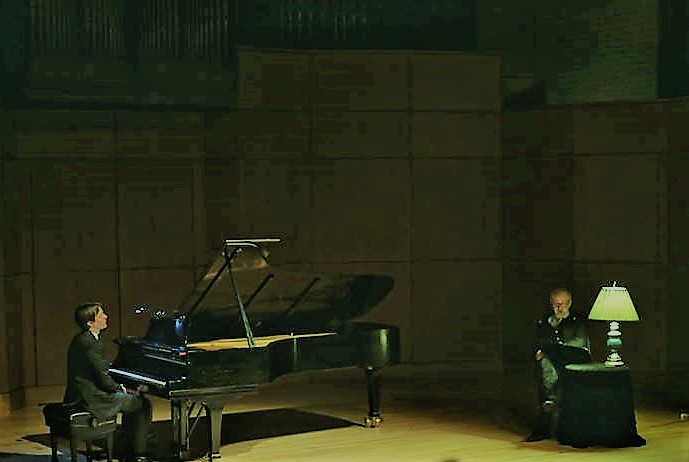
The Canada International Arts & Music Society invited music lovers to an evening with talented pianist Łukasz Mikołajczyk. The concert took place in the UBC School of Music ‘Roy Barnett Hall’.
Program consisted of Maurice Ravel’s Gaspar de la nuit (Gaspar of the night); Fryderyk Chopin’s Waltzes (A flat major, A minor, F minor) op.34, Polonaise A flat major, op. 34 and Sergei Rachmaninoff’s Prelude B flat major op. 23 no 2 and Prelude D major op. 23 no 4.
Ravel’s late composition of ‘Gaspar de la Nuit’ has three very distinctive and different parts. Some call it a suite and the term is used often. If it is, it is an atypical suite. But that is none consequential, suffice to say it is a three parts composition, which similarities (or connectivity) is based mostly on atmosphere and oneiric visions based on a poem by Aloysius Bertand of the same title.
First part, ‘Ondine’ is a story of siren-like beautiful creature, which woes a young man to her watery kingdom. Not unlike the famous sirens wooing Odysseus in his travels. It does pose a certain degree of technical challenges for a pianist: the fast repetition of short cord at the beginning and complex changing of different movements by the end. Yet, it should be presented to the listener as any easy, evocative of flowing water, composition. An attentive listener will easy find similarities to it in Ravel’s earlier composition, Jeux d’eau or even to music of Debussy.
Mikołajczyk played it splendidly, giving it time (despite fast movements, cords and multi melodies) to overtake the listener with vision of cascading water, waves and the apparition of Ondine spreading her charms and invitation to the surprised young traveller. In this type of composition the aim is to play the fast and changing parts without being noticed that it is a bit of virtuoso piece. The feeling has to be of the murmur of water, the flowing on its surface of a siren and her song-charming. And, I am certain, that the audience (in this particular piece) did not even notice the difficulty of the music, being instead overtaken by that magic vision and spell.
Despite the unusual fact that I was on the stage, not among the audience, and in a small way part of the performance, the pianist had my full attention and effortlessly took me inside that dream, the vision created by the music.
The second part – Gibet (to be understood not as normal gallows but an instrument, mechanism where, in old days, an already executed dead body of a criminal was exhibited, often for a very long time) – was composed more in the form close to a funeral march. It is , after all, a story of an apparition of a person, disguised as a monk or poet or philosopher, who was ‘inhabitant’ of a gibet, an ally of Satan, death incarnate. I think that Mikołajczyk was quite apt in playing the somber mode of the music. It took us to places dark and hidden. Full of death and decay.
And – finally! – the Scarbo. Third and last part of Gaspar de la Nuit. I said ‘finally’ for in this piece a technically excellent pianist has the chance (and does not have to conceal it) to be .. a star. A virtuoso. Extremely difficult score, not played that often for that reason, where the pianist has to be a bit of gymnast as far as his hands are concerned. The story is of a mischievous gnome perched upon a church tower or stony gate. Quite a bit of a rascal, who runs and jumps, laughs and spits at people causing havoc and despair. As it is composed to woe the listener with the pianistic virtuoso of a musician – I am not even sure that the story itself is that visible or noticeable to the audience. I think that everybody is just overtaken with the pace and overlapping passages and at certain moment just concentrates on the intricacy of the players hands than on the story. But that’s Ravel’s fault. The pianist often has no chance but to be a … star, not a storyteller. Personally I am in the definite minority, who thinks that it is too much of an l’art pour l’art (art for art’s sake). But Ravel, not unlike Chopin, Liszt or Mozart where soloist of the piano, too. And wanted to be the best, the most admired – to be star! They were the rock stars of their time. Don’t be afraid or too reverential to the somewhat patronizing term: classical music. There is only two types of music: good and bad one.
 After intermission (and relocating myself to be among the audience, ha ha ha) Mikołajczyk played more known and popular pieces by Chopin and Rachmaninoff. There is really not much of a reason to talk about the music, it’s character and emotions of both of these immensely popular composers. What is worth stressing though, is the fact that despite a sharp difference in musical style (Chopin was a romantic period composer and Rachmaninoff definitely an impressionist) one could easily link their common emotional musical background. Unlike Ravel, a contemporary and a friend of Rachmaninoff, who was through and through French culture composer. Chopin and Rachmaninoff shared a somewhat similar culture of Polish and Russian Slavs. An innocently, almost child-like happy at moments and very brooding at other. Sentimental and romantic (romantic not in a musical sense but common language, conversational understanding) to the core. And that is often noticeable in both composer’s emotional tone. Their ‘storytelling’. I had a distinct feeling that Łukasz Mikołajczyk felt more attuned to their music, to its soul. Some things come naturally, and others you have to learn, study to understand.
The Waltzes of Monsieur Chopin that were flowing from under Mikołajczyk’s fingers, were so light, so sweet. It was good choice to show the differences of their atmosphere stemming from employing different scales: from major to minor.
Rachmaninoff’s Preludes (D major op. 23 no 4 and B flat major op. 23 no 2) are always a good choice for a pianist and listener. Detailed and intricate yet composed so brilliantly, bring such a joy to listen.
And, of course, how could he denied himself and us to listen again to his interpretation of the wonderful, sweeping music of Polonaise A flat major op.53. Composed in 1842 polonaise (translated literally: Polish dance) belongs to a canon of piano music world wide. It is majestic, heroic. Even the tempo from the very beginning is marked as Alla polacca e maestoso (a’la Polish and majestic). Its rapid cascading octaves, perfect intervals, thrills and the need to use more or less the entire keyboard makes it a class in itself. It is also a physical ‘killer’ for a pianist. If a Chopin’s waltz is a nice stroll through a park – that this polonaise is a ten miles run. If you are not physically prepared to play it – you will never achieve the effect that is required to show its glory. In music, for myself, I often compare it to two very distinctly different compositions having nothing in common with this piece in form and type: Handel’s Messiah and Verdi’s Requiem. All three have in common the feeling of grandiose majesty. Something eternal. The main theme of this Polonaise serves the same purpose for setting the tone of the composition as in Verdi’s Requiem does the Dies irae. Final victory, even through mortal death. Verdi’s and Handel’s is based on God’s glory, Chopin on nationalistic pride. But the victory is a triumph of freedom and evokes the feeling of heroism.
 Mikołajczyk , I think, has made that piece his own. Which is difficult for one main reason: it is and was played many times by so many great pianists that it makes it almost impossible to escape comparisons. And for a young pianist it is not easy to be compared with the giants of the keyboard. So to make it your own, to achieve an emotional ownership of the way you feel it and play it seems to be the only logical choice. It does not mean making some sort of variations on the Polonaise, after all, let’s still keep Chopin – Chopin. But it allows you to play it the way you want to play as if it was never played by anyone. Otherwise the weight of it could be difficult to bear. I think that Mikołajczyk achieved that.
Let me go back to the paragraph, were I was writing about Ravel and the third part of Gaspar of the night, the Scarbo. When I said that there is not really a classical music and the non-classical music. There is good music and bad, period. I am satisfied beyond doubt that, on that evening in Roy Barnett Hall, I was listening to the good type.
*) Omar Sangare, “A true theatre critic” solo performance play. I have wrote an extensive review of the play for the Theater Institute of Romaszewski in Warsaw, after it was performed in Vancouver’s International Fringe Festival, where it was highly acclaimed.



 Z bohaterskim błyskiem patriotycznego uniesienia, Prezydent Polski podpisał Ustawę o Prawdzie, czyli nowelizację Ustawy IPN. Aby się upewnić czy jest zgodna z Konstytucją RP wysłał ją do Departamentu 7-mego Komitetu Centralnego PiS (czyli Trybunału Konstytucyjnego 4 Rzeczypospolitej) o zbadanie. Mimo to podpisał podpisał nie czekając na wynik tej opinii. Najwyraźniej już ją znał zanim prośba o takową opinię wpłynęła do Trybunału 😉 . Nie będzie Niemiec, Żyd, Amerykanin i Ukrainiec pluł nam w twarz. A tymbardziej Polak!

 > > Pogwarki < <