Bogumił Pacak-Gamalski

Fort Needham
It sits upon a hill.
Peacefully, pleasantly
offering a nice view
of Bedford Basin to the left,
and the Narrows to the right.
Time is dangerous –
First world war raging somewhere in
mud of France and Belgium.
Canadian boys are gassed
to death as they jump
from their trenches
in an effort to gain
few feet of that foreign soil.
If the gas is not used,
they are cut in half by
Mauser machine guns.
Time is prosperous In Halifax:
The Harbour bustling with
sea and train traffic from
all over North America.
Shops are full of local
and foreign sailors,
merchants and buyers,
fishermen sale their
daily fresh catch straight
from their wooden boats.
Powerful artillery guns
protect the entrance
to Halifax Harbour
from any attempt by
Emperor Wilhelm Imperial Navy
to conquer the entrance
to entire North America.
The Fortress of Halifax
safeguards Boston and
the rest of United States.
It is not a bad day
in the Harbour
on December 6, 1917.
The Norwegian ship ‘Elmo’
filled with fresh relief supplies
for the war-torn Belgians in Europe
slowly begins its voyage
from Bedford Basin, enters
the tight waters of the Narrows.
But the war in Europe needs
more than bread and flower.
It needs also munitions, gun powder,
chemicals to make bombs.
Comes another vessel,
the French war supply ship,
– ‘Mont-Blanc’.
Like the snow-covered
peak in the French Alps.
It is sailing from Halifax
to Bedford Basin.
People gather on the Richmond Hill,
on the slopes of Fort Needham
to watch the passing foreign ships.
Fathers hold their children
by hand and explain to them
the colours of the flags,
the foreign ensigns.
Boys are particularly exited.
Scared, but excited even more
when the two ships collide.
As boys all over the world do,
when they see an accident happening.
The ‘Mont-Blanc’ burned for half an hour.
Then the world collapsed.
Upon the ships,
upon the boys on hill
and boys playing in their homes,
in their backyards,
seating on their grandmas laps.
It collapsed on the grandmas
and grandpas, too.
It collapsed on their city.
It is late summer, 2024.
I walk the slope of Port Needham
to it’s flat top.
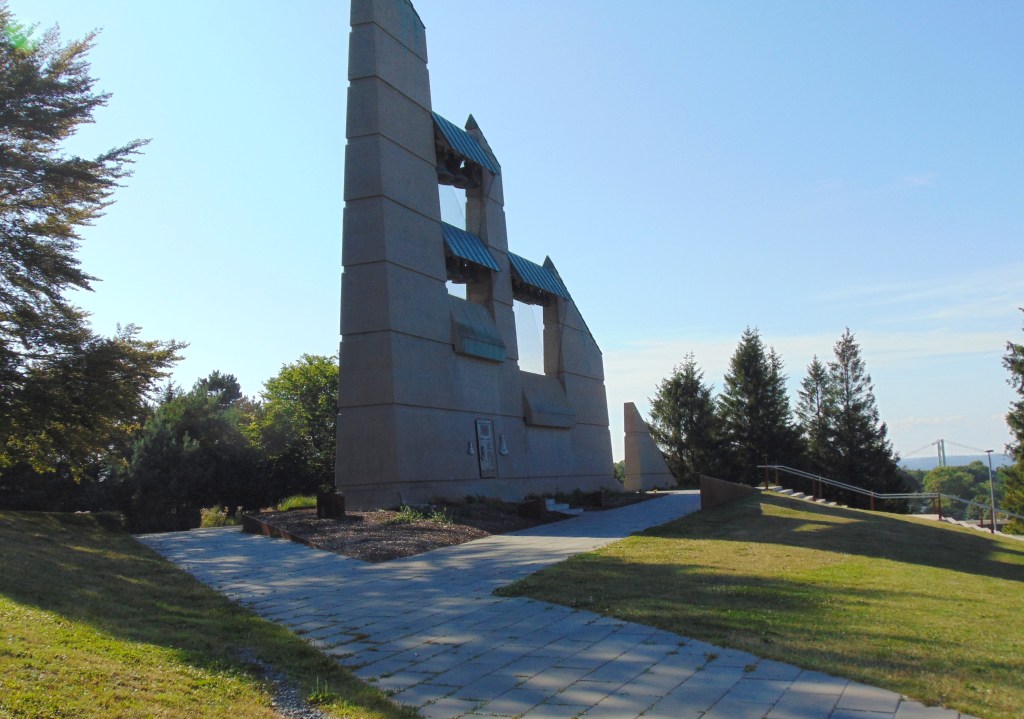
In the middle seats a large structure
of modern bell tower.
I see the Tower from my window
on the other side of the Narrows.
It’s 2 o’clock.
Time for the Bells to sing,
to cry and to remember.
Every day and every boy,
who perished than.
Every girl and uncle,
and mum an pop.
Even the lonely
older chap, whose name
no one knew and no one will.
All one thousand
nine hundred
forty six.
The largest explosion
Prior to Hiroshima
and Nagasaki.
A poet remembers, too.
(Bogumil Pacak-Gamalski, 09.09. 2024)
 > > Pogwarki < <