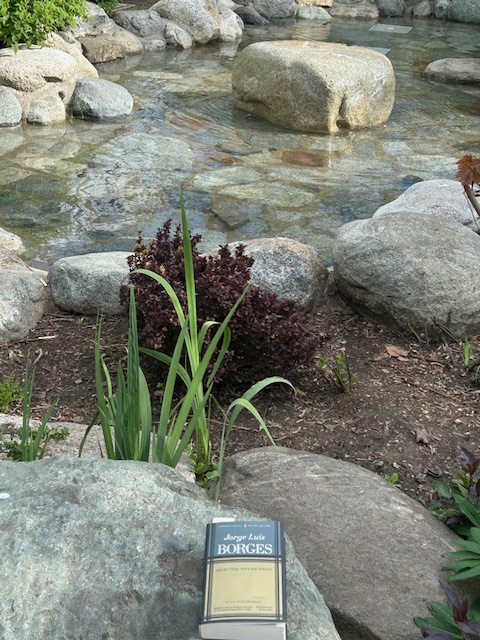
Bogumił Pacak-Gamalski
On Claude Mauriac Coversations with André Gide
Introduction:
Andre Gide as a guide – but to what light, what knowledge?
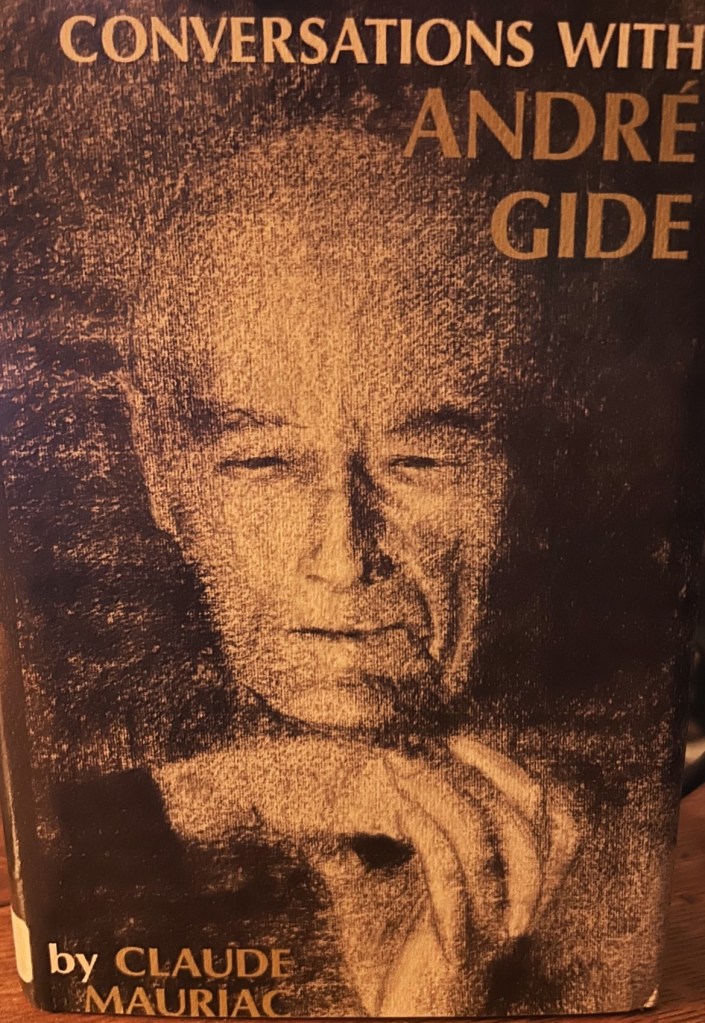
Andre Gide not himself with his books, his amazing literature, but Gide as seen in his twilight years through conversations and observations of a young Parisian, Claude Mauriac. No, no that more famous father, François Mauriac[i] (a writer, critic and member of French Academy and Nobel laureate in literature). Claude followed his father’s footsteps, who also interviewed Gide and wrote about him extensively.
All of it and all of them reminded me how amazingly important for continental Europe was the French literature since Moliere, and especially in revolutionary XIX and first half of XX century. Italian, Spanish, or German literatures had its episodes, individual, singular writers, the same as English from across the Channel. But none of them had such an impact on literary styles, thought, as did French literature as a whole at the same time frame.
I remember vividly that right after I stopped reading Mickiewicz, Kraszewsk and Krasicki[ii] – I went straight to Stendhal[iii]. I’m talking about a 10-12 year old boy in a peculiar cocoon called ‘Polish People Republic’[iv]. Yes, it meant communist. France for us was modern Athens. Of course, I had to re-read a lot of it again in a two-three short years to better comprehend it – but by the time I was fifteen, I knew by memory all the streets of Paris, from Montmartre to Montparnasse. It was very helpful when I eventually ended up in Paris for a visit with Kot Jelenski[v] – a true bridge-navigator between French high culture and Polish literary/art achievements.
The story with reading about Gide goes a few weeks back. I was trying (still unsuccessful) to get from our Library a book by Klaus Mann and his talks with Andre Gide. He was the last one to have this type of talk with the great writer. That book simply vanished from Vancouver Library – last time I was actually told that: disappeared. I went finally to get that book by older Mauriac – François. Remembered seeing it on shelf of the Library, but this time that book was gone, too. LOL. Machiavellian conspiracy?!
But they had this book by the younger Mauriac and I took it. It might have been a good idea. He was very young and very much taken by Gide, and his own criticism was not blinded by arrogance or pre-conceived notions, as could have been the case with his father writings. Even more intriguing is the fact that older Mauriac was about the same age as Gide. Claude Mauriac, being more than generation younger, would not dare to contradict, or argue with Gide. I knew he would have listen and absorb – therefore his recollections would be more crystal, so-to-speak, taken with reverence.
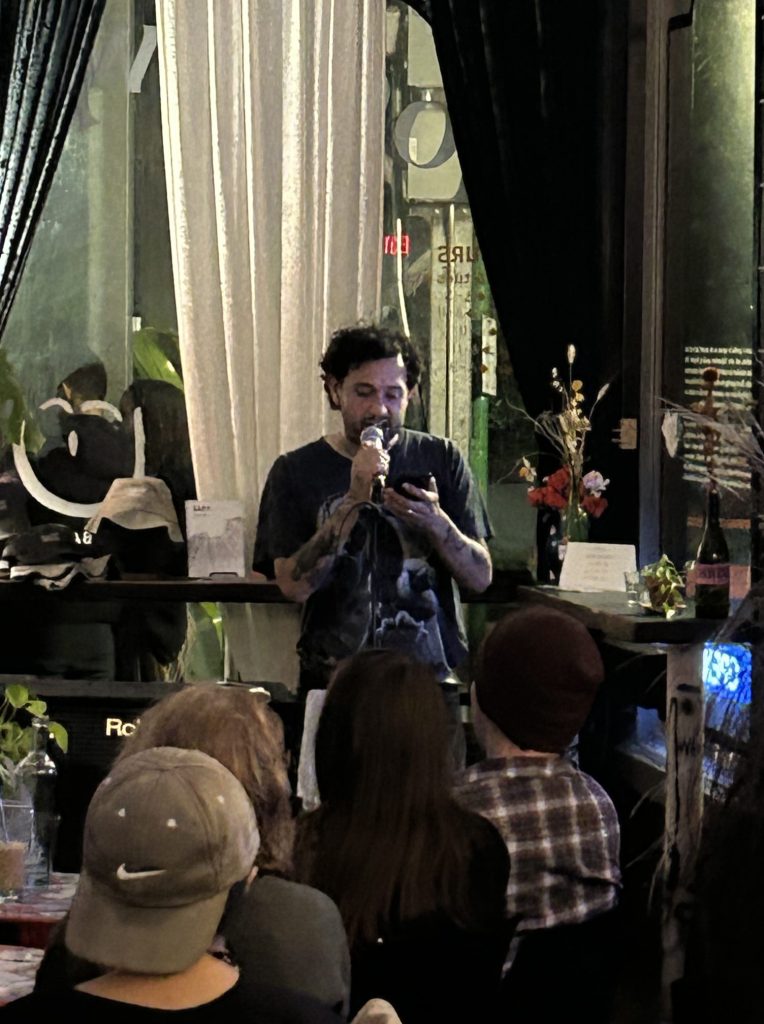
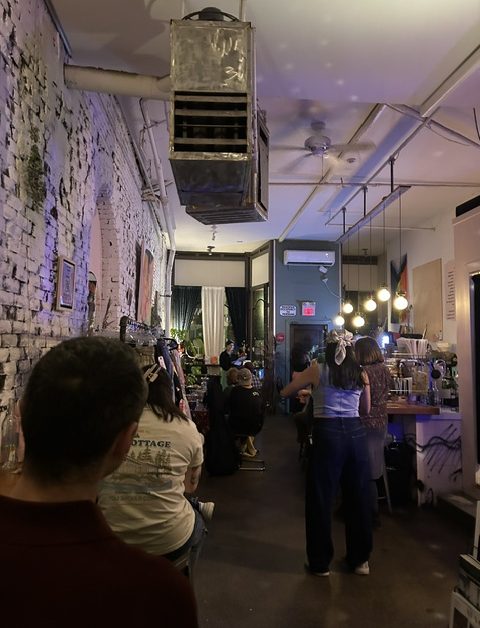
While reading these ‘Conversations’[vi] in Moodswing Cafe[vii] a strange thought came to me or, more aptly – an observation. Strangely perhaps, because on the surface it is totally disconnected from that book and it’s subject. Somehow though, it feels that I need to include it in that short essay.
Here we go:
some people, mostly the artistic type, or at the very least working on some sort of public stage while doing it, dress very differently on that stage than off that stage. I am definitely not talking about actors, as these professionals play a role, not themselves. No, my observation is about any type of performer, who presents their own skill/art in a public space. They often dress very differently than they are off that stage. Why? Are they victims of ‘Dr. Jekyll and Mr. Hyde”[viii] syndrome? I doubt it. Yet, it seems to me that they think as their artistic persona would be too peculiar, too extravagant for normal, ordinary life. Extravagant?! Obviously that ‘artistic’ part is very important and it shows that they are fuller, happier and more confident in that ‘stage attire’ than in ordinary, boring clothing.
They should allow themselves that freedom of dressing a bit differently simply because ‘it’ is them and ‘it’ would show confidence and joy. Being an artist does not make you better than others, but it does give you the privilege, the right to be a little bit of a peacock. Perhaps not with fully displayed tail – but a colorful peacock nonetheless.
I think that Gide helped me to have that thought, observation. Certainly monsieur Cocteau[ix], who comes up in Mauriac’s story very often would think that. I do not shy from this ‘perversion’ definitely.
(Next day in Melriches Cofee bar on Davie Street)
Well, back to the subject, the book of Claude Mauriac.
As I said I wouldn’t have borrow that book if not for the simple fact, that the other, written by his famous father was not at the library. Yet, being as it was, I have found out that it worked very well. That Claude, young aspiring critic and journalist did not come to Gide to discuss, analyze a famous writer style, body of work. He came timidly with open mind and heart to observe, to learn about Gide from Gide, without pre-conceived notions about Gide as a man. Obviously, the age difference added to his deference.
Did he understand the peculiarity of aging Gide homosexuality? Yes, he knew of it very well, Gide never hid it, but did he knew the emotional price paid by an aging homosexual artist – even in liberal Paris of the 30ties – who was single, did not have a partner? Of course he did.
Gide still analyzed, re-lived his tragically ended marriage ( her sudden death), a marriage never fully ‘consummated’. If you are not sure of the torture, perhaps you should read the gem of literature, the „Immoralist”[xi]. It had tremendous effect on me decades ago, when I read it first time.
Claude Mauriac was not only young (o, so very young!), he was (as his father) staunchly, almost fervently Catholic. But he did try very hard not to let himself be judgmentally opinionated in his dogmas, especially noticing that his own famous father (also fervently Catholic) did not allow himself to judge Gide writings through his sexuality or otherwise private conduct. Au contraire – he held him in high esteem.
Yet, I must say without a hint of trepidation, that I sensed very strongly, that Claude was drawn mysteriously not only to Gide’s admired writings but also to his suggestive handsome looks and his, at times, flirtatious behavior. And I also do remember the ancient times when I was at Claude’s age, and how intellectually attractive were my much older friends. One must assume that admiring these much older friends intellectual prowess easily translates into physical allure. It goes without saying that intellectually accomplished men (and women), who are artists or people formally associated with art ventures do age gracefully, and barring serious illness, they do retain physical attractiveness rather well. That ‘attractiveness’ should not be confused with just mere and banal ‘good looks’.
On p. 160 of that book Claude re-examines his feelings toward Gide and vice versa. He now recognizes Gide acting as a clever gamer, he sees his ‘perfidy’ to be friendly toward him – a boy, a budding young journalist. But is it a fair examination of Gide’s acting by Claude himself? I don’t think so. I think and I assume it, because I believe that Claude wrote that book honestly. I also believe (although he doesn’t state it as an explice) that at times, through the extended vacation in southern France, he often was jealous of his father closeness and long friendship to Gide. Closeness that took away Gide attention to Claude only. That he might have been at times in the shadow of these two towering figures of contemporary French high culture. Granted – it offered him an extra security that the father might have offered just by being close, but it did steal the singular attention of Gide that might have been his otherwise. If he did not have these feelings, he would have been indeed very abnormal young man, and I don’t think that he was ‘abnormal’, LOL. François Mauriac and Andre Gide were undeniably first class stars of French literary culture; they knew and admired each other accomplishments for decades. Hence, vis avis that Claude persona and personality fades into shades of words, of importance of their lively discussions.
(following day, back in Moodswing Café)
I have become more and more attune to Andre Gide again. Yes, it started with Claude Mauriac Journal , but it took me much farther. It is now me at times, who talks with Gide. Sometime I argue with him, sometime I adore him … and yes, sometime I just want to shout at him: shut up already, Andre. You are not god or, at the very least, you are not the only god of European Olympus! Another false claimant to Homer’s lyre.
Alas, truth to be told, I do love Andre. When Claude Mauriac takes him to visit deathly ill dear friend Paul Valery[xii] and he is not sure what his friend was whispering to him, I feel sorry for Andre. When he returns for a second visit … he is half an hour late. Valery is dead. Claude is overtaken by the look of broken, crying Gide. Was he crying for Valery? Undoubtedly, but mostly he was crying for their youth, for ‘that’ Paris. He was crying for himself. Selfishness? Perhaps … but truly, who is not selfish at the very core, the very center of our ego, our soul? When you cry after dear lover’s death – you cry over your loss much more than the loss of another person (of course the ‘other person’ would be your lover, but the asserted ‘yours’ is the key to that loss: something, someone was yours, belonged to you and now was taken away).
Egotist? I remember years ago reading F. Scott Fitzgerald “Short Stories”[xiii] and loved it so much. It was his greatest literary achievement and it prompted me to read his first full novel “This Side of Paradise”[xiv] from 1920. Many have called it an absolute portrait of the generation and its first section is titled The Romantic Egotist. How appropriate! These short stories and the novel portray a generation that just went through the unthinkable loss of millions in that devastating war of 1914-1918. Generation that was hungry for life, love, excess – ALL of it.
Dear Andre, did you know during your talks with this improbable youth called Claude Mauriac, that his world (as well as yours – once again) is just about to collapse under the pitiful actions of his admired earlier presidency of Maréchal Pétain, the Lion of Verdun, who become the Mouse of Vichy? No, of course you did not. After all you went to Tunis and Algiers. Did you enjoy the young bodies of the Arabian boys? Of course you did. After all it wasn’t the first time, was it? But you still should have told some of it to young Claude. He was naïve …
Gide dies soon after Valery. I’m personally taken by these moments and his sad, somber realizations. Am I now waiting for my death? Is my return to Warsaw a Gide’s return to Paris after the war years in Africa? Return to die…
(following day, back in Melriches Café on Davie in Vancouver)
Ah, yes – it is very hard to leave this place again, these streets, buildings, even shops, stores. Perhaps it is most difficult leaving the parks and their trails. Everything is so dear for me there. Everything? If life is everything – than yes, it is.
Our love, that I will never find again, my writings. Despite many shorter and longer returns to Poland, my dearest Poland, the undeniable fact remains that I was twenty two years old boy, when I left her. Now I am close to Andre Gide’s age, when Claude Mauriac wrote his Journal and become emotionally attached to that famous French writer. Andre died in Paris few years later, in 1951.
Regrets? No, have I not left my dearest Poland, I would have never found him – My Boy, My Life, My Soul. Things like that do not happen twice. Yet – Poland is my first love of books, of literature, of poetry, music. When I finally landed in Canada (after a year in London and two years in Italy) I was a truly fully developed man spiritually and intellectually. Back in the old communist Poland young people had to develop fast and mature fast. Of course, there was time for first kisses and romances – but a romance is not That Love you dream of, when you are that young. That one was waiting for me here, in Canada. Do I believe that things are preordained somewhere for us? That I don’t know and I am not going to be wasting time trying to answer such a theoretical question – cosmology was never my strength.
I do have one regret, though. Back in the 80ties I went to Paris to visit Kot Jeleleński[xv], an amazing intellectual and art lover. Art lover is one description – but of course he must have been a great lover romantically, too. After all, he was a lover of improbable Leonor Fini[xvi] and improbably beautiful Stanislao Lepri – an Italian aristocrat. He did, in pre-war Poland, had a friendship with Polish great poet Kamil Baczyński (a hero of Warsaw Uprising, where he died fighting German occupiers) – I forgot to ask him if he ever made love to beautiful Baczyński? But I would like to think that they kissed at the very least, both of them were very handsome boys. That is a side thought only, pleasurable but of no consequence. Yet, my regret is that I should have asked Kot to take me to the streets and cafes in Paris which Gide frequented. Kot was Parisian bare none. It is my great regret. You don’t ask just a tourist guide for places and stories like that. Stories like that could be told only by art lovers. Or artists themselves.
Who, if not Konstanty Jelenski could have told me the true shades of Gide? Jelenski, the ever arbiter elegentiae, the guardian of Polish and European literature? How did he survived the death of his love – Stanislao, the gorgeous Italian? I didn’t know that Kot at that time was dying himself of incurable cancer. Being as elegant in every meaning of the word, he never shown anyone his physical ailments. Let’s talk about art, not of something as ghastly as death – he would have probably answered.
Our lovers die too soon.
I have talked for a long time with Giedroyc[xvii] in Maisons-Laffitte near Paris, editor-in-chief of highly influential literary and political monthly “Kultura” – but our talk was all wasted on politics instead about literature. Those were the times, but we should have known that even during war, talking about art and love is more important than politics! One that could have put us back on these important tracks was another editor of ‘Kultura” – Józef Czapski. Tall as a skyline physically and intellectually, himself a lover of young Russian poet Nabokov and later of Ludwik Hering – but Czapski was not in Paris, when I visited Giedroyc. Maybe Czapski met Gide, he could have due to his aristocratic connections he mingled o lot in the ‘society’ circles of Paris. Eh, the occasions and talks we missed…
When Oscar Wilde took Gide to a hotel in Algiers, Wilde rented two rooms and in both rooms was a local Algerian boy. Naturally, the boy was rented, too. They both delighted in their boys. Yes, I know my dear Reader that you are aghast – but trust me, I am certain that both of these writers delighted in these Algerian boys. They definitely were not terrified of these boys. Not only that – to your surprise (no doubt) I must tell you that it was not illegal – the age of consent was not 18, not even 15. It was at that time …thirteen. O tempora, o mores! Did you, dear Reader give a sigh?! Did you just say, with wiping sentimental tear off you check: the good, old times? No? You didn’t? I thought you did – because that is what you usually say, when you comment on current times, don’t you?
O, please spare me the debacle. I am not going to Algiers tonight, or any other time. And the age of consent in Algiers now is the same as in Poland or in Canada. Even in Paris, LOL. Not sure about Texas or the Temple in Utah – religions and individual states laws and customs are very different in the ‘land of the free’ south of the border. They are Christians, too (I think?) but they are the Later Saints … or is it Latter-day saints? Maybe it is just very special Latte or Cappuccino; it is all too complicated for a simple guy as me.
Thinking of Gide for few more days and thinking of him I wrote two pieces of poetry: one in Moodswing Café in New Westminster and one … sunbathing on nude beach and swimming in Mud Bay of South Surrey’s Crescent Beach. I think it necessary to finish this essay, which no longer is an essay only about Andre Gide, with these poems. Maybe I should even dedicate it to his memory and talent.
To you Andre, to the memory of great man of letters from France.
Winter time in a small village in Pyrenees.
Night comes quickly and darkness covers
the valleys and peaks. Suddenly, the windows
off a small stony church lights up in delicate
orange glow. From the top of the church steeple
comes the song of its bells: big bam! Big bam!
big!, big! big! Bam! Bam! Bam! Baaaam-mmm!
The air vibrates with each tone of the big bell
and sends bronze-coloured sounds to the valleys.
Archangel Michael blows into long, golden trumpet.
The music envelopes the meadows, climbs up the hills.
The call of God, the call of the Shepherd:
come and be enlighten in the mystery of life
and promise of death merciful that claims us all.
They run – the tired travelers, the herds of goats.
They cry and hope, as the trumpet sounds again
and dies suddenly like the last drop of now empty goblet.
The church becomes a masjid and archangel becomes muezzin,
that intones to all: Allāhu ʾAkbar. In Pyrenees Hannibal’s army
stop their march and rise their tusks and trunks: they sense the pitch
of the hymn and the psalm as the far flung peaks of Alps slowly
cover the church, the mosque and streams in the valleys.
The curtain call of History. Birth and death of Love.
Moodswing Café, 29. 05.26
B. Pacak-Gamalski
It’s almost seven in the evening.
The sun just starts to burn its glory.
I talk to young Adonis I just met in the water,
when we were swimming close by.
Back on the hot rocks of the beach
he asks me about a book I’m reading.
That book is about Andre Gide and young
Claude Mauriac, who wrote that book.
No, I don’t suppose that my Adonis knows
who was Gide and I explain that he was seventy
at that time and fabulously-scandalously gay,
but Claude was barely twenty one and staunchly catholic.
Definitely believing being straight as an arrow,
straight as the priest, who presided piously over Holy Mass
in the church they attended with Gide and Claude’s father
in the southwestern France, in Malagar, close to Garonne’s
fast moving waters and not far from Spain’s Pyrenees.
Not sure if all that did not scared him: Malagar, big river Garonne,
close to Spain. A thought might have crossed his mind:
is he crazy per chance? And he moved few steps to the left.
Yet, he stroke a pose of Greek efeb to accentuate
his graceful, but muscular body. I pretend
not to read his mind and just admire his statuesque’s
shapes. Like a monument in Louvre or in Athens.
Michelangelo must have painted or sculptured him.
Gide and Claude in France? Who are they?
And who cares on a nudist beach
in the company of Greek efeb?!
Crescent Beach in South Surrey, 30.05.26
B. Pacak-Gamalski
[i] François Mauriac | Nobel Prize-Winning French Author | Britannica
[ii] A. Mickiewicz – great Polish poet, author of national epopee “Pan Tadeusz; Jozef Kraszewski, a popular author of many historical novels in the late XIX century; Ignacy Krasicki, bishop and writer called a Polish La Fontaine, satirist and critic of an old feudal system, XVIII century
[iii] Stendhal (orig. name: Marie-Henri Beyle) French novelist, precursor of realism and psychological portrait
[iv] Quasi sovereign satellite of Soviet Union block of states created after the 2 w.w. (1944) – the most liberal and free from the entire soviet Block. It ended in 1989 by peaceful free election led by ‘Solidarity” movement.
[v] Konstanty Jelelenski – eminent Polish émigré in Paris after the end of 2 world war; one of the three founding intellectuals, who organized and run the famous Paris “Culture’ periodic – an extremely influential magazine among intellectual and literary elite and not only for Polish people in the West, but mostly for people in communist Poland, where it widely distributed as ‘bibula’ (illegally)
[vi] Conversations with A. Gide; by Claude Mauriac; tr. M. Leback; pub. George Braziller Inc. New York 1965; s. 235
[vii] Services 4 — Moodswing Coffee + Bar
[viii] The Strange Case Of Dr. Jekyll And Mr. Hyde | Project Gutenberg
[ix] Jean Cocteau – a prominent French poet, performer and avant-garde style movement instigator
[x] Melriches Coffee, 1244 Davie St, Vancouver, BC. | Make that happy connection!
[xi] The Immoralist | French Novel, Existentialism, André Gide | Britannica
[xii] Paul Valéry – Wikipedia
[xiii] The short Stories of F. Scott Fitzgerald; pub. By Charles Scriner’s Sons, New York, 1989, p. 776
[xiv] https://www.ebsco.com/research-starters/literature-and-writing/side-paradise-f-scott-fitzgerald#this-side-of-paradise-by-f-scott-fitzgerald
[xv] Konstanty Jeleński — Wikipédia
[xvi] Leonor Fini at Weinstein Gallery
[xvii] Jerzy Giedroyc – Wikipedia