Antologie poezji polskiej w Kanadzie

(z perspektywy antologisty)

Do kraju, o którym Zofia Bohdanowiczowa, nestorka polskiej poezji w fiedlerowskim „imperium” pachnącym żywicą, pisała:

Kanada blaskiem rozsypana,

Na dwóch lecąca oceanach,  

Nie słyszy mnie i nie dostrzega

 Źdźbła wiszącego na jej brzegach”,

przybyło po II wojnie światowej, bo ten okres interesuje mnie najbardziej, wielu polskich pisarzy, którzy osiedlili się głównie w Toronto (na przykład Wacław Iwaniuk, Jadwiga i Adam Tomaszewscy, Florian Śmieja, Eva Stachniak, Aleksander Rybczyński, Roman Chojnacki, Edward Zyman, Marek Kusiba), Vancouver (na przykład Bogdan Czaykowski, Andrzej Busza, Grażyna Zambrzycka, Roman Sabo) i Calgary (na przykład Tomasz Wójtowicz, Antoni Wolak). Zapewne niskie poczucie własnej wartości imigrantów, ich poczucie alienacji, a także miałkości i błahości trudnej egzystencji w ogromnej wielokulturowej Kanadzie, pseudonimowane w wierszu Bohdanowiczowej ulotną florystyczną metaforą „źdźbła wiszącego na jej [Kanaday – B.S.R.] brzegach”, towarzyszyło długo niejednemu z tych twórców. Od początku jednak starali się oni zaznaczyć niejako dwutorowo (w języku polskim, a niektórzy również w angielskim swą obecność na arenie literackiej zarówno w Polsce, jak i w Kanadzie. I choć żaden z polskich poetów tworzących w Kraju Klonowego Liścia nie odniósł spektakularnego sukcesu mierzonego milionami czytelników, dolarów czy złotówek, to godne odnotowania (poza tomikami indywidualnymi, których w tym miejscu nie biorę pod uwagę) są cztery antologie poetyckie, w których pojawiły się wiersze Polaków – anglojęzyczne: Contemporary Poetry of British Columbia, opracowana przez Michaela J. Yatesa, wydana przez Sono Nis Press w Vancouver w 1970 roku, i Volvox, Poetry from the Unofficial Languages of Canada in English Translation, opracowana przez tego samego antologistę i wydana przez tę samą oficynę w Port Saint Clements rok później, oraz – najistotniejsza jak dotąd dla recepcji poezji polskiej w Kanadzie – dwujęzyczna polsko‑angielska antologia Seven Polish Canadian Poets pod redakcją Wacława Iwaniuka i Floriana Śmiei, wydana w 1984 rokuw Toronto przez Polski Fundusz Wydawniczy. Czwartą, którą moim zdaniem warto w tym miejscu odnotować, jest antologia Wiatry. Wybór wierszy w opracowaniu Bogumiła Pacak‑Gamalskiego,wydana w Surrey w 2015 roku.

Dwie pierwsze z wymienionych przeze mnie publikacji nie są oczywiście antologiami sensu stricto poezji polskiej w Kanadzie. Contemporary Poetry of British Columbia jest swoistą anglojęzyczną antologią „regionalną” czy „topoantologią”, odnotowującą wybrane wiersze poetów zamieszkujących w Kolumbii Brytyjskiej lub, jak czytamy w króciutkiej przedmowie, tych, którzy byli związani wówczas z tą prowincją Kanady. Skomponowana została przez Michaela J. Yatesa – kanadyjskiego poetę i dramaturga. Antologista spośród poetów mających jakiekolwiek związki z polskością (bo ci mnie w tym miejscu interesują) wybrał do swojej książki Bogdana Czaykowskiego (wiersze: Garden – przekład Adam Czerniawski; Didactic Verse – przekład Adam Czerniawski; Evening Scene – przekład Andrzej Busza i Michael Bullock; The Hourglass – przekład Andrzej Busza i Michael Bullock; Ars Poetica – przekład Andrzej Busza i Michael Bullock), Andrzeja Buszę (Black – przekład polskiego oryginału Łabędzie Jagna Boraks i Michael Bullock); Tiger – przekład Jagna Boraks i Michael Bullock; Woman with Cello and Foxes – przekład Jagna Boraks i Michael Bullock; Astrologer in the Undeground –przekład Jagna Boraks i Michael Bullock) i autora o polskich korzeniach, piszącego tylko po angielsku Mieszka Jana Skapskiego, którego jedna z recenzentek jego twórczości określiła jako „A fisher man mystic philosopher” („Rybaka, mistyka, filozofa”). Michael J. Yates zapowiadał kolejne tomy antologii poezji Kolumbii Brytyjskiej, planów tych jednak nigdy nie zrealizował.

Swoistym, aczkolwiek zakrojonym na mniejszą skalę, projektem będącym kontynuacją konceptu Yatesa zdaje się antologia, która ukazała się w 2015 roku w Surrey w kręgu współpracowników rocznika „Strumień”. Wybór wierszy, opublikowanych – z jednym wyjątkiem – wyłącznie w języku polskim, współczesnych poetów polskiego pochodzenia zamieszkałych na Zachodnim Wybrzeżu, zarówno w USA, jak i Kanadzie, czyli Andrzeja Buszy (Vancouver), Leszka Chudzińskiego (Seattle), Bogumiła Pacak‑Gamalskiego (Vancouver), Karoliny Piotrowskiej (Vancouver) i Grażyny Zambrzyckiej (Vancouver), nosi tytuł Wiatry. Redaktor antologii – Bogumił Pacak‑Gamalski – uzasadnia dobór autorów zaprezentowanych w książce w sposób następujący:

Kierowałem się raczej odmiennością poetyki, wpływów różnych szkół estetycznych i rozpiętością generacyjną niż jakąkolwiek arogancką oceną talentu czy „ważności” autorów.

W sposób poetycki tłumaczy też w Słowie wstępnym tytułową metaforę antologii:

Oto i wiatry znad Pacyfiku, wiatry wolności i szczęścia wolnej twórczości. Są w nich pokłady „wtórne” (a więc wiatry obrzękłe obrazami z przeszłości, obrazami osób i miejsc, bo poeta – mimo prób syzyfowych – od przeszłości czasoprzestrzennej uciec nie może) i pokłady obrazów, refleksji wybiegających ku nowym brzegom. Jest zapis duszy i intelektu autora. Zapis pewnej pasji, potrzeby nazwania czegoś, bez których o jakiejkolwiek twórczości mówić nie można. Jeżeli poezja sama wiatrem nie jest (choć z metafory wietrznej korzysta wielokroć), jest śladem tego wiatru dziejów i człowieka, jest odciskiem wiatru na fali, na nadbrzeżnym piasku plaży, w koronach drzew. Śladu nas.

Antologia ma zatem prezentować dorobek polskich poetów związanych z Zachodnim Wybrzeżem, tak się jednak składa, że większość (Andrzej Busza, Bogumił Pacak‑Gamalski, Karolina Piotrowska, Grażyna Zambrzycka) z przedstawionych autorów zamieszkałych w kanadyjskiej Kolumbii Brytyjskiej stała się wizytówką tego właśnie regionu. Książka wydana w Kanadzie jest skierowana do czytelnika polskojęzycznego, ma więc przede wszystkim propagować twórczość w języku polskim wśród Polonii kanadyjskiej, ale też dotrzeć do odbiorcy w kraju.

Antologię otwiera zbiór wierszy Andrzeja Buszy zatytułowany Wyrosło nade mną niebo, złożony z utworów nowych w tłumaczeniu Romana Sabo (na przykład Wiosna, Buciki), ale też tych, które powstały już dość dawno oryginalnie po polsku (na przykład Omnia mea mecum porto czy Powrót). Wybór wierszy, celowo chyba ignorujący chronologię ich powstawania, odkrywa ciekawą i wcześniej niezaakcentowaną nigdzie aż tak mocno stronę poezji Andrzeja Buszy. Podkreśla jej dwubiegunowość, balansującą między subtelnym zachwytem nad urodą życia i świata a, będącym cechą „dystynktywną” tej twórczości, wanitatywnym spojrzeniem melancholika, które najlepiej opisują słowa wiersza tytułowego:

kiedy staję na palcach

by zanurzyć dłoń

w jasnym powietrzu

spod stóp ucieka mi ziemia

jak wahadło

zawieszone

na iglicy zenitu.

Następnie prezentowani są kolejni poeci Zachodniego Wybrzeża, wśród nich Leszek Chudziński, którego twórczość ze względów geograficznych tu pomijam, Bogumił Pacak‑Gamalski – poeta melancholijnych, dość fabulacyjnych wierszy o upływającym czasie, Karolina Piotrowska – autorka wierszy zaskakujących świeżością metafory, somatycznych i metafizycznych jednocześnie, budująca intensywne obrazy poetyckie, oraz Grażyna Zambrzycka – jedna z najciekawszych współczesnych poetek polskich, potrafiąca ożywić przeszłość, aby wytłumaczyć teraźniejszość.

addendum

tłumaczka wierszy A. Buszy (i innych wierszy polskich poetów w Kanadzie) Jagna Boraks – to znana dziś pod małżeńskim nazwiskiem Lillian Boraks Nemetz; wiersze Karoliny Piotrowskiej były napisane w języku angielskim i tłumaczone przez Bogumiła Pacak-Gamalskiego

Zainteresowanych nabyciem nielicznych już egzemplarzy “Wiatrów” proszę o kontakt mailowy przez strumien.rocznik@gmail.com

Zapomniani lub mniej znani poeci polscy z Kolumbii Brytyjskiej w Kanadzie

Onegdaj publikowałem tu cykl o poetach mojej młodości więc sięgało to do poetów i poezji lat sprzed 1939, którzy jeszcze w latach 60., 70., a nawet 80. mieli znaczenie, żyli w świadomości młodego czytelnika. Znalazło się tam też kilku poetów polskich z mojego pierwszego emigracyjnego doświadczenia[i] i dwoje z Kanady – Wacław Iwaniuk i Barbara Czaplicka. Wspomniałem też o dwóch wybitnych poetach emigracyjnych: Bogdanie Czaykowskim i Andrzeju Buszy, z którymi miałem przyjemności mieć bliską znajomość i współpracowałem z nimi w Vancouverze. Ale wymieniłem ich tylko z nazwiska, nic o ich twórczości nie pisząc, bo kiedy z nimi pracowałem nie byłem już ‘człowiekiem młodości’ i w temacie się to nie mieściło.

Dziś odnalazłem kilka brulionów poetyckich mniej znanych, a bardzo ciekawych poetów z Kolumbii Brytyjskiej. W większości dziś zapomnianych, ze szkodą dla literatury polskiej. Ich twórczość przypadała na lata przed połączeniem polskiej poezji i literatury z polska twórczością emigracyjną.

1.

Zacznę ten tekst od Anny Galon. Była jedną z najstarszych poetek i tłumaczką literatury, z którą współpracowałem. Córka znanego oficera piłsudczyka pułkownika Zbigniewa Brochwicz-Lewińskiego. Jej życiorys był dość skomplikowany i trudny. Dzieciństwo i bardzo wczesna młodość w Polsce przerwane wojną, ucieczka przez Rumunię z rodziną, znalazła się potem we Francji, gdzie zaczęła szkołę średnią. Kapitulacja Francji i wyjazd z ojcem z wojskiem polskim do Szkocji, gdzie studiowała po wojnie. Za namową męża (muzyka-pianisty) wrócili do nowej Polski. Po wielu latach i różnymi drogami znalazła się w Ottawie w 1984, a w 1998 przeniosła się do Victorii. Mimo różnicy całego pokolenia byłem więc sam ‘emigracyjnym seniorem’ wobec niej. Prowadziliśmy liczne rozmowy na tematy literackie i imponowała erudycją w tym temacie. Na moją prośbę przetłumaczyła bardzo dobrze szereg wierszy znanej poetki kanadyjskiej P. K. Page, których część opublikowałem w roczniku „Strumień”. Była bardzo aktywna (mimo poważnych schorzeń, które ograniczały jej mobilność) w kanadyjskim świecie muzyczno-literackim w Victorii. Zmarła w Victorii w 2013.

Z łam „Strumienia” przytoczę dwa jej dość charakterystyczne wiersze:

KSZTAŁT

Chciałabym cała rozsypać się

                w słowa

a potem od nowa się poskładać

sama siebie dobierać

                z namysłem, celowo

ułożyć w kształt przemawiający

                pełny

                                sensu i treści

a cały prześwietlony i

                przekazujący

                                światło[ii]

Z BUTAMI – WARA!

Buty skarpetki zdejmuję

szoruje nogi i ręce

dłonie namaszczam odpowiednim kremem

                by nadać im miękkość dotyku

                                wrażliwość czucia

Cała spłukuję się pod czystą wodą

wewnątrz ogień rozniecam

I tak dopiero

pokorna i drżąca

otwieram

zasuwy twojej duszy[iii]

W 2004 wydała własnym nakładem tłumaczenia swoich wierszy na język angielski w skromnym tomiku “Stashing for a rainy day”. Niestety, nie był asygnowany jakimkolwiek krajowym lub międzynarodowym oznaczeniem katalogowym.

2.

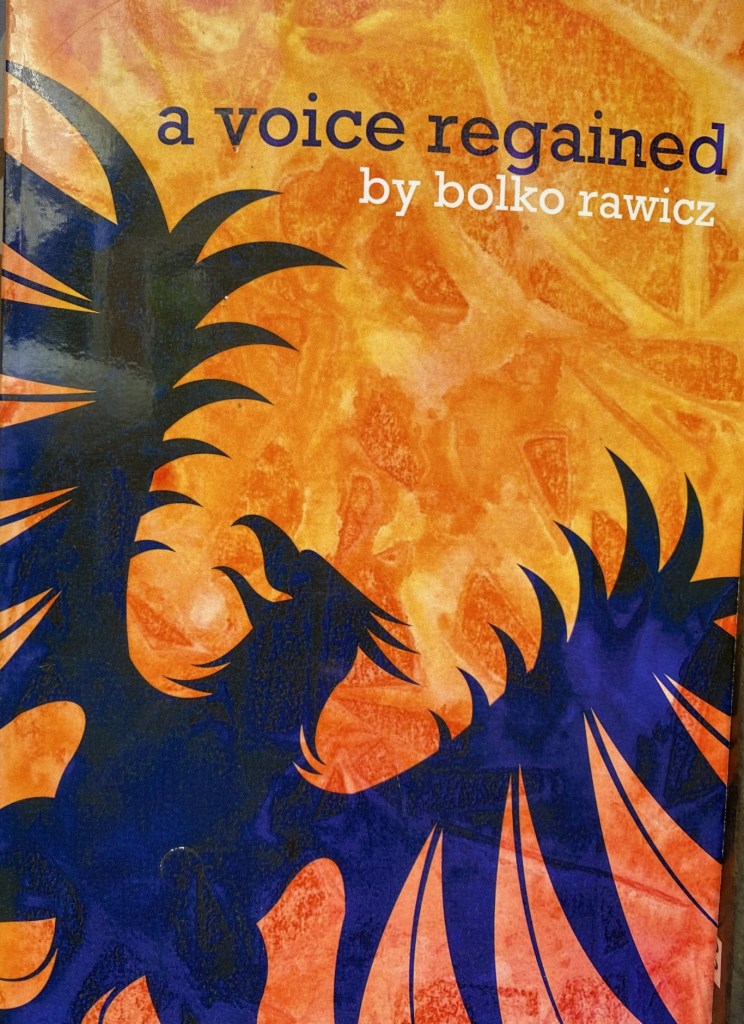
Ciekawym młodym poetą, którego też publikowałem w ‘Strumieniu[iv] jest Bolko Rawicz. Poeta do którego raczej nie można dodać przymiotnika ‘polski’ ze względu na język, w którym tworzył.  Kanadyjczyk polskiego pochodzenia, wyjechał z Polski z rodziną w wieku 10 lat, którego wierszy nigdy bym pewnie nie poznał, gdyby nie jego dziadek, który zwrócił mi na poezje ukochanego wnuka uwagę. Tworzy w języku angielskim. Wnuk jak i dziadek byli matematykami, specjalistami tej całej magii matematyczno-komputerowej. A tu poezja. I dobra. Pisze do dziś i publikuje, uczestnicząc w Vancouver ‘s Poetry Slam od tamtych lat do obecnych. Z moich badań wynika, że wydał dwa tomiki poezji : ‘A voice regained”[v] i „Something to believe in” [vi]. To spotkanie z inną, bardzo współczesną i zdecydowanie pobawioną wszelkich parnasistowskich ciągotek poezją.  Czasami jest to wręcz poetycka publicystyka społeczno-polityczna, komentarz socjalny, społecznościowy napisany wierszem. I taki wiersz na ważne tematy socjalne przeczytać pewnie wygodniej i łatwiej innemu zaangażowanemu młodemu Kanadyjczykowi niż długie wywody nudnych dziennikarzy. Tu – w poezji – w jednym słowie można zamknąć cały skomplikowany wywód.

Choroba dotknęła go stałą szkodą ciała, co z wiekiem, dojrzewaniem zaprowadziło go do wierszy innych, refleksyjnych, introwersyjnych.  W wieku młodym tego typu schorzenia mogą kłaść się wielkim cieniem na człowieka.  Przytoczę więc przykład właśnie tych dwóch, odmiennych poetyk.  W tym drugim, refleksyjnym i głębokim, następuje też pewna metamorfoza wyzwolenia przez akceptację miłości – Feniks wzlatujący w przestworza. Ten wiersz mnie zawsze wzruszał, budząc nadzieję, że uczucie wielkie niezmiennie wyzwala.

Wiersz pierwszy ze stron „Strumienia” w 2011.

Whale song

You were just sitting

on the sandy beach,

when suddenly appeared

a whale who made speech

‘we had to break the silence,

to talk about the violence

to the land and to the sea,

and to blow our cover

we had to all agree.

and we waited long to see

if humanity would be

wiser before we

told of our technology

for some different energy,

but we did begin to see

more of you the light to see

and you would understand

our philosophy,

but we are running out of time

and we’ve got to end the rime,

because we can’t resist

fearing soon we won’t exist

if we let this destruction persist,

but we are coming to you in peace

and want you to decrease

the use of gasoline

and ask you to police

the oilmen in the three-piece

suits not to exceed

in all their greed,

and with the whalers plead

to not make us so bleed.” (Rocznik “Strumień” , Nr.7, 2011, s. 17)

From a-dark brightly

A time faraway of past

love had left me

bitter and afraid

my spirit darkening,

and descending,

into a realm betwixt

wakefulness and sleep,

like a sunken flower

once touched

by a glimpse of sun,

long since un-searching

of light.

Many of years hence,

like a bird forsaking

the shelter of its tree

to seek the world without,

alas only

to stumble and fall,

its wings having forgotten

the memory of flight,

my spirit stirred

with the yearning

to be free,

but unaccustomed to the bright,

returned again imprisoned

as it once more was struck

by the blinding light of love.

But this very soul,

the luminance she bestowed

proved eminently more kind,

attuning her strength

of energy to heal,

awakening my spirit

to inspire it to rise,

on its way to soar.

Nonce friendship has led me

onto a better path. (z tomiku “a voice regained”, s.18)

Zawsze fascynowała mnie jego swoboda używania języka, tak charakterystyczna dla poezji mówionych improwizacji. I bez wątpienia miała na to wpływ tradycja  owych Poetry slams w Vancouverze.

3.

Jedną jeszcze, dziś zapomnianą a wartą przypomnienia, poetkę musze przypomnieć – Halinę Gur-Jazłowiecką z Victorii w Kolumbii Brytyjskiej. Przykład – w jej wypadku par excellence – poetki emigracyjnej. I biograficznie i w używanej poetyce, stylu. Dziś zdaje się kompletnie zapomniana. Urodzona w Warszawie w 1923, w latach okupacji studiowała na tajnych kompletach w Wyższej Szkole Dziennikarskiej.  Żołnierka Służby Kobiet AK w Powstaniu Warszawskim. Później więzień  obozów jenieckich w Fallingbostel, Bergen, Oberlagen i Niderladen, gdzie poznała męża. Po wojnie znalazła się w Anglii, skąd wyemigrowała do Kanady i zamieszkała w Victorii. Publikowała w prasie emigracyjnej kanadyjskiej, amerykańskiej i francuskiej. Nie mam jednak żadnych śladów kiedy, gdzie i co dokładnie. Były to lata, gdy wydawnictwa powstawały i upadały później na długo przed cyfryzacją zbiorów, a wszelkie archiwa były też bardzo nietrwałe. Nie mam też informacji kiedy i gdzie zmarła. W rodzaju poetyki i losach ‘niepamięci archiwalnej’ przypomina bardzo Barbarę Czaplicką, o której pisałem we wspomnianym już tu eseju „Poeci mojej młodości”. Jako iż życie i losy nasze indywidualne są właśnie nietrwałe, a sam jestem w takim punkcie ‘nietrwałości’ i wielkiej burzy zmian – nie mogę być pewny czy wszystkie moje dokumenty prywatnego archiwum te moje burze przetrwają i dotrą ze mną tam, gdzie na końcu tej drogi się znajdę. Spieszę więc  spisać te nazwiska, które bez najmniejszej wątpliwości powinny przetrwać. Naszego polskiego wędrownictwa po 1939 – aż do czasów emigracji doby „Solidarności’. Im bliżej tego roku 1980 – tym więcej wiedzy, trwałego zapisu archiwalnego mamy. W dekadach wcześniejszych różnie z tym bywało.


Bodaj najbardziej charakterystycznym wierszem Gur-Jazłowieckiej był uroczy, z dużym cieniem goryczy, napisany w Edmonton w Kanadzie:


Na krawędzi

Mój adres?

Kochani Moi – nie adresujcie inaczej

jak tylko: Koniec Świata

Tuż Nad Krawędzią Rozpaczy!

Co robię?

Niby ślimak, wyrwawszy się

z ukrycia

pełznę niknącym śladem

na marginesie życia.

Czy wrócę?

O, Kochani! Wracać mi już

nie pora.

I tak wciąż jestem z Wami

w Wieczystym Wczoraj! [vii] 

Tym więc zapisem składam im swój ukłon i podziękowanie za jakże często gorzką pracę na łanie ukochanej polszczyzny.

Rzeczywistość  epoki emigracyjnej od lat 40. poczynając aż prawie do lat 80. była zupełnie inna od epoki Międzywojnia z jednej strony a epoki post-solidarnościowej z drugiej.  Ci, którzy publikowali i byli trochę znani przed 1945 mieli szanse dużo wieksze na przetrwanie i na kontynuacje twórczości. Celowo piszę ‘przed 1945’ a nie ‘przed 1939’ jak się stosuje najczęściej i jest to poważnym błędem historii literatury polskiej. W tym wypadku cezura 1939 jest mylna, bo aż do 1945 istniały instytucje Państwa Polskiego w Londynie i jego przedstawicielstwa poza Anglią i istniały fundusze i wydawnictwa i środki finansowe Państwa Polskiego, które mogły i były używane na cele wydawnictw literackich, kulturowych. Więc w zakresie literatury i kultury polskiej istniała pewna ciągłość, mecenat i nawet skupiony rynek czytelniczy z państwem, tradycją i możliwościami Państwa sprzed 1 września 1939. Poza – naturalnie – terytorium tego państwa. Ta rzeczywistość i pewien mecenat  quasi-państwowy uległy bardzo szybko zanikowi, ale w okresie przejściowym był niezwykle ważny. Pozostały pewne ośrodki centralne, które dzięki temu kapitałowi oryginalnemu potrafiły kontynuować wydawnictwa i namiastkę życia literackiego. Niezbędne było też  posiadania odpowiedniego licznego zaplecza czytelników lokalnych. Londyn, Edynburg, Paryż i kilka jeszcze mniejszych ale silnych wystarczająco miast w Europie; Nowy Jork w USA, Toronto i Montreal w Kanadzie. Wszystko inne to była … prowincja i pustynia czytelnicza. To nie były czasy social networks, social media, czy nawet czegoś tak archaicznego, jak poczta elektroniczna.

Stąd ci, którzy tą kulturę polską rozwijali, pisali i wydawali poza tymi kulturowymi centrami – istnieli głównie tylko lokalnie. Tak, były nawet lokalne polskie gazetki, były spotkania w jakichś klubach, salkach parafialnych. Można było na maszynie do pisania i powielaczu, ręcznej drukarce wydać nawet mały tomik dla 30, 50, może nawet 100 sób – i to wszystko. Ta pierwsza fala emigracyjna i chyba większość aż do lat 70. zrobiła też jeden kardynalny błąd – nie potrafiła i nie umiała przekazać tego bakcyla polskości i wyższej kultury polskiej pokoleniu swoim tu urodzonych dzieciom i wnukom. Widziałem to wszędzie i każdy mi to mówił.  Co najmniej jedno pokolenie tu urodzonych, wychowanych i wykształconych Kanadyjczyków polskiego pochodzenia utracono na amen. Jednostki nieliczne, które z tej reguły potrafiły się wyłamać były tym właśnie – jednostkami a nie regułą. W takiej atmosferze, bezwzględnie przygnębiającej dla  lokalnego twórcy polskiego, niektórzy zmagali się i dalej pisali, lokalnie publikowali. Aż odeszli. Mam na myśli te faktyczne, biologiczne odejście.  Odeszli przed zrozumieniem wagi ich pracy, przed powstaniem możliwości cyfryzacyjnych. Czyli w świat niebytu. Znikały nawet tu i ówdzie zakładane małe ale jednak archiwa. Ktoś umierał i ktoś następny wyrzucał archiwum na śmieci. Można ironicznie ale i dość rzetelnie powiedzieć, że o szansie przetrwania w pamięci historycznej decydował nie zawsze tylko talent – decydowało też miejsce zamieszkania. Adres.

Inne czasy, mili moi. Tak, były kiedyś takie. I to wcale nie w dobie dinozaurów ani księcia Popiela na wyspie goplańskiej.


[i] https://kanadyjskimonitor.blog/2023/12/28/spacer-z-poezja-i-poetami-mlodosci-cz-3-emigracyjna/

[ii] Rocznik „Strumień”; nr. 2, 2000, s. 4

[iii] ibid

[iv] ibid; nr. 7, 03/2011, s.17

[v] „A voice Regained” , B. Rawicz, ISBN 978 0 557 29966 9, s.26; 2009

[vi] „Something to believe in”, B. Rawicz, s.54; 2017

[vii] Rocznik „Strumień”; nr. 2, 2000, s.13

Henry Kramer concert in Halifax

Few words of personal explanation. Of my wonderful life with my beautiful husband, lover and partner, John. Life that tragically ended with John passing a year ago. Yet life worth every moment, every second. Music, music – it has been such an important part of our life. Through music – in all forms, shapes, and styles – we understood each other deeper, fully. Like the name given by German composer Felix Mendelssohn (1809-1847) to his ‘Songs without words’. Love truly does not need words. As in any true process of creation, words – if used – are only a mere ornament, part of the mechanical structure. True creation begins and ends in a sphere of senses: sound, smell, touch, feeling. Everything else is just a noise.

Therefore, when I walked that wintery evening from Henry Street to Coburg Street and to St. Andrew Church for my normal rendezvous avec la musique – he walked there with me.

What a wonderful rendezvous it was! It was an immense pleasure to listen to the music played by the most gifted pianist, Henry Kramer. Kramer is an American musician recently being offered a teaching position in the Faculty of Music at Université de Montréal, and because of the proximity, he was able to come to Halifax and give us a taste of talent. What a treat, indeed.

One award (among many others) I have to mention is the American National Chopin Piano Competition in Miami, where he claimed the 6th spot in 2010 (the First Place automatically awards the winner a spot in the top piano competitions of the world – the Warsaw International Chopin Competition). But there was a connection to that famous Warsaw Competition: among his jurors was the former  3rd place winner of the said International Warsaw Competition, Piotr Paleczny. I was lucky enough to hear Paleczny playing many years ago during that Competition in Warsaw and to know him personally. He was, as a young fellow at that time, a very sweet guy. And truly fantastic piano player.

Henry Kramer missed that Warsaw Competition ticket – but he did not miss the 2016 prestigious and top-ranking Queen Elisabeth Competition in Brussels. And he got the Second Prize – that is a ticket to just about all concert halls in the piano world.

I was not in Miami to hear him personally there, but remember his concert in Seattle. Remember him well enough to make a note of his playing: don’t forget his name because you will hear of him.

Back to Halifax. Have a chance years later to do that. To be at his concert. How can I describe the overall feeling, reaction? I will use a term I don’t remember using before in any of my musical reviews:

Henry Kramer is a pianist of a very elegant way of playing. That it is. Elegant way of playing. You could say: bravado, astonishing, lively, emotional, technically brilliant. But after listening to him intently, paying attention to how he treats not only the music but the entire piece that makes a player, his arms and body and keyboard, pedals, and the entire massive instrument a one-piece, one symbolic union – that is the term that came to me: grace and elegance.

And what a good term, when you play music submerged in a very specific time of European chamber music of early romantics. Time of Shuberts, Mendelssonhs, and to a lesser degree even Liszts (Liszt belongs more to the next epoch – Romanticism). A time when musicians produce an extraordinary amount of compositions (almost in manufacture-like tempo) to appear in a multitude of salons of political, and Church dignitaries, aristocrats and extra-rich townsfolks. Time of Early Romantics. These were not huge concerthalls, or musical theatres (there were some in big cities – but that was a rarity, not a rule). The salon for chamber music was small, and the guests were not as plentiful. If you play the same music more than a few times – the opinion arises that you are done, finished. You emptied yourself and can’t compose anything anymore. So they did compose. A lot. Franz Schubert composed 20 sonatas (not all of them in a finished form) and a number of larger pieces: 12 (13?) symphonies; circa 10 Masses; over …. 1000 (that is one thousand, no mistake) songs with at least one instrument and many more occasional pieces in different form. No, he was not eighty years old, when died. He was  … thirty-one.  Show me a contemporary composer, who composed half of that volume, I dare you.

Was he a great composer? No, by any means. But he was an important composer and very talented. Had he lived decades longer, had he achieved financial independence and powerful support from powerful patrons – chances are he would have had time and space to compose a few timeless and extraordinaire pieces of music. It was also a time when music was composed in a very strict and form-fitting format. Just as poetry in classic times. The next generation started slowly to dismantle that construct. And then came Gustav Mahler, followed by Schoenberg with his Second Viennese School and music was never the same again, LOL.   

The old Saint Andrew Church in Halifax was a perfect setting for Schubert’s music and for the elegant style of Henry Kramer. The main nave offers wonderful acoustic and being of Anglican (in Canadian, United Church form) type is not too ornate and void of the weight and ballast of Catholic big churches.

From the moment Kramer appeared on the stage with a short introduction to the music – he won the audience with his pleasant way of greeting and talking. There was no ‘pomp and circumstance’ – just a warm and subdued tone.

From the first keystrokes, he was very attentive to musical detail, to the phrasing. Schubert’s Piano Sonata in A Major seemed to be written for him. The Allegro Moderato at the beginning was lovely. It’s a relatively robust tempo but the two melodies and two distinctive themes lead to a lovely passage. And his brilliant way of slowing ‘things down’ in Andante is just that: have time to ponder, exclaim, and reflect. At a certain moment, a listener not familiar with this work might think – that it is, finite. Perhaps little annoyed that it happened so soon, LOL.  Kramer used the intervals splendidly, they were very pronounced as the composer intended.

But forget the intervals, forget the delicacies, the sublime. Here comes the Allegro. Better check your seatbelts! This is a pianist (a good pianist) paradise: time to awe and conquer the audience. And he did. The bravura almost and brilliant style shine here with dances, and passages. The keyboard is used in its entire length and the pianist must grow two or three more fingers, LOL. But it is truly a pleasure to listen to it. Even if you are not an enthusiast of early Romantics (just like me) – I still can come and listen to the entire sonata again – just to enjoy the finale! Bravissimo for the artist!

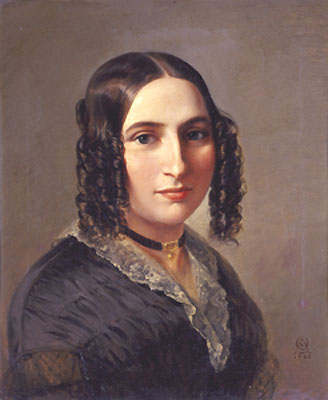
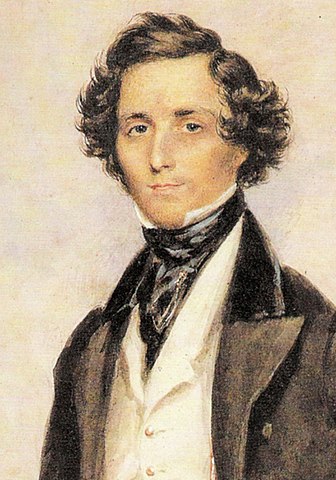
After Schubert music, Kramer opens to us the world of two siblings, contemporaries of Schubert: Fanny Mendelssohn – Hensel (1805-1847) and Felix Mendelssohn Bartholdy (1809 – 1847). Both siblings were very close to each other.

Fanny Mendelssohn

Felix was well well-known and very much accomplished composer in Berlin’s circle. His sister never (partly because of her father’s opposing views) accomplished such a fame during her lifetime but her compositions show a good measure of talent and ability. She was also very respected as a musician by her devoted brother, who often asked for her opinion and advice in his own works. As it happens from all their works the most famous ones often played even now are their songs. Or rather ‘songs without words’ (Lieder ohne Worte), as was the name Felix gave to his most famous composition. There is a story that at one-time friend of Felix offered him to write words for his ‘songs’. The composer is said to respond: “What the music I love expresses to me, is not thought too indefinite to put into words, but on the contrary, too definite.” What a lovely and indeed precise response!

Felix Mendelssohn

The pianist played Fanny’s 4 Lieder for Piano, Op. 8 (no.2 Andante con espressione and No.3 Larghetto), and Felix’s Songs Without Words Op. 19 in E Major and Op. 67 in F-sharp minor. It was a pure musical pleasure. His elegant way of playing was at its best. The depth of emotions coming from the sound he was producing was truly touching. I remembered years ago when I listened to the incomparable Jan Lisiecki playing the extremely difficult and technically challenging piece of Ravel’s Gaspard de la nuit and I thought: how this very sweet and happy young man (I have known Jan Lisiecki since he was fifteen years old very sweet boy when I did my first interview with him) can evoke the atmosphere of pure horror and terror so plainly, so vividly? Talked after his play with him about my question. And his answer was as plain as it could be: it is not enough just to play – you have to feel it inside you, you have to take that symbolic journey to that place, that moment and then transfer it to the tips of your fingers. Just playing every note, in exact tempo is not always enough. And I understood that instance what he meant. Of course. It is so plain. The feeling, the emotion. Listen to famous, dramatic singers of opera! The words are almost comical often. If you just sing them – you could almost laugh, like a satire, not a tragedy. It is the emotion, the timbre of the note you play, and the spirit of the sound you produce that signifies emotions. This is exactly what Kramer achieved when he played the Songs Without Words.  And I repeat: with that musical elegance.

But even the best of us must give up sometimes the comforts of elegance. When you deal with Franz Liszt’s Piano Sonata in B minor, S. 178 you really have no choice. When the Paganini of grand piano composes music that should rival Paganini’s Caprices – elegance and etiquette go away. I often compare him to Tina Turner and her singing career. Was it elegant? Heaven’s forbid, no! Was it great? Of course, it was a wonderful madness! Would Henry Kramer, that elegant musician be able to play such music, to forgo his comfort zone?

Oh, yes. He did it to my delight. That was not a summery evening stroll through the meadow. It was a full gallop! Not even of one horse – it was a herd of wild horses. What a choice for the finale and what a stamina to do it after already playing so many pieces.

Liszt’s sonata is one of his late compositions when he composed mostly for pleasure and not to gain popularity or earn money. It is in a way also a break with the established way musical forms were composed. Sonata, as a sonnet in poetry, has very strict rules.  Three, sometimes four pieces. You state your musical subject in the first part, elaborate more freely on it in the middle, and finish with a recapitulation of the first statement. But Liszt decided to do away with two distinct pieces and used just one. Try writing sonnets in the form of elegies. In a way, he liberated composers from the strict and tight corset of existing musical architecture. Today everyone understands it. We have gone through modernity and postmodernity. But at that time … it received scorn from all the greatest composers. Clara Schuman (Liszt dedicated it to Robert Schuman) said it was ‘merely a blind noise’; Johannes Brahms apparently fell asleep while Liszt performed it; similar scorn was shown by Anton Rubinstein. The only exception was Richard Wagner. Yet, by the early XX century that ‘blind noise’ was recognized as the pinnacle of Liszt compositions. Times are changing.

I can’t tell how many times I heard that amazing, powerful compositions being played by many wonderful pianists. In a way, my favorite was the recording of it by Kristian Zimerman, one of the outstanding pianists of my generation in the entire world.  

But the way Kramer played it was more than satisfied. I listened with full abandonment and total ecstasy of my sensory powers. No surprise that after that accomplishment the audience would not let him leave the stage. The standing ovation had no end. And fully earned. To no surprise, he had no choice but to thank the audience with two extra encores.

We finished with a nice chat and my congratulations for very well-presented program and excellent play. But I started the conversation by thanking him for transferring me that evening from Saint Andrew Church in Halifax to Carnegie Hall or to Vienna Philharmonics.

Spacer z poezją i poetami młodości. Cz.3 – emigracyjna.

Londyn 1981. POSK, gazety polskie („Orzeł Biały”, „Dziennik Żołnierza”, „Tygodnik Polski”), serdeczna przyjaźń z generałem-pisarzem Tadeuszem Alf-Tarczyńskim. Potem kontakt korespondencyjny z Giedroyciem, którzy przysyłał mi  do obozu uchodźców we Włoszech paczuszki z wydawnictwami abym pilnował, by polscy towarzysze niedoli uchodźczej je czytali, by wyjeżdżali w świat z minimalną choćby wiedzą o współczesnej historii Polski, literatury polskiej – słowem,  by nie byli ‘chłopami przywiązanymi do beznadziejnej roli PRL”.  Kilka już lat później, podczas pierwszego powrotu do Europy (wtedy jeszcze nie do Polski) umówiłem się z nim telefonicznie i pojechałem do jego Maisons- Laffitte, do redakcji „Kultury”. Mieliśmy bardzo długą, przedłużaną stale z obu stron, rozmowę. Biedna pani Zosia Hertz, która bardzo pilnowała by Giedroyc nie tracił czasu na rzeczy mniej istotne, kilkakrotnie usiłowała naszą dyskusję przerwać i ja grzecznie wstawałem z krzesła, a on łapał mnie za rękaw i śmiał się: siadaj, siadaj, jeszcze nie skończyliśmy. Bardzo żałowałem, że już nie zdążyłem na poznanie uwielbianego przeze mnie Józefa Czapskiego, którego wówczas w Paryżu nie było.

 Zetknięcie się wtedy z poezją Łobodowskiego, Wata, Balińskiego. Później, już w Kanadzie, z Iwaniukiem, Czajkowskim, Buszą, Czerniawskim, Śmieją, Czaplicką.  Naturalnie z czasem tych poetyckich i personalnych ‘znajomości’ przybywało. Ale ubywało (jak to z latami się dzieje) mojej młodości. Aż odeszła. A w tym tekście mówimy o wierszach i autorach mojej młodości.

Barbara Czaplicka pisała wiersze bardzo ciepłe. Była zdecydowanie liryczką. Trochę właśnie tego Staffowskiego ‘malowania pejzaży’ natury ale i człowieka. Publikowała większość swych wierszy w londyńskich „Wiadomościach” Grydzewskiego (kontynuatora przedwojennych „Wiadomości Literackich”). W Kanadzie znalazła się bodaj dziesięć lat po wojnie (przyjechała z Anglii). W torontońskim wydawnictwie polonijnym Polski Fundusz Wydawniczy wydała swój bodaj jedyny zbiorek wierszy zebranych. Nigdy więcej już z jej wierszami się nie zetknąłem.  Ale ten zbiorek i te wiersze pamiętam. Właśnie za ich ciepło, które bardzo mnie ujęło. Czasem warto wrócić do poetów zapomnianych. Bo często są zapomniani niesprawiedliwie, choć ich styl nie był odbiegający od modnych wówczas nurtów literackich. A nurty – wiecie, jak w modzie. Nie zawsze dobre i mądre. A czasem też krótkotrwałe. Przepiękne wspomnienie jej czasów młodości (dzieciństwa?) w ujmującym konterfekcie dwóch Żydówek: Chai i Ruty. Takiego wspomnienia, konterfektu naturalnie nie można czytać bez pamiętania strasznych lat hitleryzmu i Zagłady.

Żółta wystawa Chai: dziobate czajniki,

Garnki, miotły, plecione z wikliny koszyki.

W drzwiach stoi Chaja w czarnym, koronkowym szalu:

Pod spłowiałą peruką starość pełna żalu.

A dalej – serce dobre w deskach okiennicy:

Sklep grubej Rut w fartuchu – beczki ze śledziami,

Sery z koziego mleka, lada z bajgełami

Rut, karmiącej żebraków na biednej ulicy.

/ …….. /

Spotkały się na ścianie dwa cienie kobiece

i rozbłysła serweta w kolorowe kwiaty!

A nad świecami czarne, brodate chałaty

I piękne smutne oczy wielbłądów pustyni.

/…/  [i]

Wiem, że już nie żyje od wielu lat. I nic więcej. Przez to, że zmarła długo przed 1990 – na strony literatury polskiej w Kraju nigdy nie weszła. Nie istnieje gdziekolwiek (dostępny mi przez Internet) jakikolwiek jej biogram, jakiekolwiek wspomnienie że była, że pisała.  I bardzo to niesprawiedliwe. Źle o sumienności badaczy polskiej literatury świadczy. Może ktoś ten wpis mój i surowy a sprawiedliwy zarzut odczyta na jakimś wydziale filologii polskiej i jakąś prace doktorancką zrobi? Lub esej badawczy chociażby napisze? Wstyd, że biała karta pozostała. Znalazłem jeden zapis w Archiwum Emigracji na UMK w Toruniu. Jednozdaniowy, bez daty śmierci. W tym Archiwum spędziłem sporo czasu w latach 90. spotykając się z jego twórcą, prof. Supruniukiem – historykiem dziejów literatury polskiej emigracyjnej po 1939, muzealnikiem. Szkoda, że tak mało, nic prawie. Jedne co udało mi się ustalić, to fakt, że była siostrą znanej pisarki emigracyjnej Zofii Bohdanowiczowej.

I tylko jeszcze pierwszy tercet z wiersza ‘Zmartwychwstanie „Karmy” ‘:

Już znudziły się rządy starogreckich losów…

Zapadł siwy zmierzch bogów w literackim świecie,

Z chmurnych marzeń Olimpu, logiki Chaosu.[ii]

Najsilniejsze (wówczas) wrażenie wywarła na mnie poezja Józefa Łobodowskiego. Jego pierwsze wiersze czytałem jeszcze w Londynie, w 1981. Był to zbiorek pięknych wierszy zatytułowany „Pamięci Sulamity”. W pewnym względzie wyjątkowy zbiór poetycki, gdyż w całości, z autorskim wstępem biograficznym o „Sulamicie’, poświęcony młodej, niesłychanej urody polskiej poetce  pochodzenia żydowskiego – Zuzannie Ginczance. Ginczanka była wydana w łapy hitlerowskich oprawców przez Polkę we Lwowie kierowaną antysemityzmem i chęcią zysku finansowego. A ten cały zbiór Pieśni Łobodowskiego poświęcony jest tejże poetce, jest jego jedyną godną heroiną – Sulamita-Zuzanna.  Ostatnie badania w Polsce wykazują pewność, że Ginczanka była rozstrzelana przez hitlerowców w Krakowie w styczniu 1945.

Ze względu na pochodzenie etniczne ale i sam fakt, że młoda poetka uwielbiała „Pieśń nad Pieśniami” Salomona – Łobodowski te wiersze spisał właśnie w stylu tej biblijnej Pieśni. Opierał się zwłaszcza na ich literackim tłumaczeniu wersyfikacyjnym na hiszpański przez San Juana de la Cruz. I zdecydowanie sam Łobodowski użył tej formy nie przez jej pochodzenie etniczne, do którego ani kulturowo ani religijnie Ginczanka wagi nie przykładała (nie znała nawet języka jidysz) ale przez jej zauroczenie tą pieśnią Salomona i jej wyraźnie erotycznym, miłosnym zabarwieniu. Więc ta kunsztowna forma (w tym wypadku i w tej sytuacji i czasie absolutnie adekwatna i mistrzowsko przez poetę użyta) wierszy dodaje ich uroku, wagi, jest jakby  uniesieniem wspomnień o Sulamicie na ołtarze legend antycznych. Nie trzeba dodawać, że Łobodowski był kiedyś w Zuzannie zakochany, jak wielu innych artystów warszawskich.

(Kiedy po latach czytałem najbardziej głośny i ceniony przez samego Miłosza poemat Andrzeja Buszy, napisany stylem biblijnym „Kohelet”  (imię jednego z mniej znanych proroków Starego Testamentu) – nie spodobał mi się ten styl i byłem generalnie poematem rozczarowany, głównie właśnie przez użycie tej specyficznej poetyki.  A Buszę jako poetę bardzo cenię i lubię jego wiersze.)

Zacząć muszę więc od pieśni pierwszej Łobodowskiego, Pieśni która od końca, od śmierci Sulamity, zaczyna opowieść jej życia:

Nie pasałaś swych stad na górach Galaadu,

nie biegałaś pod namioty Kedaru.

Nie widziano twoich drobnych śladów

wpośród winnic znojnego Engaddi.

Nie witali cię pasterze śniadzi,

kiedyś szła przez Heseboński parów,

aleś była jako szafran i cynamon

i cieszyła się wołyńska cisza wiejska,

czarnowłosa przyjaciółko hebrajska,

och, Szulammit, Szulammit,

och, Zuzanno![iii]

Nie pamiętałem wówczas głębszego bólu po Stracie opisanego tak lirycznie i patetycznie jednocześnie. Jeśli porównać mogłem, to jedynie do strof żalu Kochanowskiego po utracie ukochanej Urszulki w jego czułych Trenach.

I te dziedzictwo literackie, te geny kulturowe, Łobodowski tak w swej Pieśni ujął:

 „Pieśń nad Pieśniami”, zaklęta w rytm czarnoleski –

ciężkie dukaty, wydłubywane z poetyckiej kieski –

jakże jej było nie smakować ich okrągłości?!

Rytm, uświęcony przez poetę z Czarnolasu,

połączył z natchnieniem z najdawniejszych czasów[iv]

Jeszcze dziś dreszcz mnie przeszywa, gdy czytam te wersy.

Poezja Ginczanki była w Polsce mojej młodości kompletnie nie znana i zapomniana. A zachwycała się jej talentem, wierszami (i urodą) cała literacka Warszawka Międzywojnia. Dopiero ostatnie dekada coś w tej mierze zrobiła i o niej się pisze. Tuwim ją uwielbiał. Ale na długo przed bardzo późnym ponownym ‘odkryciem’ Zuzanny Ginczanki w Kraju – pamiętali ją poeci na emigracji. Pamiętał serdecznie wspaniały Łobodowski.  

Córki jerozolimskie, nie budźcie ze snu Sulamity,

póki nie zechce obudzić się sama.[v]

Poeci emigracyjni w Kanadzie.

Jedno z pierwszych moich poszukiwań po wylądowaniu tu. Bo o czymże tu dumać na torontońskim bruku? Zanim ich jeszcze poznałem osobiście – już chciałem znać z wierszy. I natychmiast pierwsza palmę dostał poeta z Ontario właśnie – Wacław Iwaniuk. Najbardziej mi bodaj ze wszystkich poetów kanadyjskich tamtego pokolenia odpowiadał stylem, formą wiersza. I przede wszystkim – języka. Słowo znaczące to, co oznacza. Bez koloryzowania. Prawie prozatorsko, a jednak poetycko. Bo słowo proste ma wielką moc i wagę, gdy się je z szacunkiem traktuje. Pisał głównie po polsku ale większość wierszy publikował w tłumaczeniu na angielski, często własnym. Olbrzymia zasługa tłumaczeń tych wierszy należy się Jagnie Boraks (Lillian Boraks-Nemetz), którą potem poznałem w Vancouverze i do dziś bardzo cenię wymianę uwag z nią, stosunki serdeczno-koleżeńskie.  Tłumaczyła też wiersze innych polskich poetów. Ma duże zasługi dla polskiej poezji w tłumaczeniach na angielski.

Iwaniuka tomik wierszy który pierwszy czytałem był właśnie po angielsku. Więc takie te fragmenty tu będę przytaczał, bo tak jego poezję wtedy, w czasach młodości, poznałem.  Jeden krótki w całości. Jest w pewnym sensie kwintesencją jego poetyki, formy. Oszczędność, a przez to waga każdego słowa. Bo, powtórzę raz jeszcze: wiersz to nie ciągi zdań. Wiersz to słowa. Każde na wagę prawdy.

Madrigal

In love

As in all loves

The spine blushes.

Bones and muscles blossom.

Sheets inhale the beads of sweat.

Words are few

but they pierce the air.[vi]

Cóż więcej można powiedzieć współczesnym językiem poetyckim o miłości? Frazeologia tu zbyteczna, kiedy ‘pościel wdycha krople potu’. Metafora jest prosta, może nawet rażąca dla duszków bladolicych – ale jakże prawdziwa, szczera. I to znowu przypomnę: szczerość poety to sine qua non poezji współczesnej .

Iwaniuk też, jak tylu już tu wymienianych, ‘popełnił’ wiersz o poecie. Kim jest w jego wizji:

/ …/

Yes, he erects his signs

at each  turn

of his own painful labour,

similar to Homer’s marble voices.

/ …. /

Still some people wonder,

they regard such a poet as a charlatan

(not even an alchemist)

who has deformed words,

freed them from rules and principles

violating the sanctity of grammar,

to emerge finally with a distorted cento,

so painfully mutilated,

which he then calls

a poem.[vii]

Maja Elżbieta Cybulska w swojej pracy o Iwaniuku  pisze, że on ‘odpoetycznia’ poezję i ‘upoetyzowuje’ prozę.[viii] Sam Iwaniuk zaś w jednym z wierszy dodaje:

Nie wiem co jest prozą a co jest poezją

ale słowo gdy szczelnie pasuje do treści

smakuje jak owoc

i to jest chyba poezja. [ix]

Więc jednak wiedział i rozumiał. I odróżniał. Proste.

Zetknąłem się wówczas z wieloma innymi autorami emigracyjnymi i w Kanadzie i USA. Nie chcę wymieniać nazwisk, bo wszystkie pewnie bym już dziś nie spamiętał. Ale nikt, prócz wymienionych wyżej na mnie wówczas wrażenia takiego nie zrobił, jak ci poeci, których wspomniałem.  Jeszcze kilka lat później, na początku zamieszkania w Vancouverze, miałem możność dobrego i głębokiego poznania poezji wspaniałych (a jakże innych jeden od drugiego) Bogdana Czaykowskiego i Andrzeja Buszy. Wspólpracowałem z nimi blisko, publikowałem ich teksty w swoim roczniku twórczości „Strumień”.  Ale ‘gumkę’ lat musiałbym zbyt już naciągnąć, by tamten okres mógł nazwać czasem mojej młodości. Byłem już człowiekiem dojrzałym.

No i jeden jeszcze ‘szkopuł’ – umarło się śmiercią naturalną literaturze emigracyjnej. Zmiany polityczne w Polsce literaturę polską na nowo scaliły. Bez względu na to, gdzie mieszkał polski poeta. Bo ,narodowość’  poety i pisarza określa narzędziem twórczości. Czyli języka w jakim się tworzy.


[i] druga i trzecia zwrotka  oraz fragmenty 9-cio wersowej ostatniej zwrotki wiersza ‘Ulica’; s. 11 (B. Czaplicka, „Wiersze”, wyd. Polski Fundusz Wydawniczy, Toronto, 1986)

[ii] ibid  s. 49

[iii] z Pieśni ‘Na smierć Sulamity’, pierwsza stanza, s. 17 (J. Łobodowski, „Pamięci Sulamity”, wyd. Polski Fundusz Wydawniczy, Toronto, 1987)

[iv] ibid. s. 27

[v] ibid s. 52

[vi] ‘Madrigal’, s. 36, tł. Jagna Boraks (Wacław Iwaniu, „Dark times”, wyd. Hounslow Press, Canada, 1979)

[vii] ibid, z wiersza „Who calls what a poem”, fragmenty, s. 60, tł. Jagna Boraks

[viii] M. E. Cybulska „Wacław Iwaniuk – poeta”, s. 16 (wyd. Oficyna Poetów i Malarzy, Londyn, 1984

[ix] ibid. s.16

The success of the Polish film director in Canada’s premiere movie festival, TIFF.

Green Border” movie poster (@Kino Świat)

I had a pleasure meeting Jason Gorber, a prominent Toroto-based movie critic, at the Green Border screening on Tuesday. Today, I have read his comment:

“A masterpiece from an underappreciated master of both big and small screen, Agnieszka Holland’s searing look at the refugee crisis on the border between Belarus and her native Poland is as profound as it is provocative.

The performances are astounding, the narrative horrifying, resulting in a story that’s deeply unsettling and emotionally raw.”

We wtorek, na projekcji Zielonej Granicy, miałem przyjemność poznać znanego krytyka filmowego z Toronto, Jasona Gorbera. Dziś przeczytałem jego komentarz:

“Arcydzieło niedocenianej mistrzyni dużego i małego ekranu Agnieszki Holland, jej wnikliwe spojrzenie na kryzys uchodźczy na granicy Białorusi z jej rodzinną Polską, jest tyleż głębokie, co prowokacyjne.

Gra aktorska wprawia w oslupienie, a narracja poraża, co skutkuje historią głęboko niepokojącą i emocjonalnie surową.


Of Lovers and Friends and friends and lovers

Of lovers and friends. Of the most unfortunate ones, who were friends and became lovers. Oscar Wilde once described that dilemma clearly. And trust me – he knew a thing or two about it. Yes, of course, I’m taking off that famous line from the Ballad of Reading Gaol. Yes, yes – that line: ‘Yet each man kills the thing he loves’, which is followed, by the end of that stanza, with: ‘The coward does it with a kiss,
The brave man with a sword!’[i].  The year
was 1898, he was just recently released from prison in England. Went soul, heart, and financially broken to France, to try to re-established himself. Of course, too late. Just the Ballad remained, a shadow of a once proud, elegant poet, a member of society. With the misfortune of falling in love with some rich boy. Who, with tears or glee (who knows) sold him to the gallows trying to save his own skin (and father’s money, naturally).

Thus, boys and girls alike, for heaven’s sake – do not fall in love with your friends. Rather, become friends with your lovers.

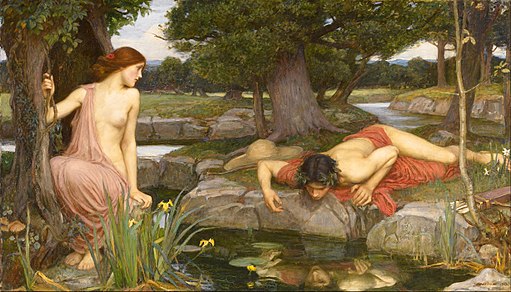
Narcissus and Echo by John. W. Waterhouse

In the Prologue to the “Alchemist”[ii], Paulo Coelho writes beautifully the story of Narcissus’s death. Of course, Coelho would not have been such an amazing writer, if he had merely repeated the thousands years old story told already hundreds of times by others.  No, he added a sweet surprise at the end. So humanely grotesque (as all Greek gods stories were): when the goddesses of the forest came to the Lake, where gorgeous Narcissus drowned, they asked the Lake: Why do you weep? and expectedly the Lake replied I weep for Narcissus. The goddesses were understanding, they themselves chased the boy through the forest, trying to see his famous beauty, the beloved of Apollo himself. And they admitted to the Lake, with a hint of jealousy, that although they pursued the boy, the Lake alone could see his beauty the best.  At that moment the old story takes a different, shocking turn when the Lake replies: But… was Narcissus beautiful? A conversation ensues, as expected. The goddesses explained that obviously since Narcissus so often admired his own reflection in the Lake waters, the Lake must have noticed his beauty. The Lake paused, thought, and after a while replied: I weep for Narcissus, but I never noticed that Narcissus was beautiful. I weep because, each time he knelt beside my banks, I could see, in the depths of his eyes, my own beauty reflected[ii]. What an amazing twist to the old tale! I love writers and poets, who tell us: oh, come on! don’t be timid – allow yourself to dream, to tell the secret and true thoughts, and desires. Mirror, mirror – tell me if I am … . LOL  

Thus, be a friend of your lover. Avoid the terrible pitfalls of friends, who become lovers. There are really very few brave souls, who survived the utter honesty of true friendship in forming eroto-romantic union. Poor Andre Gide felt forced to explain his “Immoralist”[iii] by the timid (and so obviously false, LOL) words in the Preface to his little, yet so sweet book. Thank God at the very end he was able to utter the most powerful explanation in the history of art: To say the truth, in art, there are no subjects, which only sufficient explanation is the art itself[iii]. O! Little critics with overblown moralistic egos – be quiet already. You are not a philosopher but a scribe jealous of a writer.

The dilemma of choosing if a friend could be a lover was a paralyzing complexity for Jean Genet in his amazingly honest story of “Prisoner of Love”[iv]. More so even, because it is intertwined with the love and passion for the Palestinian cause.  Did he consummate his love for the Palestinian boy or was it just a Platonic passion? The powerful novel/memoirs, written in France (his last work, shortly before his death), were treated as not very important literary achievements. Au contraire, mes amis – it is one of his best. Powerful, very deep psychologically, insightful. This book and a little (in size comparison) booklet “Out of Place”[v] by great intellectual Edward Said taught me much more than any historian about Palestine and its tragic People ever could. But it is a different subject.

How can you write about friends and lovers without mentioning three amazing people: Polish writer/intellectual and modus vivendi of Parisian art circles – Konstanty Jeleński; his wife, famous Spanish-Italian surrealist painter Leonor Fini[vi] and Italian aristocrat, painter and diplomat Stanislao Lepri. All of them lived happily and joyfully in sexual and friendship union until their deaths. How did they survive all the pitfalls of such a union? I personally believed that that Jelenski and Lepri were the primary lovers most of all, and Fini was their artistic, crazy, and much senior femme fatale.

In 1995 Jelenski invited me to visit him in Paris.  But, when I finally arrived – his sprawling and beautiful apartment on rue de la Vrilliere was a circus in full swing. Leonor was just preparing her special exposition in the Senate of the French Republic.  Paintings were everywhere: on sofas, on beds, on chairs. And people were constantly coming and going. Friends from all over Europe. Poor Kot felt so bad, I had a chuckle. He quickly rented me a room in a small hotel nearby, on rue Croix des Pettits Champs. I was happy, telling you the truth. My gosh, I was young then, and Paris and her evenings and nights were so … appealing? Appealing, for sure, LOL. This way he had more time to concentrate on the crisis at hand (Leonor’s Exhibition) and I could concentrate on things (shall we say?) not only intellectual. Hmmm. After all – late evening walks along the Seine could be very  … exciting? Enough said.

But back to friends and lovers – Leonor, Konstanty (Kot or Kocik in Polish – sort of French un minou, which definitely would be a much more proper name for Jelenski, who was truly a very sweet guy), and Stanislao.  How did they survive for so long? Especially that at the beginning there was one more constant female shadow – a true femme fatale of their ménage à trois: Konstanty’s formidable mother. Madame Rena Jelenska de domo Skarzynska, from very old Polish nobility. Rena couldn’t stand Leonor. She didn’t mind at all (was actually fond of him) Stanislao Lepri. But that old crazy Spanish whore?! Poor Kot. Even more tragic because he actually truly loved both women: his mother and Leonor. But on the subject of staying together till death – I think that Kot, Leonor, and Stanislao could because actually, they all slept with each other (separately at the beginning, I assume) before they became friends. They were the happy part of the equation: lovers, who become friends.

Last but not least here is a more modern case of brilliant Irish novelist Colm Toibin in his multi-layered novel “The Story of the Night”[vii]

The novel is truly a masterpiece of combining so many complicated subjects and themes without losing for a moment the personal story of its protagonist – Richard Garay.  Richard leads many lives: English, Argentinian, artist, businessman, even (for a brief moment) politician. But most of all – gay in a very macho dominant male world of South America. Another constant is the presence of his dear friends: Susan and Donald.

The writer (himself an openly gay writer) does not shy from describing many of Richard’s lovers and one-night encounters. But it is the brief encounter of sexual attraction revealed by Richard toward his straight friend Donald that warrants mentioning. Encounter – which is important to note – planned by Donald. He ‘just’ wanted to check if, as he suspected, Richard was homosexual … .  No sexual encounter ever happened. But, yes – it couldn’t be denied that Richard was aroused and willing. Even the fact that the act itself was never consummated – it changed their friendship dramatically. In some way, it wounded it mortally.

Therefore, my dear boys and girls, please take it as the wisdom of almost god (meaning me, naturally). If you must experience the forbidden truth and fornicate, please choose a stranger rather than a friend. With a stranger, you have nothing to lose (other than your presumed virginity). If you are lucky the experience will bring you a lot of joy and satisfaction, at worst – it will be a disappointment (first times often are, nothing to be ashamed of). With a friend, the stakes are much higher and sometimes lasting lifelong bitterness or guilt.

And do read a good book before. Not really educational. A good literary book. Like one of these mentioned above.


[i] Selected Poems of Oscar Wilde including the Ballad of Reading Gaol, by Oscar Wilde; CreateSpace Publishing Platform, 2017; p. 56

[ii] „The Alchemist”, Paulo Coelho; pub. Harper One, 1993; p. 197

[iii] “Immoralista”, Andre Gide, by Wyd. Zielona Sowa, Cracow, 2006 (Polish translation by I. Rogozinska)

[iv] „Zakochany Jeniec”, Jean Genet; wyd. W.A.B, Warszawa, 2012; p. 486 (Polish translation by J. Giszczak)

[v] „Out of Place”, Edward Said; Random House, 1999

[vi] https://rynekisztuka.pl/2011/12/16/leonor-fini-i-konstanty-a-jelenski-portret-podwojny-w-warszawie/

[vii] “The Story of The Night”, Colm Toibin; McClelland&Stewart Inc., Toronto, 1997; p. 312

Alors – encore une fois, s’il vous plaît

by: Bogumil Pacak-Gamalski
These words often came to mind, seriously and in a playful mode, during my last Saturday visit to venerable Music Conservatory in Halifax.

First of all – finally something different than baroque music that seem to be in a bloodstream of Maritime musicians (or Cecilia Concerts –   most popular,  almost singularly exclusive organizer of  musical performances). Who doesn’t love Vivaldi and Bach? We all do! No, not so much. Not all and not all the time, anyway. Specially in my case. The same canons and styles repeated thousand times with slightly different arrangement and these funny rococo dresses, white powder and astonishing wigs  – could make you bit nauseating  … .

Halifax venerable Conservatory of Music

No this time, no. That was the music at its most glorious times. The times of Beethoven and Brahms. An ornamental intermezzo with less known (for a good reason) English composer Frank Bridge separated the German giants of great music. Immortal music. 

Whenever I am in Berlin and walk through the Tiergarten (Berlin’s Hyde Park), I like to go and sit on bench near the monuments of German’s giants of music: Haydn, Mozart, Beethoven. Only a short distance further is monument of Wagner. Never saw any of Brahms in Berlin. His famous and wonderful monument is in Vienna and modern, symbolic style sculpture in his native Hamburg –  that one I have seen many times as it is located just a stone throw away from my favored walking park in Hamburg – Planten un Blumen.  But enough of cities, monuments and parks I like to walk in. Back to music. In Halifax, not in Germany.

Let’s start with absolutely wonderful and musically very mature Gryphon Trio of Annalee Patipatanakoon (violin), Roman Borys (cello), Jamie Parker (piano). With addition of equally talented and very energetic  Ryan Davis (viola) it made brilliant quartet.

It is such an immense pleasure to listen to musicians, who effortlessly play with such unison and harmony! Each could be and indeed is a soloist in her/his right. But as member of an musical ensemble they become one. All the strings combined sounded like they were played by one soul with many hands. No unnecessary showmanship but unity in sound, tempo and tone.

Pianist Jamie Parker and his style of playing was very familiar to me. By no accident, of course. Parker studied in Vancouver under the tutelage of no one other than Lee Kum Sing. I recalled many long chats with Lee Kum Sing about his method of preparing young pianists to stage career. And the many traps and very insidious mannerism that lurks for musicians hungry of applause.  In early middle and conservatory level musical schools, teachers tend to tech how to play an instrument. But are very oblivious to the teachings of public expressions and stage unforgivable atmosphere. It is only in later years, if they are lucky enough, that they might found someone, who would teach them that. Someone, who has a stage/soloist experience. Typical music teacher in a conservatory or even an university is good theorist, good musician – but failed or couldn’t even begin a soloist career. It takes stamina, courage, perseverance and clear vision to become one.

In Halifax Conservatory the  hall was full. I was pleasantly surprise that a large section of the audience was below the typical here custom of silvery hair covering age of substantial life experience.  Not that there is nothing wrong with it. Especially if that composure still hides an eternal youth! No, it simply saddens me often that so many young people avoid such experience of good music. Chances are that if you don’t get that shot early in your life – you will never discover the beauty of so called classical music (I despise the term myself – music has only two genres: good and bad, period). And it is, for most part, a good music. Music that expands your horizons, your emotionality.

Anyhow – my luck this evening resulted in choosing my seat – between two empty seats. Alas, empty not for long. Just before the music started playing – two very young men sat on both sides of me, LOL. Probably below the age of twenty. 

Music. How to begin? A good suggestion would be: play most likely the absolute god of all music. The incomparable Ludwig van Beethoven.  And why not a composition, when The Great One was founding his totally unique, own musical style. The Piano Trio No.5 in D major, opus 70.

That composition (also known simply as a “Ghost’ – often combined with Macbethian origin) is superb on many levels. And is has been many years since I heard it full in a concert hall.

They began. The strings play the Allegro vivace wonderfully. Every note is essential, not replaceable.  The cello seems to lead dancing guests, the tempo and direction of the troupe. You can see the dancing group of guests in some forest, some meadow.  Very diminutive, quite sound of piano is somewhere, far away, only in moments yet it seems so constant. The sound of air around.

Then comes the Largo. Totally different in every aspect from I and 2 part. Ghostly indeed. My mind for split second jumps to memory of Ravel’s ‘Gaspar the la Nuit’.  Naturally, my comparison would have been absolutely alien to Beethoven as he died many years before Ravel composed ‘Gaspar’.   But the atmosphere is there. Specially in the piano parts. The piano plays here the leading part, the strings follow.

Presto returns to the happy  yet,  majestically vibrant procession like in Allegro, albeit in different melody and  more robust tempo.

After that trio I was sold fully. Uncanny-funny  side note: large city surroundings offer sometime surprises even for much more solid stages. It did during this concert in a perfect moment – during Largo. Distant noise of flying nearby helicopter.  I noticed some listeners were petrified. I found it very amusing and … interesting. In Largo, that distant monotonous sound was like a military drums of funeral march.  It fit the music very well.

After a short intermezzo the stage is taken by our pianist and the youngest but not lacking in talent, viola soloist, Ryan Davis. They both played a two short pieces of British composer from the turn of XIX and XX century, Frank Bridge. Bridge was , at his time and place, very well-known player of viola. These two compositions (Pensiero and Allegro Appossionato) are a good testament of his knowledge of the instrument. I see it mostly as an ornamental music, what we would call today: popular music. And I am sure it was popular in London’s salons of that time. It certainly allowed Davies to shine as an exceptionally musical viola player. In Allegro he was brilliant.

In music, the term pensiero  would be closer to largo in character and meaning. It represents  a heavy, uneasy thought, longing. The most brilliant representation of it would be, of course, no other than the music of Verdi in his unforgettable choir in NabuccoVa , pensiero, sull’ali dorate . Frank Bridge composition definetly is not sull’ali dorate (… on golden wings). But it is pleasant to listen to.  

Last but by any means not least, comes Johannes Brahms complicated Piano Quartet No. 1 in G minor. Brahms was so absorbed in his own prestige, in his almost neurasthenic fear of not living up to the greatest of greats in music, that he worked on his pieces over and over for years at a time. Changing note here, tempo there or even scale. The end was mostly brilliant composition but, at times (I think) it lacks soul. Music must be a story. A story of epic proportions, human story of struggle: in grief and in joy, despair and happiness.  It is very original construction of musical subjects unfinished, un-ended. As sentence ending many times without a period. Sentence beautiful, nonetheless.

I think that it must pose a challenge for musicians to play it, to find the right pace and continuity. I thought that the Gryphon Trio with Ryan Davies played it splendidly.

You truly start to like it, to have sort of understanding of the music, in the middle of part two (Intermezzo – Allegro) and 3rd part (Andante con moto) brings some continuity and lyrical story to follow, to imagine.

Finally comes Rondo alla Zingarese. One of the most intense finale of the entire period in music. Let me use more precise, elegant terminology:  it is insane, it is crazy. And it is wonderful.  How does it end? It doesn’t! When you are sure that a powerful finale stopped playing and you are just about to jump to your feet with applause – the musicians play another finale, almost identical but not exactly. And again, and again … .

Even if you are not the greatest fun of the serious music – please go once to a concert of Johannes Brahms Piano Quartet N.1 in G-major, op. 25. And if you absolutely can’t stand this type of music – stay away for the first 3 parts – but, for Heaven’s sake, come back to listen to Rondo alla Zingarese.  It will change your opinion of so called ‘classical music’! I guarantee it. You might even scream at the end:  encore une fois, s’il vous plaît !

The Gryphon Trio with Ryan Davis concert in Halifax, April 29, 2023

Ci, którym sztandary nie kłaniały się …

Każda wojna, każda rewolucja, każde powstanie jest brzemienne w mity, legendy chwały i bohaterstwa. Cmentarze ze szczerniałymi od starości krzyżami, z białymi brzozowymi krzyżami, małe kapliczki i tabliczki po lasach, na rogach ulic, tynkach kamienic. I wielkie pominiki z marmuru, granitu, stali. I nazwiska-symbole dowódców, żołnierzy. Ma też bardów. Zwłaszcza tych, którzy polegli w walce, jak Baczyński lub Gajcy. Każda wojna, walka na śmierć i życie ma też setki nieznanych lub bardzo mało znanych młodych poetów, twórców sztuki, którzy tej wojny, tej walki nie przetrwali, a przedwczesna śmierć uniemożliwiła im rozwój talentu, publikacje. Twórcze zaistnienie w historii swojego kraju. Więc, gdy rocznica już siedemdziesiata ósma Powstania Warszawszkeigo nadeszła – nic nie pisałem na jakichkolwiek forach i w jakimkolwiek formacie. Dajmy im już usnąć, bo ten ciągle powracający szmer i walka słów o sens tej hekatomby już zbyteczny. Historia. Teraz zwłaszcza, gdy nikt prawie z tch, co o tym opinie wydają w tamtym czasie nie istniał. Nawet w zamysle rodziców. Nawet Powstania Styczniowego i jego przywódców tak nie szarpano, jak tych z tego 1944.

Teraz, blisko dziesięć dni od tej daty wybuchu Powstania, od jego obchodów chcę jednak przypomnieć, poniekąd symbolicznie tych, o których w tych obchodach nie wspominano. Tych nie znanych lub prawie nieznanych, bardzo młodych żołnierzach-poetach Armii Krajowej. Skłoniła mnie do tego wymiana zdań z dyrektorem Książnicy Pruszkowkiej, który w tych obchodach w Pruszkowie pod Warszawą brał udział. Bo przypomniało mi to postać Stanisława Kowalczyka, wyjątkowo uzdolnionego poety, o którym bez wątpienia, gdyby tą wojne i ten rok 1944 przeżył, byśmy usłyszeli dużo więcej, a literatura polska miałaby nowy, piękny rozdział. 23 sierpnia 1944 ta nadzieja, ta szansa na nowe publikacje, nowe wiersze – zgasła.

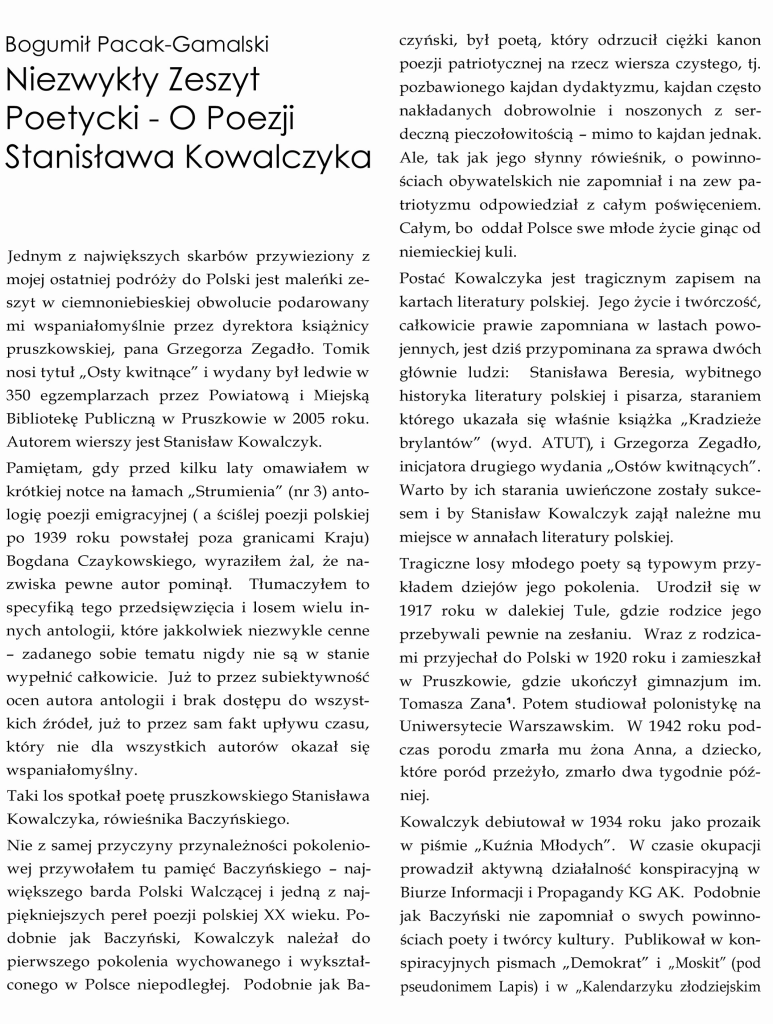
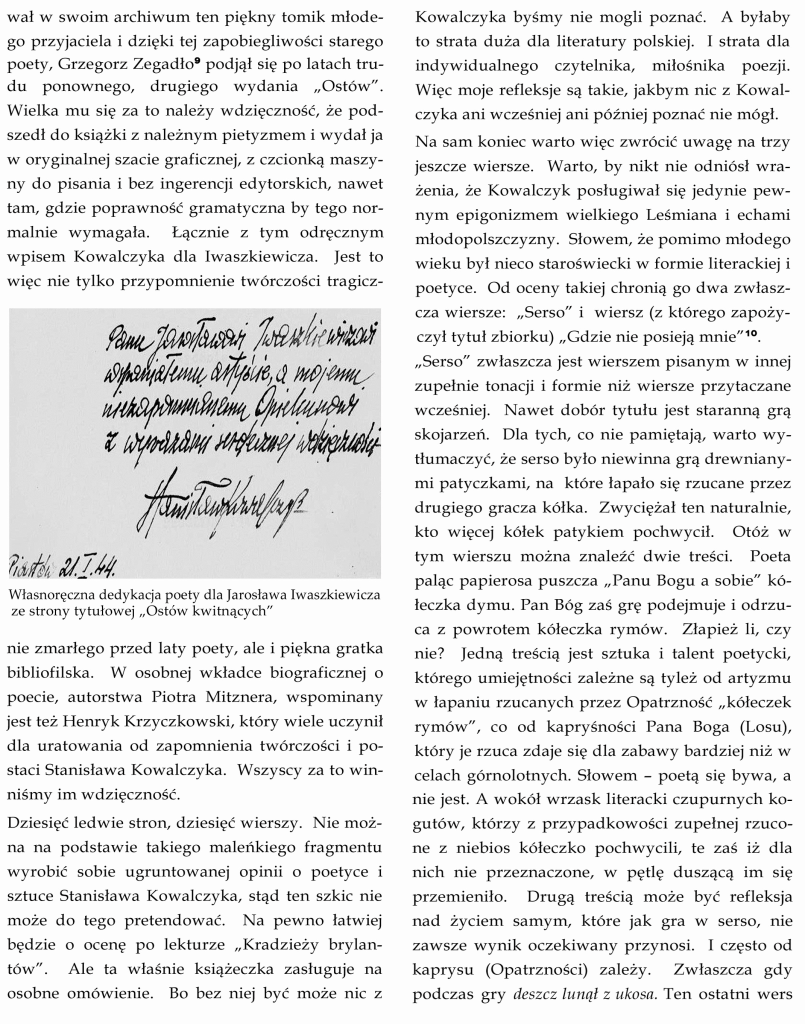
Poniżej publikuję zdjęcie ze stron rocznika “Strumień” (wydanie z 2007) z moim esejem na temat jego twórczości.

Sam, w latach gdy w Pruszkowie mieszkałem (sypiałem raczej, bo mieszkałem de facto w Warszawie, gdzie żył cały mój świat) lubiłem tą drogę do Pęcic. I od tegoż, 2007 roku, na zawsze już mi się z Kowalczykiem będzie ona kojarzyć. Więc: non omnis moriar – dla mnie, Polaka całe życie z literaturą związanego, Stanisław Kowalczyk na zawsze tej literatury ważnym fragmentem pozostał.

Musings on music, art and it’s poetry and echo of Jean-Luc Therrien concert

Bogumil Pacak-Gamalski

When I was a young admirer of classical music, I sought well established, famous musicians. To be at a concert of someone known to be a master, virtuoso of an instrument. To listen to music played the way the music ought to be played. Orchestral or solo, chamber type or powerful experience of full orchestra in a symphony directed by an admired director!  Ah, for young, hungry for excellence youth – that was the pinnacle. I am glad I did it. Solid base, fundament is very helpful. For as long as you are not too timid (I wasn’t) to allow yourself to freely like or dislike certain composition, specific type of music. Art is not a religion. Art is freedom foremost. Of course, it didn’t hurt that I lived in a big city, that was very well known for its affinity for music and no shortage of good concert halls, musicians –  Warsaw. Even in communist times (or perhaps in spite of it), culture flourished in Poland. And (that must be acknowledged) it was affordable, fully supported by the government. The results were not always pleasant for the authorities but wonderful for the public. Art schools of all sorts and levels were also heavily subsidized by the communists. And art was our escape from the dreary and boring life around. There was no shortage of exceptionally talented people in every field of culture. The most difficult task was for writers, the easiest for musicians. Visual arts were somewhere in between. With written or spoken word your intentions (freedom, truth) were clearly visible, audible. So writers and poets had to manipulate, use so called ‘writing in between the lines’ technique. But musicians could escape they eye and furry of the censor much easier.  Particularly (as often was the case) if the censor was not very perceptive or of more feeble then intellectual mind. As it is often the case with censors.

That solid base allowed me to be comfortable to change my tastes in music and musicians. With time I preferred live concerts with younger, knew players, voices, sounds. The masters, after all, are always within arm’s reach on the vinyl, CD’s, online.

It is a marvelous journey to observe a young player blossoming, becoming mature musician. How his playing changes and goes through a metamorphosis. It is thanks to these players that an old, sometime very old, sheet of music that you have heard so many times – becomes alive again, young, vibrant. As it should. The composer might be gone long time ago but the music must be kept alive, current. Otherwise a concert is like a visit in a museum – interesting, enriching but often too long, tiring at the end. Canons are important for technical reasons, not for spirited interpretation. The overwhelming desire must be always kept on the essence of art and being an artist: what story I have to offer to the listener? What is my commentary on beauty or philosophy, ethics and esthetics to a contemporary listener? Of course, the trick is to remain respectful and true to the notes written often very long ago. Being always aware that circumstances and habits change with epochs. But human soul, dreams, emotions remain the same for millennia. Therefore you must try to find in the composition and your study of the composer biography, that inner message, the emotion that should be immortal. The story of human condition. And you, the pianist, violinist, trumpeter, flautist, guitarist must tell the story in your own voice. We, the audience must believe that you are telling us your own story. Just like Hamlet on the theater stage should no longer belong only to Shakespeare – you must become that Hamlet and it must be a contemporary voice. It must be your desire, your despair or triumph that will move us.

Just playing good, properly adhering to the tempo, intervals, tonality, melody will not do much for art. It might be proper, might be even elegant. But it lacks creativity. Just because you go every Sunday to a church to attend mass, know the hymns, the prayers – does not make you pious. In this way art and religion are very similar indeed: they require fervor and passion in the ultimate consumption.

Have been lucky to observe, over the years, many carriers and artists. Known some of them personally, with some have even become friends (that is rewarding but also difficult for someone who writes about their art). Some exceptional, others less but still truthful to their search. Still, others have given up the stage for the safety of teaching careers in musical schools, in academia. Stage is not for everybody. It could be a terrifying place. But it also offers the freedom to fly, to soar. Just make sure that your wings are strong. Rewards could be amazing.

On April 30th, at the evening, I drove over hundred kilometres from Halifax to Lunenburg to listen to a young pianist, Jean-Luc Therrien. He was just about to end (except for one more concert in Antigonish) his tour of Debut Atlantic, well established artistic venue supported by Canada Council for the Arts. Afterwards, I planned to write a review of the concert. But life, at times, has other plans for us and I had to postpone writing it. To a point that typical review becomes obsolete. Your own memory and emotions are no longer as vivid as a day or two later.  Yet, I wanted to mention it and the pianist, for it was a very good musical experience. Worth mentioning.

Alas, on that day I drove to Lunenburg in search of that young passion in music, for new musical meeting with new pianist. Almost like on a first date: with a bit of tension and trepidation but excited and looking forward to it.

The setting was similar to my previous concert outing in Halifax, in St. Andrew United Church, with acclaimed pianist Richard-Hamelin and a young cellist Cameron Crozman. Again, Therrien concert was in an old, Central United Church, with beautiful stain glasses, settled in district filled with gorgeous old churches.

It was such a shame that the venue wasn’t either advertised properly to local community (considering the fact that Lunenburg and its neighbour, Mahon Bay, are  small towns with densely populated smaller downtowns) or the locals are interested only in tourist dollars, not in supporting and admiring culture. The small audience that gathered inside was definitely not disappointed. And the young, smiling and very pleasant pianist did not show lack of enthusiasm for music or respect for listeners.

Perhaps the opening piece, Prelude et dance op.24 by Jacques Hétu was the most difficult to play. Not only for the fact that this Canadian (from Quebec) contemporary composer is probably not very popularly known. It is composed with extensive pedal work and requires a strong, modern piano. I’m afraid that the old, venerable grand piano of Heitzman (best Canadian piano maker in XX century) could not fully reproduce the sound that Hétu intended. Yet, definitely it was a very interesting composition and I listened to it with great interest.

The next part paid off any misgivings in multifold. Third part of great Suite bergamasque – one of the most played and loved Clair de Lune. Heard it so many times played by the greatest pianists. But chased away any thoughts of any comparisons, which would have been unfair. Let the young man play it the way he hears it in his soul. And he did. Maybe a bit timid at the very first phrases but the rest was beautiful. So poetic. With that interpretation he sold me. The rest of the concert I just enjoyed myself.

Jean-Luc Therrien is definitely an emotional pianist. His music comes not only through his fingertips but also from his heart and soul. It is not yet pristine and fully disciplined technically, but it flourishes by full emotional immersion of the pianist. You can always improve your technical skills if talent, luck and perseverance gives a long stage career. But that God’s given touch of emotionality cannot be learnt, it must reside in your soul from the very beginning.

That was seen also in somewhat diabolic prelude of Debussy: the F-sharp minor “What the west wind saw” – fast paced and full of arpeggios composition not for timid pianists.

Therrien finished this part by playing one of the giants of romanticism (Debussy personal hero) Franz Liszt Mefisto Waltz No.1. I must admit that I never liked that composition and do not see it as a musical achievement of this great Romantic pianist and composer.  Therefore can’t offer my personal opinion on Jean-Luc Therrien play of it. It sounded proper – that’s all I can say.

Second part of the concert was difficult and challenging for any pianist. Introduction of modern Canadian composer from Alberta, David McIntyre in “A wild innocence“. It was very short and technically interesting. But in a whole – lacking artistic musical purpose. I suppose, since the entire tour is organized traditionally  by Canadian Council of Arts – the repertoire must include domestic contemporary composers.

True challenge and musical artistic genius was brought by the final piece, Sergei Prokofiev Sonata no.2 op. 4. It is very transformative music composed in times of great upheavals and changes in artistic expression. It is also affected by personal sorrow of Prokofiev due to sudden and tragic death of his close personal friend. Yet, as a true artist, the composer packed the score with much deeper, philosophical discord of great changes on the horizon of humankind. It has parts that seem almost too easy, almost not worthy the title ‘classical music’. Somewhat reminds me of music by Gershwin on the other side of Atlantic at the same time. But it is all misleading. The ‘easiness’ of these parts underscores the other parts of the compositions. One compliments the other. It speaks in new language, different of languages of Debussy, of Liszt, Chopin and Mozart. I thought that Therrien played it splendidly. Emotionally and with great musicality. I could clearly see young Prokofiev overwhelmed with sadness of losing very close friend and escaping to memories and happy times, melodies and finding somehow peace in the finale were he brings all the rhythms, all the movements of previous parts into conclusion. With somewhat stoic understanding, even moments of lightness: nothing is forever, nothing is given in perpetuity. Neither in private life nor in world habits, styles, epochs.  

It was very nice that the small group of listeners  wanted to show the pianist how much they enjoyed his concert and did everything not to stop clapping and almost forced him for a bis. He definitely gave us all big joy and pleasure. The pianist obliged and play a small piece of Robert Schuman’s music. Elegant but not empty. In times of Schuman, in between musical epochs, compositions had to be formed elegantly, while a good composer still could enrich them with true meaning, thought or emotion. Many things could be said about Schuman as a composer – but never that his compositions were not a good music.

Therrien recorded two CD that are worth mentioning: Piano Preludes by American-Spanish label Orpheus Classical ( Claude Debussy Book 1 of Preludes and Franz Liszt Symphonic Poem no.3, S.97 (nota bene: Liszt was the father of this musical form). Therrien arranged it himself for solo piano.

Second of these recording is a CD produced by French label Klarthe. It contains an array of fantaisies by many composers played by duo of Jean-Samuel Bez (violin) and Jean-Luc Therrien (piano, of course).

Of these two recordings, I particularly liked the ‘Piano Preludes’ produced by Orpheus Classical.