Bogumił Pacak-Gamalski

Music! Music is like a song of angels, like flower petals falling down in a slow pirouette. Music is …
Surely it is. Or that’s what you hope for, anyway. But sometimes … sometimes music is just a cacophony of noise. It is actually irritating to your sensory system.
I can’t believe that I’m writing these words. Do you know why? Of course, I will tell you, otherwise I wouldn’t write it. Because of one of the most talented, most popular composers that ever existed – Mozart! And because of two top piano players in Canada for many years now – maestros David Jalbert and Charles Richard-Hamelin. The darlings of the most prestigious stages of the world. I have heard both many times, been on numerous occasions to concerts of Hamelin, and listened to Jalbert’s CDs and CBC Radio performances.
Last Saturday[i] they performed for the very first time together. Playing compositions not separate but composed for two pianos or a composition for four hands. I hoped they would have played separately, their own program of any choice.
And I hoped Mozart had never composed that awful cacophony of his Sonata For Two Pianos in D major, no. K.448.
Or otherwise, I hoped I never went to that concert.
There is my own rule that I’m breaking now: when you have nothing nice to say, then be silent. If it was a concert of a new, fledgling pianist or the first public performance of some young and unknown composer – I wouldn’t say a word. None of it applied in this case, though. It definitely doesn’t matter for Mozart. He is dead for about 250 years and doesn’t care anymore who and what is written about his music. Besides – he left us with many of the best-ever composed works (except this one! LOL).
For the pianists – Halifax is not Carnegie Hall or Warsaw Symphony concert hall (sorry Cecilia Concerts organizers, but let’s face reality; Jalbert and Richard-Hamelin can afford one bad review after many years of a string of good reviews).
One more thing – I will have a few much nicer things to say about the rest of the concert. In particular about absolutely beautiful Divertissement Andantino varié, no. D 823 and Fantasie in F minor, no. D 940, both of Franz Schubert.
I think that at times things just get wrong from the very beginning, before anyone touches a single key on any piano.
Originally the concert was planned for Richard-Hamelin and a young American pianist, Eric Lu. Was really looking forward to it. Very talented young star of the keyboard, Eric Lu is one of these musicians I really wanted to listen to in a live concert, not just recording. When I exchanged notes with him, I told him how much I was looking to this and promised to write my impressions from the concert. As recordings are usually musically perfect – they often lack the emotions, the exchange of the atmosphere between a live audience and an artist, impression insaisissable.
But, as in many ‘wants’, this happened to remain exactly that: inasaissable, unfulfilled. Sudden medical problems prevented him from coming to Halifax. Alas, the tickets were sold, the show must go on.
Richard-Hamelin and the organizers had to quickly find another player and talented David Jalbert agreed to oblige. It is one thing for two pianists to play different compositions in one concert, and totally different for them to play the same music composed for two pianos. Just because you choose two very well-known pianists doesn’t mean they will be the best tandem. One more thing we learned (meaning the audience) is that they … never played together before. Two best Chefs do not guarantee the best dinner cooked together, often it ends in culinary disaster.
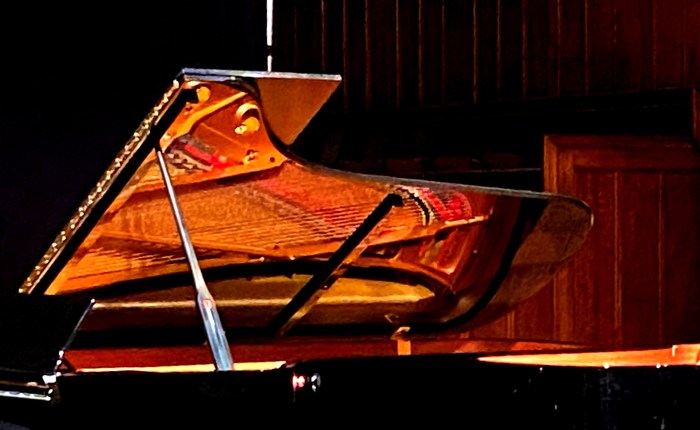
What was the original idea of starting the concert with this insane Sonata in D major K.448 by Mozart – I have no clue. There were really moments when I had to gather my willpower not to just get up and leave this musical nonsense. Noise. Yes, it did have allegro, andante and molto allegro and it was in D major. Could have been in ,Z minor’ as far as I am concerned – the effect would have been the same. The pianists did not help much, either. I thought there was a total disconnection between them. One was playing his own vision, the other – another vision. As you know, in classical music there are (in European instruments) no larger pieces of instruments than the grand piano. It seemed that the distance on that particular evening between these instruments was even larger than the length of these gigantic instruments.
Mozart was twenty-five years old when he composed it. At this age – despite or maybe because of already big popularity and fame – you are not mature enough to measure everything in the right emotions, true perspective. Maybe he felt the stress of the expectations that the young composer must constantly produce new pieces, constantly prove his genius? Not unlike many young artists these days. Sometimes the pressure proves to be too much.
Now, would it sound better if I felt the connection between the pianists? I don’t think so. Guess we will never know. Can’t recall if I ever heard that composition, and therefore can’t compare.
The Andante was at least musically much better. The lyrical melody, even some sort of peace, brought comfort. The best was the end, the Molto Allegro. For many reasons: primo – it was the end of it (LOL); secundo – the pianists finally noticed each other and began to speak in the same language of emotions; tertio – it was the best part of the entire sonata. Beautiful repetitions of the best melodies in the form of rondo.
Rachmaninoff’s ‘Russian Rhapsody’ was composed well and it was delivered much better, too. By that time the pianists made peace with each other and played together, not separately. But the choice was disputable, too. It is definitely not the best work of this brilliant composer. And not truly a full rhapsody, either. Of course – the amount of compositions for two pianos is limited, too. No complaints, though. Had I not been exposed to the fiasco of Mozart’s sonata – I probably would have enjoyed it more.
The best came next. Franz Schubert, whose music I adore. There is so much emotion, and yet so much elegance in it.
Poor Schubert died being very young. It was as he anticipated it – he composed constantly, often in the form of musical sketches, that later were supposed to become a full-fledged larger piece. As was the case of his ‘Lebenssturme’ (Storms of Life), Allegro in A minor, D.947 that he planned to expand to a full sonata. Sadly, he died the same year, never having the chance to expand this (and many other) composition.
Jalbert and Richard-Hamelin by now played in unison, and my dislike of their playing dissipated completely. They took me with Schubert on a wonderful walk, sometimes a run through some park in Germany. Run after love, after romance, after youthful life perchance? With all the desires and pitfalls of that tumultuous age. I so remembered it myself. And that is the pinnacle of a good concert – when the music transfers you outside of the concert hall to some faraway places, times perhaps.
But that was just a taste of the charm of his music … and the ability of both pianists to show if they fully trust and understand each other. The diminutive form of Divertissement on French motifs D.823 (three parts: Opus 63; Andantino varié and Rondo Allegretto. This gem was composed for piano for four hands. Similarly, the final Fantasie in F minor D. 940 was for piano and four hands. That was the cherry on the musical cake. Such ephemeral music! It felt like dancing with angels. The two pianists sitting by the same black and white keyboard melted together as one with four hands. Now everything was making sense, everything was in place and the music took us all to a sphere of magic.
And that is what you want from Art, my friend.

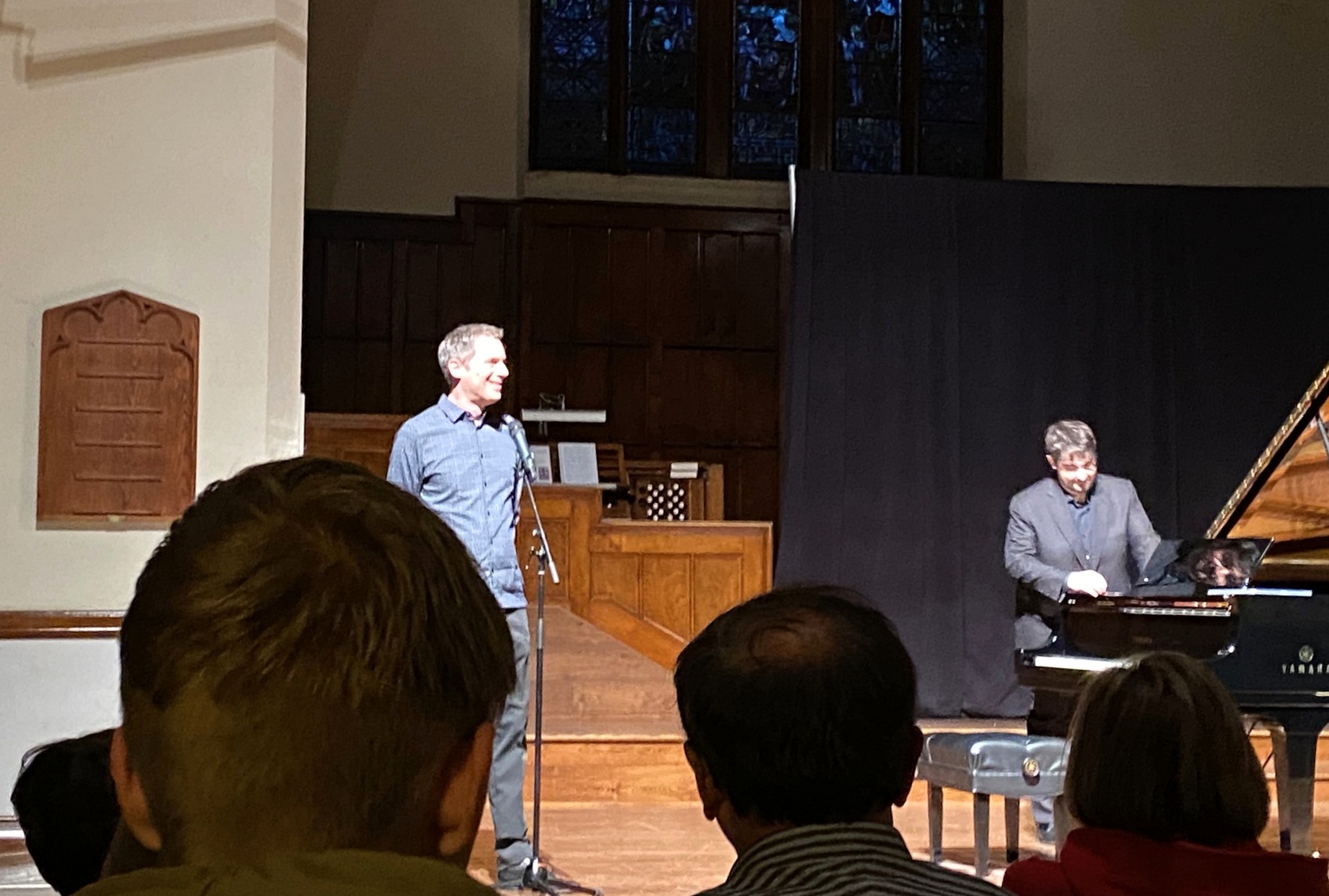

[i] Cecilia Concerts series, Halifax, in St. Andrew Unitarian Church, Apr. 06., 2024





































































 > > Pogwarki < <