Henry Kramer concert in Halifax

Few words of personal explanation. Of my wonderful life with my beautiful husband, lover and partner, John. Life that tragically ended with John passing a year ago. Yet life worth every moment, every second. Music, music – it has been such an important part of our life. Through music – in all forms, shapes, and styles – we understood each other deeper, fully. Like the name given by German composer Felix Mendelssohn (1809-1847) to his ‘Songs without words’. Love truly does not need words. As in any true process of creation, words – if used – are only a mere ornament, part of the mechanical structure. True creation begins and ends in a sphere of senses: sound, smell, touch, feeling. Everything else is just a noise.

Therefore, when I walked that wintery evening from Henry Street to Coburg Street and to St. Andrew Church for my normal rendezvous avec la musique – he walked there with me.
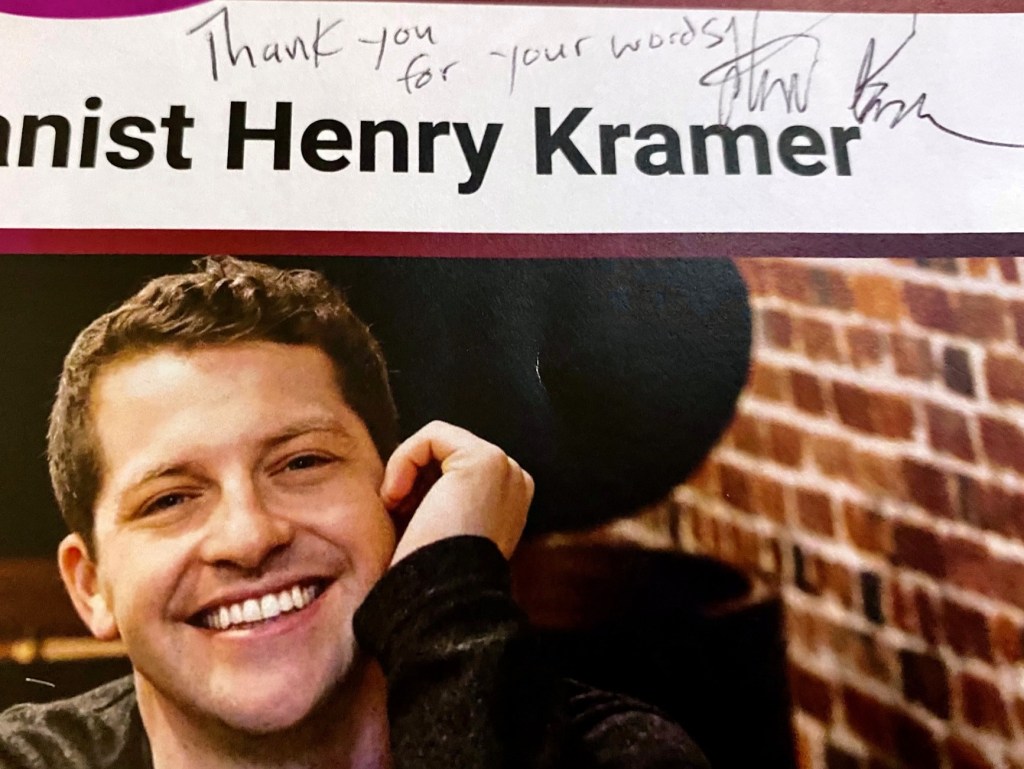
What a wonderful rendezvous it was! It was an immense pleasure to listen to the music played by the most gifted pianist, Henry Kramer. Kramer is an American musician recently being offered a teaching position in the Faculty of Music at Université de Montréal, and because of the proximity, he was able to come to Halifax and give us a taste of talent. What a treat, indeed.

One award (among many others) I have to mention is the American National Chopin Piano Competition in Miami, where he claimed the 6th spot in 2010 (the First Place automatically awards the winner a spot in the top piano competitions of the world – the Warsaw International Chopin Competition). But there was a connection to that famous Warsaw Competition: among his jurors was the former  3rd place winner of the said International Warsaw Competition, Piotr Paleczny. I was lucky enough to hear Paleczny playing many years ago during that Competition in Warsaw and to know him personally. He was, as a young fellow at that time, a very sweet guy. And truly fantastic piano player.

Henry Kramer missed that Warsaw Competition ticket – but he did not miss the 2016 prestigious and top-ranking Queen Elisabeth Competition in Brussels. And he got the Second Prize – that is a ticket to just about all concert halls in the piano world.

I was not in Miami to hear him personally there, but remember his concert in Seattle. Remember him well enough to make a note of his playing: don’t forget his name because you will hear of him.

Back to Halifax. Have a chance years later to do that. To be at his concert. How can I describe the overall feeling, reaction? I will use a term I don’t remember using before in any of my musical reviews:

Henry Kramer is a pianist of a very elegant way of playing. That it is. Elegant way of playing. You could say: bravado, astonishing, lively, emotional, technically brilliant. But after listening to him intently, paying attention to how he treats not only the music but the entire piece that makes a player, his arms and body and keyboard, pedals, and the entire massive instrument a one-piece, one symbolic union – that is the term that came to me: grace and elegance.

And what a good term, when you play music submerged in a very specific time of European chamber music of early romantics. Time of Shuberts, Mendelssonhs, and to a lesser degree even Liszts (Liszt belongs more to the next epoch – Romanticism). A time when musicians produce an extraordinary amount of compositions (almost in manufacture-like tempo) to appear in a multitude of salons of political, and Church dignitaries, aristocrats and extra-rich townsfolks. Time of Early Romantics. These were not huge concerthalls, or musical theatres (there were some in big cities – but that was a rarity, not a rule). The salon for chamber music was small, and the guests were not as plentiful. If you play the same music more than a few times – the opinion arises that you are done, finished. You emptied yourself and can’t compose anything anymore. So they did compose. A lot. Franz Schubert composed 20 sonatas (not all of them in a finished form) and a number of larger pieces: 12 (13?) symphonies; circa 10 Masses; over …. 1000 (that is one thousand, no mistake) songs with at least one instrument and many more occasional pieces in different form. No, he was not eighty years old, when died. He was  … thirty-one.  Show me a contemporary composer, who composed half of that volume, I dare you.

Was he a great composer? No, by any means. But he was an important composer and very talented. Had he lived decades longer, had he achieved financial independence and powerful support from powerful patrons – chances are he would have had time and space to compose a few timeless and extraordinaire pieces of music. It was also a time when music was composed in a very strict and form-fitting format. Just as poetry in classic times. The next generation started slowly to dismantle that construct. And then came Gustav Mahler, followed by Schoenberg with his Second Viennese School and music was never the same again, LOL.   

The old Saint Andrew Church in Halifax was a perfect setting for Schubert’s music and for the elegant style of Henry Kramer. The main nave offers wonderful acoustic and being of Anglican (in Canadian, United Church form) type is not too ornate and void of the weight and ballast of Catholic big churches.

From the moment Kramer appeared on the stage with a short introduction to the music – he won the audience with his pleasant way of greeting and talking. There was no ‘pomp and circumstance’ – just a warm and subdued tone.

From the first keystrokes, he was very attentive to musical detail, to the phrasing. Schubert’s Piano Sonata in A Major seemed to be written for him. The Allegro Moderato at the beginning was lovely. It’s a relatively robust tempo but the two melodies and two distinctive themes lead to a lovely passage. And his brilliant way of slowing ‘things down’ in Andante is just that: have time to ponder, exclaim, and reflect. At a certain moment, a listener not familiar with this work might think – that it is, finite. Perhaps little annoyed that it happened so soon, LOL.  Kramer used the intervals splendidly, they were very pronounced as the composer intended.

But forget the intervals, forget the delicacies, the sublime. Here comes the Allegro. Better check your seatbelts! This is a pianist (a good pianist) paradise: time to awe and conquer the audience. And he did. The bravura almost and brilliant style shine here with dances, and passages. The keyboard is used in its entire length and the pianist must grow two or three more fingers, LOL. But it is truly a pleasure to listen to it. Even if you are not an enthusiast of early Romantics (just like me) – I still can come and listen to the entire sonata again – just to enjoy the finale! Bravissimo for the artist!

After Schubert music, Kramer opens to us the world of two siblings, contemporaries of Schubert: Fanny Mendelssohn – Hensel (1805-1847) and Felix Mendelssohn Bartholdy (1809 – 1847). Both siblings were very close to each other.
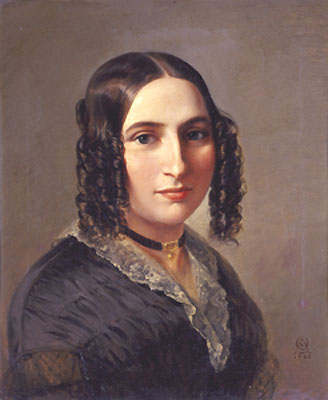
Fanny Mendelssohn

Felix was well well-known and very much accomplished composer in Berlin’s circle. His sister never (partly because of her father’s opposing views) accomplished such a fame during her lifetime but her compositions show a good measure of talent and ability. She was also very respected as a musician by her devoted brother, who often asked for her opinion and advice in his own works. As it happens from all their works the most famous ones often played even now are their songs. Or rather ‘songs without words’ (Lieder ohne Worte), as was the name Felix gave to his most famous composition. There is a story that at one-time friend of Felix offered him to write words for his ‘songs’. The composer is said to respond: “What the music I love expresses to me, is not thought too indefinite to put into words, but on the contrary, too definite.” What a lovely and indeed precise response!
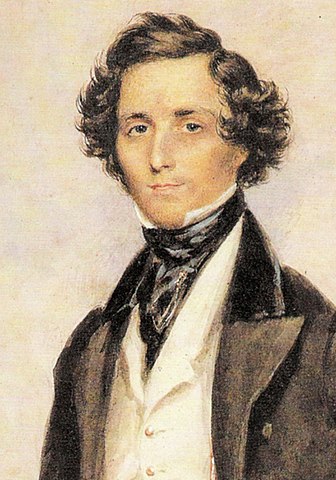
Felix Mendelssohn

The pianist played Fanny’s 4 Lieder for Piano, Op. 8 (no.2 Andante con espressione and No.3 Larghetto), and Felix’s Songs Without Words Op. 19 in E Major and Op. 67 in F-sharp minor. It was a pure musical pleasure. His elegant way of playing was at its best. The depth of emotions coming from the sound he was producing was truly touching. I remembered years ago when I listened to the incomparable Jan Lisiecki playing the extremely difficult and technically challenging piece of Ravel’s Gaspard de la nuit and I thought: how this very sweet and happy young man (I have known Jan Lisiecki since he was fifteen years old very sweet boy when I did my first interview with him) can evoke the atmosphere of pure horror and terror so plainly, so vividly? Talked after his play with him about my question. And his answer was as plain as it could be: it is not enough just to play – you have to feel it inside you, you have to take that symbolic journey to that place, that moment and then transfer it to the tips of your fingers. Just playing every note, in exact tempo is not always enough. And I understood that instance what he meant. Of course. It is so plain. The feeling, the emotion. Listen to famous, dramatic singers of opera! The words are almost comical often. If you just sing them – you could almost laugh, like a satire, not a tragedy. It is the emotion, the timbre of the note you play, and the spirit of the sound you produce that signifies emotions. This is exactly what Kramer achieved when he played the Songs Without Words.  And I repeat: with that musical elegance.

But even the best of us must give up sometimes the comforts of elegance. When you deal with Franz Liszt’s Piano Sonata in B minor, S. 178 you really have no choice. When the Paganini of grand piano composes music that should rival Paganini’s Caprices – elegance and etiquette go away. I often compare him to Tina Turner and her singing career. Was it elegant? Heaven’s forbid, no! Was it great? Of course, it was a wonderful madness! Would Henry Kramer, that elegant musician be able to play such music, to forgo his comfort zone?

Oh, yes. He did it to my delight. That was not a summery evening stroll through the meadow. It was a full gallop! Not even of one horse – it was a herd of wild horses. What a choice for the finale and what a stamina to do it after already playing so many pieces.

Liszt’s sonata is one of his late compositions when he composed mostly for pleasure and not to gain popularity or earn money. It is in a way also a break with the established way musical forms were composed. Sonata, as a sonnet in poetry, has very strict rules.  Three, sometimes four pieces. You state your musical subject in the first part, elaborate more freely on it in the middle, and finish with a recapitulation of the first statement. But Liszt decided to do away with two distinct pieces and used just one. Try writing sonnets in the form of elegies. In a way, he liberated composers from the strict and tight corset of existing musical architecture. Today everyone understands it. We have gone through modernity and postmodernity. But at that time … it received scorn from all the greatest composers. Clara Schuman (Liszt dedicated it to Robert Schuman) said it was ‘merely a blind noise’; Johannes Brahms apparently fell asleep while Liszt performed it; similar scorn was shown by Anton Rubinstein. The only exception was Richard Wagner. Yet, by the early XX century that ‘blind noise’ was recognized as the pinnacle of Liszt compositions. Times are changing.

I can’t tell how many times I heard that amazing, powerful compositions being played by many wonderful pianists. In a way, my favorite was the recording of it by Kristian Zimerman, one of the outstanding pianists of my generation in the entire world.  

But the way Kramer played it was more than satisfied. I listened with full abandonment and total ecstasy of my sensory powers. No surprise that after that accomplishment the audience would not let him leave the stage. The standing ovation had no end. And fully earned. To no surprise, he had no choice but to thank the audience with two extra encores.

We finished with a nice chat and my congratulations for very well-presented program and excellent play. But I started the conversation by thanking him for transferring me that evening from Saint Andrew Church in Halifax to Carnegie Hall or to Vienna Philharmonics.
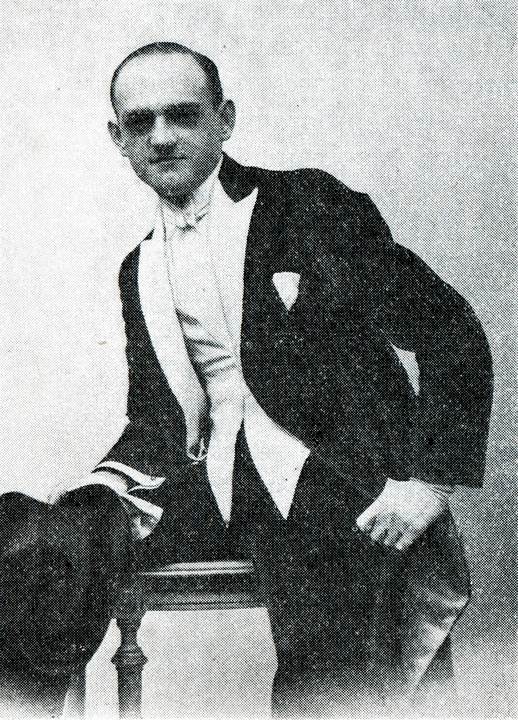

Wąsik, Kamiński i … Sempoliński

Ludwik Sempoliński

Oglądam posiedzenia Sejmu, a już zwłaszcza (ostatnio) posiedzenia Sejmowej Komisji Śledczej, która okazuje się lepsza od wielu tanich kryminałów.

Ale nad to wszystko najbardziej lubiłem zamieszanie wobec dwóch średniego wieku kryminalistów. Światek przestępczy z ‘wyższej półki’. Czasem lepszy nawet niż ten ze starego Bródna na warszawskiej Pradze. Otóż tych dwóch kryminalistów, mimo legalnego wyroku sądowego za czasów poprzedniej ekipy nie siedziało w ogóle. Nawet w areszcie. Pan Prezydent bardzo ich sobie polubił. Co trochę jest niesmaczne, bo i pan Prezydent jest żonaty i żonaci są ci rzezimieszkowi urzędnicy służb wywiadowczych. Trochę taka nadwiślańska wersja Agenta 07. Tyle, że agenciarze nadwiślańscy nie bronili państwa a je trochę tak jakby rozwalali od środka. Po zakończeniu pracy w tych agencjach wewnętrznego wywiadu (współczesna forma UB z lat znanych starszym) agencików wybrano staraniem opiekuńczej partii sprawiedliwości i ziobrystów do Sejmu. Tu ich nikt nie ruszy. A gdy ruszyć się starano poprzez Sądy – to pan Prezydent natychmiast ułaskawił. Okazało się bezprawnie, bo aktu łaski nie można stosować wobec wyroku, który jeszcze nie zakończył swej drogi i nie uzyskał stempelka prawomocności. Przeoczenie. Mógł pan Prezydent naprawić i łaski udzielić ponownie, gdy wyrok był już prawomocny. Ale się uwziął –  jestem Prezydentem Polski i nie będę dwa razy tego samego robił, prawomocny-smoczny, guzik mnie to obchodzi: jak ułaskawiam to ułaskawiam i dupy mi więcej tym nie zawracajcie! Mocny chłop, z jajami (co dla wielu było zaskoczeniem). Ale czasy się trochę zmieniły. Nowa władza do tej władzy doszła i chciała jednak agencików do ciupy wsadzić.  

Więc prezydent, facio sprytny zawołał Wąsika i Kamińskiego do Pałacu Prezydenckiego. Tu wam kochanieńcy nic nie grozi. Do własnej piersi przytulę i od kul uchronię.  A tak ich ściskał, tak obejmował, że aż łzy się zbierały ale i nieco jednak niewygodne zażenowanie mną wstrząsnęło. Ja wiem, słyszałem te legendy o pewnej erotycznej stronie cel więziennych – ale żeby tak publicznie, w Sali pałacu prezydenckiego, przed kamerami?!

I tu mi ten zapomniany a wspaniały, dawno temu zmarły Ludwik Sempoliński się przypomniał. Nienagannie zawsze we fraczku, ze swoimi szmoncesami. Jakże to on pięknie ujął, tą przyjaźń, to oczarowanie, pewien wręcz erotyzm uścisku i opiekuńczości mężczyzny wobec mężczyzny:

„… ten wąsik, ach ten wąsik, ten gest, ten ruch, ten pląsik! Titina, ach Titina – to cała piosnka ma! tralalala la, tralalal la …”  

Już słyszę, jak z płyty starej Pan Prezydent puszczał ten szlagier w Pałacu, emocjonując się sytuacją. I trochę jednak mi żal biednej Pani Prezydentowej … Bo ona wąsika wszak nie ma …

Ruling of the International Court of Justice in a case of South Africa against Israel

45. The Palestinians appear to constitute a distinct “national, ethnical, racial or religious group”, and hence a protected group within the meaning of Article II of the Genocide Convention. The Court observes that, according to United Nations sources, the Palestinian population of the Gaza Strip comprises over 2 million people. Palestinians in the Gaza Strip form a substantial part of the protected group. 46. The Court notes that the military operation being conducted by Israel following the attack of 7 October 2023 has resulted in a large number of deaths and injuries, as well as the massive destruction of homes, the forcible displacement of the vast majority of the population, and extensive damage to civilian infrastructure. While figures relating to the Gaza Strip cannot be independently verified, recent information indicates that 25,700 Palestinians have been killed, over 63,000 injuries have been reported, over 360,000 housing units have been destroyed or partially damaged and approximately 1.7 million persons have been internally displaced (see United Nations Office for the Coordination of Humanitarian Affairs (OCHA), Hostilities in the Gaza Strip and Israel reported impact, Day 109 (24 Jan. 2024)).

47. The Court takes note, in this regard, of the statement made by the United Nations UnderSecretary-General for Humanitarian Affairs and Emergency Relief Coordinator, Mr Martin Griffiths, on 5 January 2024: “Gaza has become a place of death and despair. . . . Families are sleeping in the open as temperatures plummet. Areas where civilians were told to relocate for their safety have come under bombardment. Medical facilities are under relentless attack. The few hospitals that are partially functional are overwhelmed with trauma cases, critically short of all supplies, and inundated by desperate people seeking safety. A public health disaster is unfolding. Infectious diseases are spreading in overcrowded shelters as sewers spill over. Some 180 Palestinian women are giving birth daily amidst this chaos. People are facing the highest levels of food insecurity ever recorded. Famine is around the corner. For children in particular, the past 12 weeks have been traumatic: No food. No water. No school. Nothing but the terrifying sounds of war, day in and day out. Gaza has simply become uninhabitable. Its people are witnessing daily threats to their very existence — while the world watches on.” (OCHA, “UN relief chief: The war in Gaza must end”, Statement by Martin Griffiths, Under-Secretary-General for Humanitarian Affairs and Emergency Relief Coordinator, 5 Jan. 2024.)

48. Following a mission to North Gaza, the World Health Organization (WHO) reported that, as of 21 December 2023: “An unprecedented 93% of the population in Gaza is facing crisis levels of hunger, with insufficient food and high levels of malnutrition. At least 1 in 4 households are facing ‘catastrophic conditions’: experiencing an extreme lack of food and starvation and having resorted to selling off their possessions and other extreme measures to afford a simple meal. Starvation, destitution and death are evident.” (WHO, “Lethal combination of hunger and disease to lead to more deaths in Gaza”, 21 Dec. 2023; see also World Food Programme, “Gaza on the brink as one in four people face extreme hunger”, 20 Dec. 2023.)

49. The Court further notes the statement issued by the Commissioner-General of the United Nations Relief and Works Agency for Palestine Refugees in the Near East (UNRWA), Mr Philippe Lazzarini, on 13 January 2024: “It’s been 100 days since the devastating war started, killing and displacing people in Gaza, following the horrific attacks that Hamas and other groups carried out against people in Israel. It’s been 100 days of ordeal and anxiety for hostages and their families.  In the past 100 days, sustained bombardment across the Gaza Strip caused the mass displacement of a population that is in a state of flux constantly uprooted and forced to leave overnight, only to move to places which are just as unsafe. This has been the largest displacement of the Palestinian people since 1948. This war affected more than 2 million people the entire population of Gaza. Many will carry lifelong scars, both physical and psychological. The vast majority, including children, are deeply traumatized. Overcrowded and unsanitary UNRWA shelters have now become ‘home’ to more than 1.4 million people. They lack everything, from food to hygiene to privacy. People live in inhumane conditions, where diseases are spreading, including among children. They live through the unlivable, with the clock ticking fast towards famine. The plight of children in Gaza is especially heartbreaking. An entire generation of children is traumatized and will take years to heal. Thousands have been killed, maimed, and orphaned. Hundreds of thousands are deprived of education. Their future is in jeopardy, with far-reaching and long-lasting consequences.” (UNRWA, “The Gaza Strip: 100 days of death, destruction and displacement”, Statement by Philippe Lazzarini, Commissioner-General of UNRWA, 13 Jan. 2024.)

50. The UNRWA Commissioner-General also stated that the crisis in Gaza is “compounded by dehumanizing language” (UNRWA, “The Gaza Strip: 100 days of death, destruction and displacement”, Statement by Philippe Lazzarini, Commissioner-General of UNRWA, 13 Jan. 2024).

51. In this regard, the Court has taken note of a number of statements made by senior Israeli officials. It calls attention, in particular, to the following examples. 52. On 9 October 2023, Mr Yoav Gallant, Defence Minister of Israel, announced that he had ordered a “complete siege” of Gaza City and that there would be “no electricity, no food, no fuel” and that “everything [was] closed”. On the following day, Minister Gallant stated, speaking to Israeli troops on the Gaza border: “I have released all restraints . . . You saw what we are fighting against. We are fighting human animals. This is the ISIS of Gaza. This is what we are fighting against . . . Gaza won’t return to what it was before. There will be no Hamas. We will eliminate everything. If it doesn’t take one day, it will take a week, it will take weeks or even months, we will reach all places.” On 12 October 2023, Mr Isaac Herzog, President of Israel, stated, referring to Gaza: “We are working, operating militarily according to rules of international law. Unequivocally. It is an entire nation out there that is responsible. It is not true this rhetoric about civilians not aware, not involved. It is absolutely not true. They could have risen up. They could have fought against that evil regime which took over Gaza in a coup d’état. But we are at war. We are at war. We are at war. We are defending our homes. We are protecting our homes. That’s the truth. And when a nation protects its home, it fights. And we will fight until we’ll break their backbone.” On 13 October 2023, Mr Israel Katz, then Minister of Energy and Infrastructure of Israel, stated on X (formerly Twitter): “We will fight the terrorist organization Hamas and destroy it. All the civilian population in Gaza is ordered to leave immediately. We will win. They will not receive a drop of water or a single battery until they leave the world.”

53. The Court also takes note of a press release of 16 November 2023, issued by 37 Special Rapporteurs, Independent Experts and members of Working Groups part of the Special Procedures of the United Nations Human Rights Council, in which they voiced alarm over “discernibly genocidal and dehumanising rhetoric coming from senior Israeli government officials”. In addition, on 27 October 2023, the United Nations Committee on the Elimination of Racial Discrimination observed that it was “highly concerned about the sharp increase in racist hate speech and dehumanization directed at Palestinians since 7 October”.

54. In the Court’s view, the facts and circumstances mentioned above are sufficient to conclude that at least some of the rights claimed by South Africa and for which it is seeking protection are plausible. This is the case with respect to the right of the Palestinians in Gaza to be protected from acts of genocide and related prohibited acts identified in Article III, and the right of South Africa to seek Israel’s compliance with the latter’s obligations under the Convention.

78. The Court considers that, with regard to the situation described above, Israel must, in accordance with its obligations under the Genocide Convention, in relation to Palestinians in Gaza, take all measures within its power to prevent the commission of all acts within the scope of Article II of this Convention, in particular: (a) killing members of the group; (b) causing serious bodily or mental harm to members of the group; (c) deliberately inflicting on the group conditions of life calculated to bring about its physical destruction in whole or in part; and (d) imposing measures intended to prevent births within the group. The Court recalls that these acts fall within the scope of Article II of the Convention when they are committed with the intent to destroy in whole or in part a group as such (see paragraph 44 above). The Court further considers that Israel must ensure with immediate effect that its military forces do not commit any of the above-described acts.

79. The Court is also of the view that Israel must take all measures within its power to prevent and punish the direct and public incitement to commit genocide in relation to members of the Palestinian group in the Gaza Strip.

80. The Court further considers that Israel must take immediate and effective measures to enable the provision of urgently needed basic services and humanitarian assistance to address the adverse conditions of life faced by Palestinians in the Gaza Strip.

81. Israel must also take effective measures to prevent the destruction and ensure the preservation of evidence related to allegations of acts within the scope of Article II and Article III of the Genocide Convention against members of the Palestinian group in the Gaza Strip.

82. Regarding the provisional measure requested by South Africa that Israel must submit a report to the Court on all measures taken to give effect to its Order, the Court recalls that it has the power, reflected in Article 78 of the Rules of Court, to request the parties to provide information on any matter connected with the implementation of any provisional measures it has indicated. In view of the specific provisional measures it has decided to indicate, the Court considers that Israel must submit a report to the Court on all measures taken to give effect to this Order within one month, as from the date of this Order. The report so provided shall then be communicated to South Africa, which shall be given the opportunity to submit to the Court its comments thereon.

83. The Court recalls that its Orders on provisional measures under Article 41 of the Statute have binding effect and thus create international legal obligations for any party to whom the provisional measures are addressed (Allegations of Genocide under the Convention on the Prevention and Punishment of the Crime of Genocide (Ukraine v. Russian Federation), Provisional Measures, Order of 16 March 2022, I.C.J. Reports 2022 (I), p. 230, para. 84).

86.

1) For these reasons, THE COURT, Indicates the following provisional measures: (1) By fifteen votes to two,

The State of Israel shall, in accordance with its obligations under the Convention on the Prevention and Punishment of the Crime of Genocide, in relation to Palestinians in Gaza, take all measures within its power to prevent the commission of all acts within the scope of Article II of this Convention, in particular: (a) killing members of the group; (b) causing serious bodily or mental harm to members of the group; (c) deliberately inflicting on the group conditions of life calculated to bring about its physical destruction in whole or in part; and (d) imposing measures intended to prevent births within the group; IN FAVOUR: President Donoghue; Vice-President Gevorgian; Judges Tomka, Abraham, Bennouna, Yusuf, Xue, Bhandari, Robinson, Salam, Iwasawa, Nolte, Charlesworth, Brant; Judge ad hoc Moseneke; AGAINST: Judge Sebutinde; Judge ad hoc Barak;

(2) By fifteen votes to two, The State of Israel shall ensure with immediate effect that its military does not commit any acts described in point 1 above; IN FAVOUR: President Donoghue; Vice-President Gevorgian; Judges Tomka, Abraham, Bennouna, Yusuf, Xue, Bhandari, Robinson, Salam, Iwasawa, Nolte, Charlesworth, Brant; Judge ad hoc Moseneke; AGAINST: Judge Sebutinde; Judge ad hoc Barak;

(3) By sixteen votes to one, The State of Israel shall take all measures within its power to prevent and punish the direct and public incitement to commit genocide in relation to members of the Palestinian group in the Gaza Strip; IN FAVOUR: President Donoghue; Vice-President Gevorgian; Judges Tomka, Abraham, Bennouna, Yusuf, Xue, Bhandari, Robinson, Salam, Iwasawa, Nolte, Charlesworth, Brant; Judges ad hoc Barak, Moseneke; AGAINST: Judge Sebutinde;

(4) By sixteen votes to one, The State of Israel shall take immediate and effective measures to enable the provision of urgently needed basic services and humanitarian assistance to address the adverse conditions of life faced by Palestinians in the Gaza Strip; IN FAVOUR: President Donoghue; Vice-President Gevorgian; Judges Tomka, Abraham, Bennouna, Yusuf, Xue, Bhandari, Robinson, Salam, Iwasawa, Nolte, Charlesworth, Brant; Judges ad hoc Barak, Moseneke; AGAINST: Judge Sebutinde; –

(5) By fifteen votes to two, The State of Israel shall take effective measures to prevent the destruction and ensure the preservation of evidence related to allegations of acts within the scope of Article II and Article III of the Convention on the Prevention and Punishment of the Crime of Genocide against members of the Palestinian group in the Gaza Strip; IN FAVOUR: President Donoghue; Vice-President Gevorgian; Judges Tomka, Abraham, Bennouna, Yusuf, Xue, Bhandari, Robinson, Salam, Iwasawa, Nolte, Charlesworth, Brant; Judge ad hoc Moseneke; AGAINST: Judge Sebutinde; Judge ad hoc Barak;

(6) By fifteen votes to two, The State of Israel shall submit a report to the Court on all measures taken to give effect to this Order within one month as from the date of this Order. IN FAVOUR: President Donoghue; Vice-President Gevorgian; Judges Tomka, Abraham, Bennouna, Yusuf, Xue, Bhandari, Robinson, Salam, Iwasawa, Nolte, Charlesworth, Brant; Judge ad hoc Moseneke; AGAINST: Judge Sebutinde; Judge ad hoc Barak.

Done in English and in French, the English text being authoritative, at the Peace Palace, The Hague, this twenty-sixth day of January, two thousand and twenty-four, in three copies, one of which will be placed in the archives of the Court and the others transmitted to the Government of the Republic of South Africa and the Government of the State of Israel, respectively. (Signed) Joan E. DONOGHUE, President.

  1. https://www.icj-cij.org/sites/default/files/case-related/192/192-20240126-ord-01-00-en.pdf ↩︎

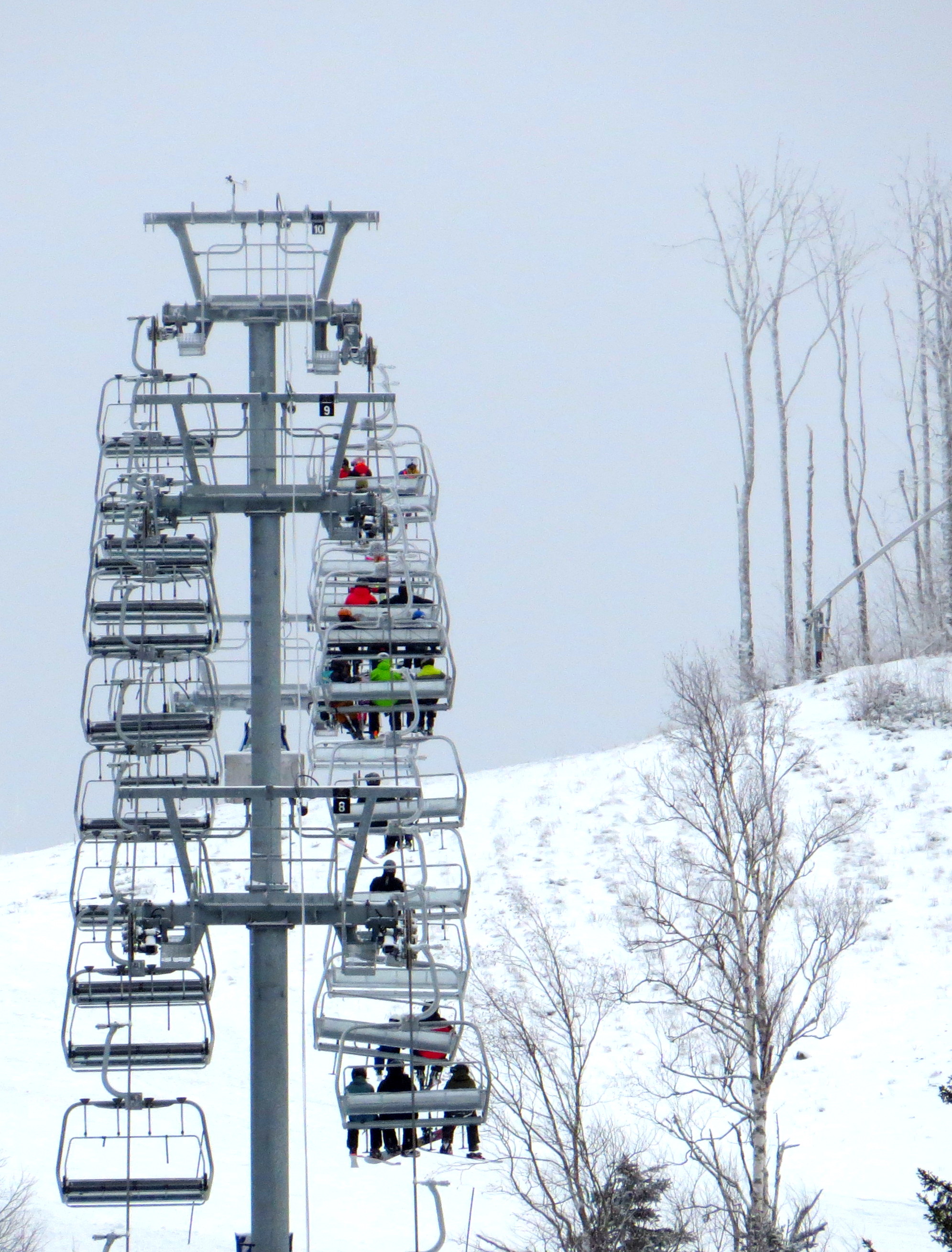
Skiing in Nova Scotia

Have not skied since I left Vancouver. But my last season was probably a year before that. In a dramatic way. Drama and I seem to go in pairs, LOL. My skis and boots were – to say it politely – a bit out of style and advanced in age. Last time I wanted them to be professionally sharpened they said there is not much more steel to sharpen. So I did it myself. The boots needed replacement, too. But didn’t change them. My last skiing was on Mount Seymour overlooking the entire Greater Vancouver. Just the views were spectacular: the entire Indian Arm fiord, Burrard Inlet, Burnaby, Fraser River, Surrey, Vancouver, and the Salish Sea. Breathtaking. That day was foggy, though. Some lifts were closed due to poor visibility. I suppose, because of that the parking lot was almost empty. But the lift going to the peak with the wonderful Black Diamond (advanced) trail downhill was open. I was the only one ‘in the line’ to the lift! I knew the vistas by heart anyway, so I was happy. Went down once and ran quickly for another ride after they warned me that they would shut it down soon due to the poor visibility. Right from the top of the lift, I took a slightly different route, more steep but under the lifts – that way I could just follow the lift and not get lost in the vast terrain covered with fog. Smart. But the trail was narrow and bumpy. After hitting one of the moguls … I went down and one of my skis went the other way, not far though. Once I retrieved it, strangely the boot would not fit into the bindings. What the …, I thought, and pushed it stronger… that is when the boot actually disintegrated, and fell apart in two separate pieces, LOL. A ski boot is not something you can tie or put together, no Jose, LOL. When I finally got back to the lift base with just one boot, the other foot in socks only – the operators couldn’t believe my story. They told me that were starting to worry and were just going to send a patrol to look for me, LOL.  That was my last skiing … seven years ago.

I never bothered to buy new equipment in Nova Scotia – it is a gorgeous province for hiking and swimming. But skiing – really?  There are two ski hills/resorts. And they are – hills. Not mountains. Went to one once during the summer, near Windsor. And decided not to spend a lot of money on new equipment to use on these  … ‘elevated terrain’ resorts. I am not any sort of expert skier, high achiever and show off. But c’mon – for the past almost 50 years I have skied in the high Polish Tatra Mountains (on Kasprowy Wierch resort, 2000 m elevation), and later in the high Rocky Mountains (Banff, Sunshine Valley, Lake Louise, 2600 m elevation) almost all other smaller resorts in BC, and of course Olympic Whistler Resort.  Out of all of them (that would include wonderful and definitely overpriced Whistler) the Lake Louise Ski Resort and Sunshine Village in Banff National Park are without any doubt the best. It is just ski paradise there.

Yet, yesterday I felt so down with the neither winter nor fall weather in Halifax recently. Look at the map for the other resort in Nova Scotia – Wentworth. I know this northern part of our province because of my regular drives to Pictou. These hills there are actually mountains, not high mountains by any stretch of the imagination but mountains nonetheless. Checked the prices of tickets for afternoon/evening skiing and voila – I could buy a senior pass! Sixty-five bucks – with full equipment rental. The same pleasure would cost me over three hundred dollars in Whistler! That is insanity.

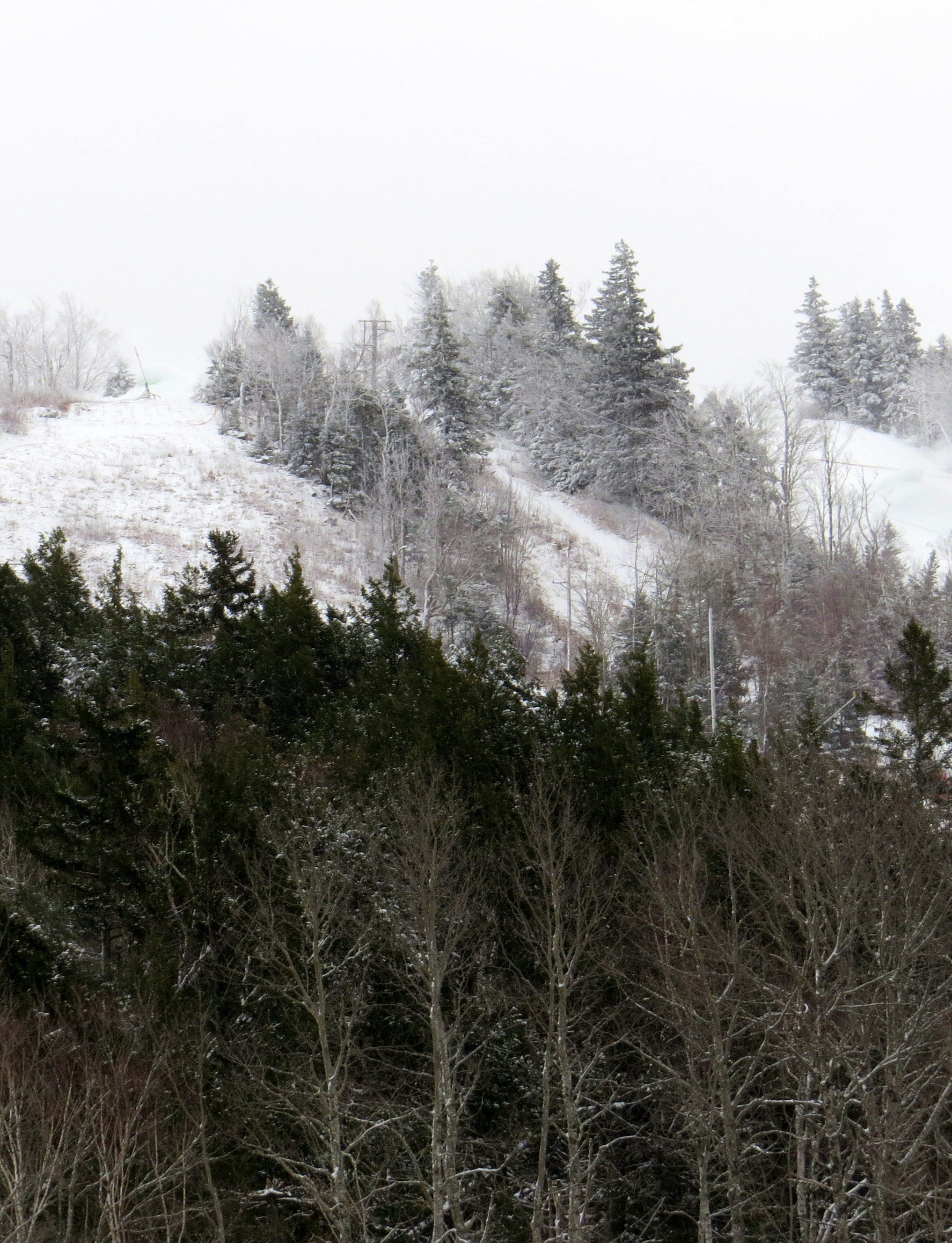
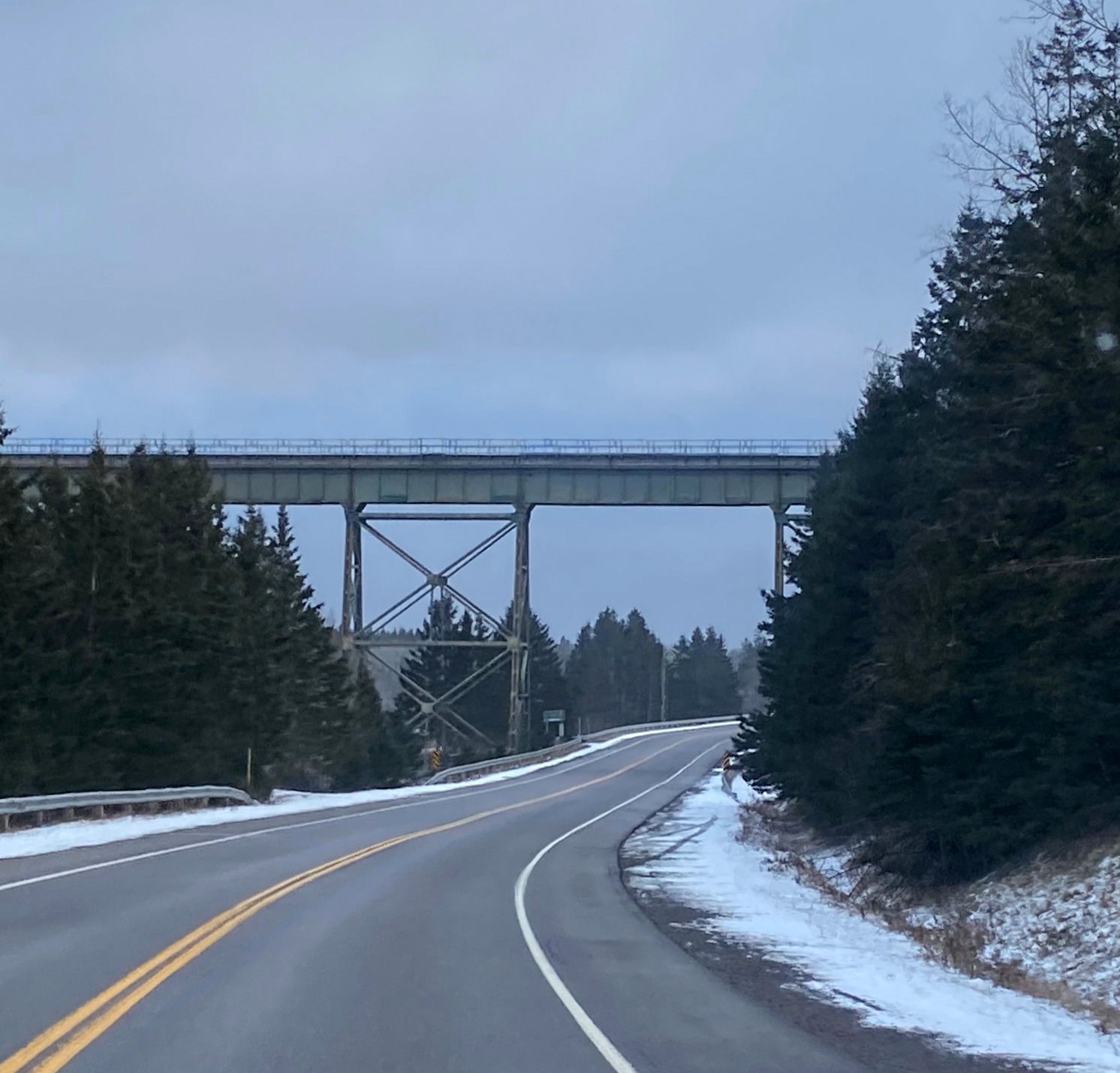
I bought my tickets online and off I went today. And what a wonderful drive past Truro. Just before the New Brunswick border, take Highway#o4. Very scenic this time of the year, with snow-covered forests and hills to the north. Probably beautiful during late summer and autumn. Traffic was less than light and I could enjoy the scenery. To my surprise, the ski area was not bad at all. No comparison between BC and Alberta – but it was actually a ski area not bad at all. I really enjoyed it. Had to be careful because the snow really was not coming there, either. Yes, a bit – but not nearly enough for skiing. Therefore all trails use mechanical snow-making which is very different and produces a fine texture and depth coverage.  Watch out for plentiful icy spots. But you definitely can ski. Also, it was the first time I used the new type of short skies (no one uses the old long ones anymore, LOL). Mind you, in my time the measure of skis was simple: stand straight, raise your arm straight u,p and make sure the ski tips reach your palm. When the attendant asked me if I wanted shorter or longer skis, I naturally said: longer. And she gave me a pair, I looked at them and said: but longer in adult sizes, not a child. She looked at me and replied: they are the longer adult ski. I almost laugh. It is actually easier to make turns in the short ski but still felt funny. Old habits die slow I guess, and welcome to the XXI century, LOL.    The Black Diamond trails were closed due to the lack of snow, but the advanced ones were very nice, and fast if you wanted. Couldn’t bring myself to use the Easy ones. I had to have some pride, for Heaven’s sake!  Skiing in these child-length skis was bad enough for this old dinosaur.

It was a good day. I will probably do it again, maybe when some good natural snow will finally come in good quantity. It truly makes a difference for skiing. If someone asks me again if you can ski in Nova Scotia, I can finally say: yes. I wouldn’t drive for this experience from Boston or Montreal, but if you happen to visit here in wintertime – yes, you definitely can.

The seed of grief is love

I have watched two movies recently. Very different and very powerful on a very personal level. Stirring emotions, and memories. The Spanish “Society of the Snow” produced by Netflix and directed by J. A. Bayona, and the Canadian production of “Good Grief” directed, produced, and written by Dan Levy. Dan Levy also played the main character, Marc.

The “Society of the snow” – let me take you on a journey in time. At the time of the catastrophe, I was 14 years old. A year later a book by British writer Clay Blair “Survive” appeared. A well-known Polish writer or essayist wrote in a Polish literary weekly “Literatura” a piece about it. It might have been Jerzy Andrzejewski, an excellent writer whose weekly column I have always read – but truly I can’t recall now. Yet the story and especially the dilemma of cannibalism versus survival made me write a short piece about it. By that, I was fifteen and of course, as any fifteen-year-old ‘writer’ had a lot to say about the issues of life and death. I sent it off to the editorial desk of Jerzy Putrament, a Polish writer, who was the editor-in-chief of the weekly ‘Literatura”, a major literary and art publication. And he published it. As it was my second publication in a major Polish magazine (the first one was in “Perspektywy”) it cemented my ‘fame and prestige’ among my teachers in my school, but not as much among my classmates, LOL.

I don’t recall if I have read the book by Clay Blair. Not sure if it was translated into Polish. Most likely I never did. But I have seen years later the first movie about it based on that novel. And I wasn’t impressed. Yet the Spanish “Society of the Snow” impressed me very much. The screen-writers (Bayona, Vilaplana, and Marques), the director, and the actors were superb in their austerity of dramatization. Everything was left to the minimum: air, food, movement, and words. Years later, while visiting Mendoza in Patagonia (the ill-fated plane took off from Mendoza on its last tragic leg of the flight to Chile), I took a special bus tour to the Andes and was able to do some hiking at the base of Aconcagua (almost 7000 meters, one of the titans of the world). The outmost desolation of that place there is amazing and overpowering. As far as you can see is a frozen horizon of white peaks and valleys. Can’t imagine surviving there with hardly any provisions for longer than a few days. I felt that the movie captured that feeling very well.

“Good Grief” by Dan Levy. Who doesn’t remember and didn’t love that sweet, funny, and almost useless in practical skills young gay guy in the now iconic CBC series “Schitt’s Creek”, with his father, great Canadian actor Eugene Levy, and fantastic Catherine O’Hara? But Dan Levy playing a grief-strickened, middle-age man in serious drama, tragedy actually? Can he carry it? He did.

I shouldn’t have watch it. But I did. I had to. As I watched his grief, as I travelled with him in his yearly journey of that grief of losing the love of his life – I went through mine. Every silent moment. Every object in his and mine apartment, photographs, furniture. At times I didn’t know if it was Dan Levy or me on that screen. If it was a movie or my memories of last year. No, I didn’t go to Paris and there was no surprise in finding ‘the other lover’. But these are just details, unimportant almost didaskalia of the drama. The differences between the lives of me and John and that of Mark and Luke are just a different shade of the same colour.

As I watched that movie sitting on my (on our) sofa I felt John taking my hand into his and squeezing it gently. I heard him saying I’m sorry, and I wanted to grab his hand, to cover it with kisses. But I didn’t, I knew the hand, his voice would dissipate into the air. So I just sat quietly, didn’t even turn my head, and continued watching the movie. With him undisturbed sitting next to me. As he always did. It felt good. Sad but good. The next morning I went for a drive to a little town called Fall River. I took him there in 2019 to a little Provincial Park, with a forest, by a long, wonderful lake. This time it was wintertime, windy and cold. The gate to the park was closed for the season. I left my car and walked the long trail on foot. The sky was splendid with clouds and sun in crispy air. It was my trip ‘to Paris’. Thank you, Dan Levy, for letting me submerge myself in that grief again.  Grief is hard, is sad. But it also is beautiful, because the seed of grief is love.

After

I couldn’t sleep.
Didn’t know how to
console You.
How to tell You –
it’s all right, Babycake.
I have survived.
No, it wasn’t Your
fault.
You tried,
You tried so hard.

Do I lie, when I say:
‘it’s all right’?
Yes, I do.
It was
so fucking hard.
I knew it would be
if and when,
but had no clue
how hard it is.
Didn’t know
that grief
could be like
hot lead
slowly injected
into your veins.
Like the disappearing
bubbles of air
you have tried
to squeeze into your lungs
nailed to the heavy
cross of impossibility.
As I watched with terror.
So what was
really the weight
of my grief
compared to that?
How do you compare
the pain of life
to pain of death?
How do you?
What’s the balance ratio
of life in grief
in one hand,
and no life
in the other?
Does a man know?
Does God?

Od Sprawozdawcy sejmowego w styczniu roku 24

uwaga: w ostatnich dwóch dniach oglądałem obrady Sejmu Polskiego. Coś chciałem z tego … hmm, bajzlu(?) zrozumieć. Informuję, że sprawozdanie dziennikarskie było pracą niemożliwą lub ponad moje nadwątlone zdrowie i kondycję nerwową. Więc napisałem to w formie literackiej, a nie dziennikarskiej. Łatwiej mi było, bo to daje licencję i do aforystyki i do przenośni wielkich, omal cywilizacyjnych. Tyle celem wyjaśnienia. Koniec wstępu.

O Polsce raz jeszcze. O tej nowej, lub odrodzonej. O tej poczętej październikiem pamiętnego roku 2023, a faktycznie posiedzeniami Sejmu Walnego na Wiejskiej (a jakże – na Wiejskiej, bo Polska to kraj bogobojnych włościan przecież, więc nie na Miejskiej pełnej rynsztoków) w styczniu 2024. A jakże o Polsce bez jej przymiotu najważniejszego, najwartościowszego pisać? Jakież to przymioty? Naturalnie literatura! Wielka, wieszcząca, krwią i potem oblana (nie tylko potem, przedtem też). Słowem – ojczyźniana. Jak łan zboża i dzięcielina biała.

Wiec jakże, jak nie od tej Wielkiej i Pięknej literatury zacząć sejmowe sprawozdanie cytując najsłodszego pieściciela polskiego słowa, samego Juliana Tuwima w przepięknym poemacie, gdy każe się wpierw całować przez brać własną, żydowską, by w ostatniej części zwrócić się czule do braci słowiańskich, polskich:

Izraelitcy doktorkowie,

Wiednia, żydowskiej Mekki, flance,

Co w Bochni, Stryju i Krakowie

Szerzycie kulturalną francę;

Którzy chlipiecie z „Naje Fraje”

Swą intelektualną zupę,

Mądrale, oczytane faje,

Całujcie mnie wszyscy w dupę.

Item ględziarze i bajdury,

Ciągnący z nieba grubą rentę,

 O, łapiduchy z Jasnej Góry,

Z Góry Kalwarii parchy święte,

I ty, księżuniu, co kutasa

Zawiązanego masz na supeł,

Żeby ci czasem nie pohasał,

Całujcie mnie wszyscy w dupę.

Czas jednak na sale sejmowe, czas na sprawozdanie obrad. Najpierw o atmosferze, o ubiorach i zachowaniach Posłów i Posłanek Najjaśniejszej Rzplitej. Raz jeszcze głos oddam sprawozdawcy sejmowemu, też zresztą Julkowi i Tuwimowi z kwiatami polskimi w butonierce:

Krawacik musną, klapy obciągną

I godnym krokiem z mieszkań – na ziemię,

Taką wiadomą, taką okrągłą.

I oto idą, zapięci szczelnie,

Patrzą na prawo, patrzą na lewo.

A patrząc – widzą wszystko oddzielnie,

Że dom… że Stasiek… że koń… że drzewo…

Jak ciasto biorą gazety w palce

I żują, żują na papkę pulchną,

Aż papierowym wzdęte zakalcem,

Wypchane głowy grubo im puchną.

I znowu mówią, że Ford… że kino…

Że Bóg… że Rosja… radio, sport, wojna…

Warstwami rośnie brednia potworna,

I w dżungli zdarzeń widmami płyną.

Głowę rozdętą i coraz cięższą

Ku wieczorowi ślepo zwieszają.

(oba utwory Julka w wybranych przeze mnie fragmentach)

No tak. Nie wypada wszak tak zupełnie, bez własnej pracy intelektualnej, wysługiwać się tylko wielkim  poetą. Coś od siebie wypada dodać, myśl jakąś, może aforyzm, zwieńczenie oratoryjnego koncertu posłów i posłanek kochanej, patriotycznej Prawicy Polskiej. Szczególnie jedna, wzorem Rejtana niezapomnianego: do szlochu omal mnie nie przywiodła sama Wielka Kępa, czasem Kempą zwana, jeszcze przez innych Tępą. Jak ona broniła innych posłów (dwóch szczególnie) za ich prace i poświęcenie Ojczyźnie! Z jaką perorą płonącą wystąpiła w oku, niczym senator rzymski, w pewnym kroku na Ołtarz poświęcenia wiodła. Co dalej się w tym kroku działo – przyznaję, nie wiem a domyślać się nie śmiem. Osamotnione dwie, wygłodzone biedne niewiasty pokazała za balustradą ustawione. Te żony, a wdowy prawie-już tych posłów dwóch, których okrutny prokurator do lochów ciemnych zamknął. Białogłowy wychudzone, w szarych mundurkach, prosto pewnie z fabryk niemieckich fabrykantów, gdzie dla dzieci wygłodzonych na strawę harowały. O, Matko-Polko, co w Ostrej płaczesz Bramie, zmiłuj się nad nimi!

Słów wprost brakuje mnie, a te co się na papier pchają zbyt może są dosadne, zbyt często w mowie polskiej używane (w każde wkładane prawie zdanie), by nimi moment ten opisać. A serce łka, o …a.

Cóż wobec tych dramatów ludzkich znaczyć mogą mowy o czyichś gdzieś zarobkach? Jakież znaczenie może mieć, że sklepikarka, która jest prezesem jakiejś firmy – miliony w niej zarabia, a dziennikarka zwykła z telewizji setki tysięcy złotych? Że jakiś syn lub znajoma ciotki kogoś dostała pracę, gdzieś w zarządzie spółki wczoraj utworzonej? Jakieś obiadki w Pałacu Namiestnikowskim, u Namiestnika z udziałem sędzin i skazanych? Nic to, betka zwykła. Aż się Pegasus wzniósł na Wiejską i skrzydłem wielkim koło zrobił kierując się na Saską Kępę, która Wielka nie jest.

I wyszło Szydło z worka. Tym innym posłom, tym niecnotom bez serc i dusz – w dupie to jest i już! Im tylko forsa w głowach, nie dramat ludź (specjalnie dwóch ludziów). Ale na szczęście Namiestnik grzmi – liberum veto! Ja i Wielki Mały w dupie mamy wybory kasty waszej i się nie damy.

A tak już było dobrze przecie na tym polskim świecie. Kościelne kasy pełne, zadowolony dobry bóg i jeden ojciec Święty, który ogrzewa mieszczan zabiedzonych w mieście wielkiego Kopernika. Nie, nie ten gdzieś z Rzymu przewrotnego, o którym Wieszcz nasz wielki pisał: Polsko, Twoja zguba w Rzymie!’ – ten  nasz, bohater pieśni narodowej „Rudy, rudy, rudy rydz-yk lepszy niż maślaczek”. I Instytut Pamięci Narodowej zbudowano, by dziatwa miała, gdzie i co pamiętać (i za co), i Świątynię Opatrzności Bożej  prawem Wielkiego Sejmu Czteroletniego i króla Stasia zatwierdzoną w 1791. Tyle lat budowa trwała, nie od razu Warszawę zbudowano – ale idee wielkie nie giną! A wy tylko w tym nowym Sejmie o pieniądzach – gdzie, kto i za ile. Aż serce łka, o …a!

Midnight walk on My Rocks, with a camera

During winter it is a bit tricky and not always a pleasureable to go for a midnight stroll. The rocks are very slippery and the water below them – not very inviting, LOL. But it is also so peaceful, so empty from any distractions. And the play of night lights in the water – just a magic in itself. Here is some of the magic captured by the lense.

The same panorama captured a day or two earlier in an early evening. Like two different worlds.

Thy Kingdom comes,o Love

January in 2024. First time this year I have come to see your ‘home in Pictou’s cemetery, at Stella Maris.

I know you are not there –it is just a place, just a stone with your name on it. Like the stone tablets of Sumerians, and Acadians, like the stone tablet given to Moses a few thousand years later. These letters, and symbols left on them by the Old Ones are not alive anymore. No ancient gods lay claim to them, not from Ur, not from Babylon, not from Sinai. What’s left in these letters are hidden stories of love, of passion.

Under these letters, under your stone is a small container with some ashes. Gray powder in a box, nothing else. But I can’t stop coming here where I can submerge myself in my despair, wallow in my grief. Here it doesn’t bother anyone. The dead ones are dead. Silent. Sometimes a black bird looks at me from a tree branch and says something in its characteristic low and screechy voice.

It sounds like a song of the Underworld. A poem of decayed generations. Only the bird, the guardian of the cemetery knows that ancient language.

There are no other visitors here, especially this time of the year. Unless it is a funeral. Another wooden box full of bones, or smaller one with ashes, goes to the ground.

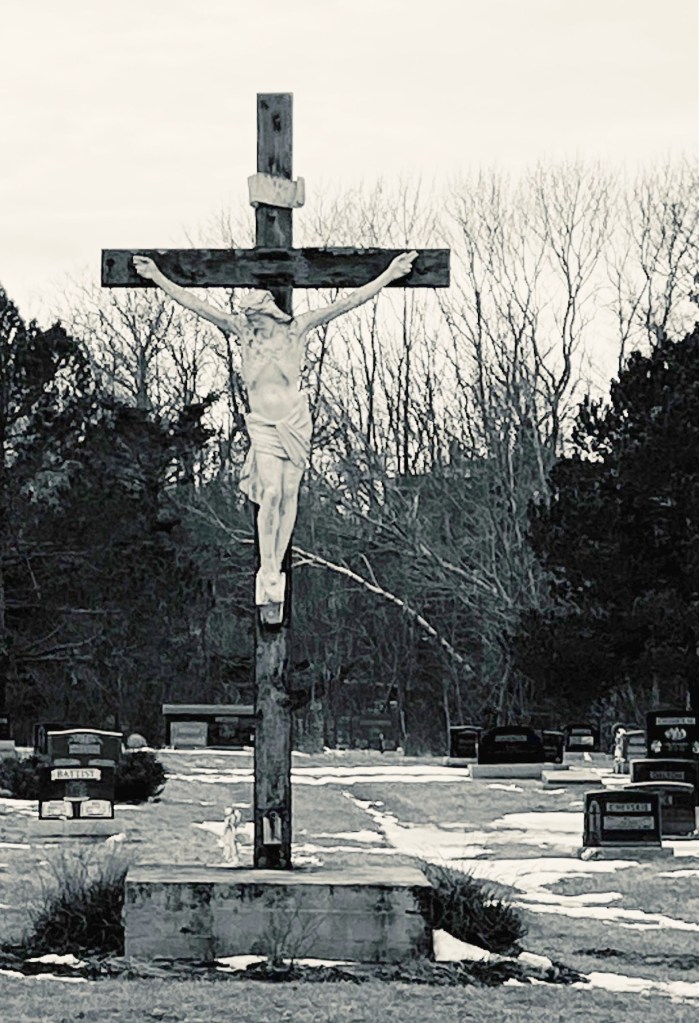
Old wooden cross with a white figure of Jesus of Joseph and Mary, who attested to prophesies of Isaiah of Kingdom coming. That cross, darkened by weather and age is strong. He does not attest to anything anymore. He is profoundly sad. Painfully sad. Sorrow emanates from his eyes and from that terrible tool of his death. Still asking: Why? Why did you lead me to this terrible, painful death, o father? What did I do to deserve such cruel punishment? Why did you forsake me, condemn me to this brutal death?

I want to talk to him, help him to quell his anguish. He was still a very young man, and did not understand. I want to tell him – don’t cry anymore. To tell him if he truly found love in Mary Magdalen or any other lovers he pursued, if he was loved and loved – it never died. Not on that cross, nor in this cemetery. That his father, his false friend Judas – they could not stop that Love, they could not erase it. It soared like an eagle, like an Angel through the Cosmos. That love, young man – if you truly were loved and loved – sang songs of Love. Eternal.

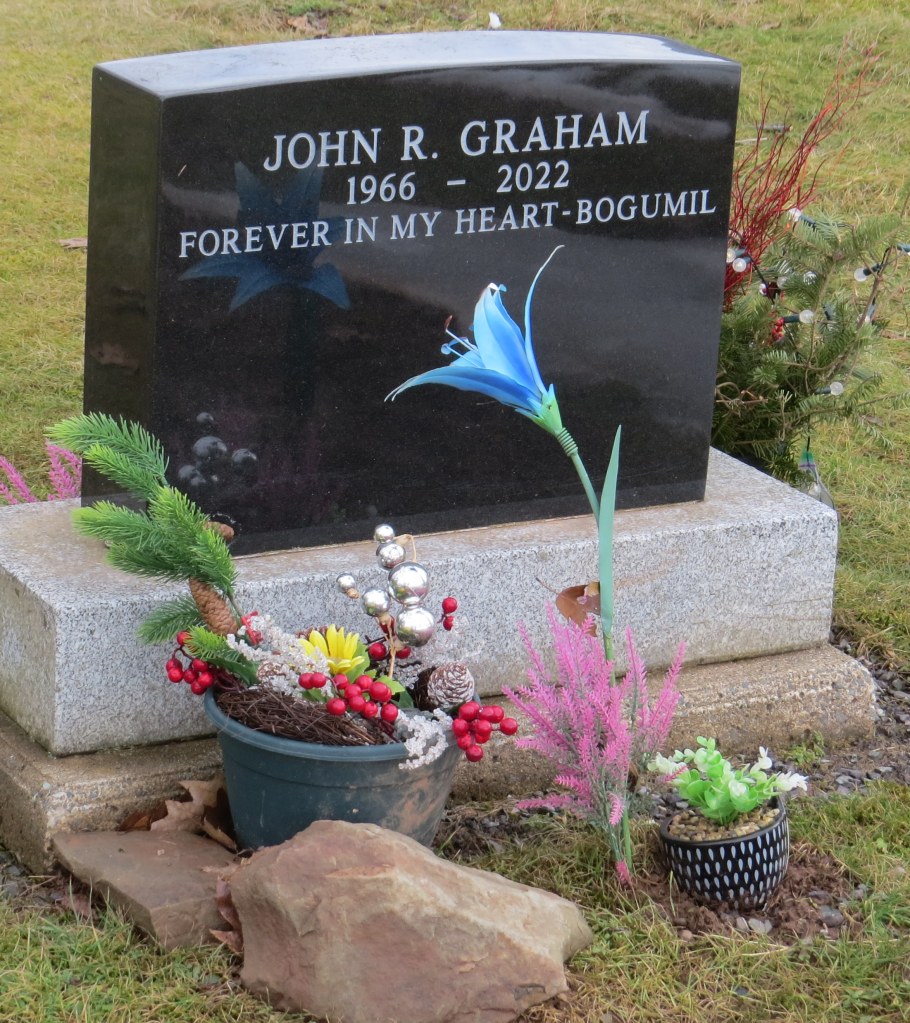
The wintery Sun came over the desolate, little cemetery. It flickered in the mud holes of the walkways, it caressed and made bright little plastic flowery arrangements on some gravestones.  Looked at your grave with my inscription: forever in my heart and smiled, too. That’s just for some passerby, maybe long after any memory of both of us would linger in anyone’s life. So he or she would have known that you were loved. And would recognize that love does conquer death. Nothing else. But She does.

Of course, you are not there, under the stone. You are in my heart, with me. All the time, everywhere. Just on that cemetery, on any cemetery, there is a special stillness of air that allows you to have these talks, these thoughts. That’s why I keep coming here. When I was very young I used to visit some special coffee shops in Warsaw, where I would write my poems on white, square, and very small paper tissues.  Now, when I am much older, I like to come to this cemetery or visit my special wild beaches I have conquered in your name and have these talks with you, and still write poems. I like it.

Before I left, went and looked at that man outstretched on this horrible cross.  I thought he wasn’t as sad as before. I hope. I hope that he got it, he understood it. That death is just that – all matter decays and dies with time. But love survives, and overcomes.  The Kingdom came through love.

Pictou