Ruling of the International Court of Justice in a case of South Africa against Israel

45. The Palestinians appear to constitute a distinct “national, ethnical, racial or religious group”, and hence a protected group within the meaning of Article II of the Genocide Convention. The Court observes that, according to United Nations sources, the Palestinian population of the Gaza Strip comprises over 2 million people. Palestinians in the Gaza Strip form a substantial part of the protected group. 46. The Court notes that the military operation being conducted by Israel following the attack of 7 October 2023 has resulted in a large number of deaths and injuries, as well as the massive destruction of homes, the forcible displacement of the vast majority of the population, and extensive damage to civilian infrastructure. While figures relating to the Gaza Strip cannot be independently verified, recent information indicates that 25,700 Palestinians have been killed, over 63,000 injuries have been reported, over 360,000 housing units have been destroyed or partially damaged and approximately 1.7 million persons have been internally displaced (see United Nations Office for the Coordination of Humanitarian Affairs (OCHA), Hostilities in the Gaza Strip and Israel reported impact, Day 109 (24 Jan. 2024)).

47. The Court takes note, in this regard, of the statement made by the United Nations UnderSecretary-General for Humanitarian Affairs and Emergency Relief Coordinator, Mr Martin Griffiths, on 5 January 2024: “Gaza has become a place of death and despair. . . . Families are sleeping in the open as temperatures plummet. Areas where civilians were told to relocate for their safety have come under bombardment. Medical facilities are under relentless attack. The few hospitals that are partially functional are overwhelmed with trauma cases, critically short of all supplies, and inundated by desperate people seeking safety. A public health disaster is unfolding. Infectious diseases are spreading in overcrowded shelters as sewers spill over. Some 180 Palestinian women are giving birth daily amidst this chaos. People are facing the highest levels of food insecurity ever recorded. Famine is around the corner. For children in particular, the past 12 weeks have been traumatic: No food. No water. No school. Nothing but the terrifying sounds of war, day in and day out. Gaza has simply become uninhabitable. Its people are witnessing daily threats to their very existence — while the world watches on.” (OCHA, “UN relief chief: The war in Gaza must end”, Statement by Martin Griffiths, Under-Secretary-General for Humanitarian Affairs and Emergency Relief Coordinator, 5 Jan. 2024.)

48. Following a mission to North Gaza, the World Health Organization (WHO) reported that, as of 21 December 2023: “An unprecedented 93% of the population in Gaza is facing crisis levels of hunger, with insufficient food and high levels of malnutrition. At least 1 in 4 households are facing ‘catastrophic conditions’: experiencing an extreme lack of food and starvation and having resorted to selling off their possessions and other extreme measures to afford a simple meal. Starvation, destitution and death are evident.” (WHO, “Lethal combination of hunger and disease to lead to more deaths in Gaza”, 21 Dec. 2023; see also World Food Programme, “Gaza on the brink as one in four people face extreme hunger”, 20 Dec. 2023.)

49. The Court further notes the statement issued by the Commissioner-General of the United Nations Relief and Works Agency for Palestine Refugees in the Near East (UNRWA), Mr Philippe Lazzarini, on 13 January 2024: “It’s been 100 days since the devastating war started, killing and displacing people in Gaza, following the horrific attacks that Hamas and other groups carried out against people in Israel. It’s been 100 days of ordeal and anxiety for hostages and their families.  In the past 100 days, sustained bombardment across the Gaza Strip caused the mass displacement of a population that is in a state of flux constantly uprooted and forced to leave overnight, only to move to places which are just as unsafe. This has been the largest displacement of the Palestinian people since 1948. This war affected more than 2 million people the entire population of Gaza. Many will carry lifelong scars, both physical and psychological. The vast majority, including children, are deeply traumatized. Overcrowded and unsanitary UNRWA shelters have now become ‘home’ to more than 1.4 million people. They lack everything, from food to hygiene to privacy. People live in inhumane conditions, where diseases are spreading, including among children. They live through the unlivable, with the clock ticking fast towards famine. The plight of children in Gaza is especially heartbreaking. An entire generation of children is traumatized and will take years to heal. Thousands have been killed, maimed, and orphaned. Hundreds of thousands are deprived of education. Their future is in jeopardy, with far-reaching and long-lasting consequences.” (UNRWA, “The Gaza Strip: 100 days of death, destruction and displacement”, Statement by Philippe Lazzarini, Commissioner-General of UNRWA, 13 Jan. 2024.)

50. The UNRWA Commissioner-General also stated that the crisis in Gaza is “compounded by dehumanizing language” (UNRWA, “The Gaza Strip: 100 days of death, destruction and displacement”, Statement by Philippe Lazzarini, Commissioner-General of UNRWA, 13 Jan. 2024).

51. In this regard, the Court has taken note of a number of statements made by senior Israeli officials. It calls attention, in particular, to the following examples. 52. On 9 October 2023, Mr Yoav Gallant, Defence Minister of Israel, announced that he had ordered a “complete siege” of Gaza City and that there would be “no electricity, no food, no fuel” and that “everything [was] closed”. On the following day, Minister Gallant stated, speaking to Israeli troops on the Gaza border: “I have released all restraints . . . You saw what we are fighting against. We are fighting human animals. This is the ISIS of Gaza. This is what we are fighting against . . . Gaza won’t return to what it was before. There will be no Hamas. We will eliminate everything. If it doesn’t take one day, it will take a week, it will take weeks or even months, we will reach all places.” On 12 October 2023, Mr Isaac Herzog, President of Israel, stated, referring to Gaza: “We are working, operating militarily according to rules of international law. Unequivocally. It is an entire nation out there that is responsible. It is not true this rhetoric about civilians not aware, not involved. It is absolutely not true. They could have risen up. They could have fought against that evil regime which took over Gaza in a coup d’état. But we are at war. We are at war. We are at war. We are defending our homes. We are protecting our homes. That’s the truth. And when a nation protects its home, it fights. And we will fight until we’ll break their backbone.” On 13 October 2023, Mr Israel Katz, then Minister of Energy and Infrastructure of Israel, stated on X (formerly Twitter): “We will fight the terrorist organization Hamas and destroy it. All the civilian population in Gaza is ordered to leave immediately. We will win. They will not receive a drop of water or a single battery until they leave the world.”

53. The Court also takes note of a press release of 16 November 2023, issued by 37 Special Rapporteurs, Independent Experts and members of Working Groups part of the Special Procedures of the United Nations Human Rights Council, in which they voiced alarm over “discernibly genocidal and dehumanising rhetoric coming from senior Israeli government officials”. In addition, on 27 October 2023, the United Nations Committee on the Elimination of Racial Discrimination observed that it was “highly concerned about the sharp increase in racist hate speech and dehumanization directed at Palestinians since 7 October”.

54. In the Court’s view, the facts and circumstances mentioned above are sufficient to conclude that at least some of the rights claimed by South Africa and for which it is seeking protection are plausible. This is the case with respect to the right of the Palestinians in Gaza to be protected from acts of genocide and related prohibited acts identified in Article III, and the right of South Africa to seek Israel’s compliance with the latter’s obligations under the Convention.

78. The Court considers that, with regard to the situation described above, Israel must, in accordance with its obligations under the Genocide Convention, in relation to Palestinians in Gaza, take all measures within its power to prevent the commission of all acts within the scope of Article II of this Convention, in particular: (a) killing members of the group; (b) causing serious bodily or mental harm to members of the group; (c) deliberately inflicting on the group conditions of life calculated to bring about its physical destruction in whole or in part; and (d) imposing measures intended to prevent births within the group. The Court recalls that these acts fall within the scope of Article II of the Convention when they are committed with the intent to destroy in whole or in part a group as such (see paragraph 44 above). The Court further considers that Israel must ensure with immediate effect that its military forces do not commit any of the above-described acts.

79. The Court is also of the view that Israel must take all measures within its power to prevent and punish the direct and public incitement to commit genocide in relation to members of the Palestinian group in the Gaza Strip.

80. The Court further considers that Israel must take immediate and effective measures to enable the provision of urgently needed basic services and humanitarian assistance to address the adverse conditions of life faced by Palestinians in the Gaza Strip.

81. Israel must also take effective measures to prevent the destruction and ensure the preservation of evidence related to allegations of acts within the scope of Article II and Article III of the Genocide Convention against members of the Palestinian group in the Gaza Strip.

82. Regarding the provisional measure requested by South Africa that Israel must submit a report to the Court on all measures taken to give effect to its Order, the Court recalls that it has the power, reflected in Article 78 of the Rules of Court, to request the parties to provide information on any matter connected with the implementation of any provisional measures it has indicated. In view of the specific provisional measures it has decided to indicate, the Court considers that Israel must submit a report to the Court on all measures taken to give effect to this Order within one month, as from the date of this Order. The report so provided shall then be communicated to South Africa, which shall be given the opportunity to submit to the Court its comments thereon.

83. The Court recalls that its Orders on provisional measures under Article 41 of the Statute have binding effect and thus create international legal obligations for any party to whom the provisional measures are addressed (Allegations of Genocide under the Convention on the Prevention and Punishment of the Crime of Genocide (Ukraine v. Russian Federation), Provisional Measures, Order of 16 March 2022, I.C.J. Reports 2022 (I), p. 230, para. 84).

86.

1) For these reasons, THE COURT, Indicates the following provisional measures: (1) By fifteen votes to two,

The State of Israel shall, in accordance with its obligations under the Convention on the Prevention and Punishment of the Crime of Genocide, in relation to Palestinians in Gaza, take all measures within its power to prevent the commission of all acts within the scope of Article II of this Convention, in particular: (a) killing members of the group; (b) causing serious bodily or mental harm to members of the group; (c) deliberately inflicting on the group conditions of life calculated to bring about its physical destruction in whole or in part; and (d) imposing measures intended to prevent births within the group; IN FAVOUR: President Donoghue; Vice-President Gevorgian; Judges Tomka, Abraham, Bennouna, Yusuf, Xue, Bhandari, Robinson, Salam, Iwasawa, Nolte, Charlesworth, Brant; Judge ad hoc Moseneke; AGAINST: Judge Sebutinde; Judge ad hoc Barak;

(2) By fifteen votes to two, The State of Israel shall ensure with immediate effect that its military does not commit any acts described in point 1 above; IN FAVOUR: President Donoghue; Vice-President Gevorgian; Judges Tomka, Abraham, Bennouna, Yusuf, Xue, Bhandari, Robinson, Salam, Iwasawa, Nolte, Charlesworth, Brant; Judge ad hoc Moseneke; AGAINST: Judge Sebutinde; Judge ad hoc Barak;

(3) By sixteen votes to one, The State of Israel shall take all measures within its power to prevent and punish the direct and public incitement to commit genocide in relation to members of the Palestinian group in the Gaza Strip; IN FAVOUR: President Donoghue; Vice-President Gevorgian; Judges Tomka, Abraham, Bennouna, Yusuf, Xue, Bhandari, Robinson, Salam, Iwasawa, Nolte, Charlesworth, Brant; Judges ad hoc Barak, Moseneke; AGAINST: Judge Sebutinde;

(4) By sixteen votes to one, The State of Israel shall take immediate and effective measures to enable the provision of urgently needed basic services and humanitarian assistance to address the adverse conditions of life faced by Palestinians in the Gaza Strip; IN FAVOUR: President Donoghue; Vice-President Gevorgian; Judges Tomka, Abraham, Bennouna, Yusuf, Xue, Bhandari, Robinson, Salam, Iwasawa, Nolte, Charlesworth, Brant; Judges ad hoc Barak, Moseneke; AGAINST: Judge Sebutinde; –

(5) By fifteen votes to two, The State of Israel shall take effective measures to prevent the destruction and ensure the preservation of evidence related to allegations of acts within the scope of Article II and Article III of the Convention on the Prevention and Punishment of the Crime of Genocide against members of the Palestinian group in the Gaza Strip; IN FAVOUR: President Donoghue; Vice-President Gevorgian; Judges Tomka, Abraham, Bennouna, Yusuf, Xue, Bhandari, Robinson, Salam, Iwasawa, Nolte, Charlesworth, Brant; Judge ad hoc Moseneke; AGAINST: Judge Sebutinde; Judge ad hoc Barak;

(6) By fifteen votes to two, The State of Israel shall submit a report to the Court on all measures taken to give effect to this Order within one month as from the date of this Order. IN FAVOUR: President Donoghue; Vice-President Gevorgian; Judges Tomka, Abraham, Bennouna, Yusuf, Xue, Bhandari, Robinson, Salam, Iwasawa, Nolte, Charlesworth, Brant; Judge ad hoc Moseneke; AGAINST: Judge Sebutinde; Judge ad hoc Barak.

Done in English and in French, the English text being authoritative, at the Peace Palace, The Hague, this twenty-sixth day of January, two thousand and twenty-four, in three copies, one of which will be placed in the archives of the Court and the others transmitted to the Government of the Republic of South Africa and the Government of the State of Israel, respectively. (Signed) Joan E. DONOGHUE, President.

  1. https://www.icj-cij.org/sites/default/files/case-related/192/192-20240126-ord-01-00-en.pdf ↩︎

Actors, directors, writers and the public. Spectacle of the past and the future:  2023 versus 2024 – the English version

In ancient Greece, there was a special, feared temple in Delphi, where the women serving as the foretellers of tomorrow and fate would tell you what yours would look like. Pythia was seldom very clear in her oracles. I will try my best to be less confusing and complicated. Also, unlike a proper Pythia, I am not a user and therefore I am not high, as I write the story, LOL.  

But before we get to 2024, let’s look back to 2023. Normally, talking about history would seem to be very safe. Nothing could be more wrong than that wisdom. History, my dear reader is only objective about plain facts. You can say safely only one sentence: i.e. the Battle of Hastings took place in 1066. Anything else would be your opinion of the battle, not facts.

So maybe it is better to ‘use’ and be high and talk about the future. At least no one can say with a conviction that you are wrong or even a liar.

But I will try nonetheless to say a few things that I hope will be reasonable, seasoned, and not too emotional.

2023 in Canada

Eighth year of Justin Trudeau’s Liberal government. From happiness and joyful youth of hope at the beginning (that was very much needed at that time) to Covid years, social upheaval (Truck convoys, occupations of Ottawa, and border crossings), and polarization of the entire Canadian society. Not many could have survived it. He did. But badly damaged. I also think that he has become tired and not as enthusiastic about bringing a sunny future to Canadians. I doubt very much if he will be able to beat his father’s record of longest-serving PM in modern Canadian history.

2023 was a series of setbacks for our Government. On the domestic scene and international scene. Most of them were probably beyond anyone’s ability to solve or remedy. But in politics, excuses are seldom granted for those in power.

In the last two years, prices of everything just skyrocketed. And so did interest rates. But food and shelter become the biggest scare of all. That certainly was not a Canadian phenomenon – similar things happened everywhere in the developed world.  In Germany, France, Poland, in the USA. Originally a lot of it stemmed from the COVID years and total breakage in world transport of goods across continents and oceans. But once that was established  – the habits of raking huge profits became entrenched in the pockets of the oligarchs of domestic and world food distributions. Owners of supermarkets, car sales, oil and energy, landlords of apartments both big ones and individual ones. Almost overnight rents went up ten, twenty, and fifty percent higher. The high prices of home ownership were already habitually high putting us all at constant risk of collapse and financial crisis of the banking system (remember what happened in the US many years ago?). But it used to be in Vancouver, Toronto, and Montreal. Suddenly it happened in Halifax, St. John, and Fredericton – for no economic reason whatsoever since none of the Maritime Provinces experienced even a semblance of any economic boom – to the contrary.  I guess greed is a part of human nature. Not a nice one – but it is.

Eventually, wages went up, too. Not nearly enough – but surely. All of it made the fight against inflation even more difficult – but the Bank of Canada stayed its course and no serious inflation ever occurred. It wasn’t popular – but necessary. That is the difference between politicians and high-ranking Officers of the Crown (like national banks presidents). Politicians are at the mercy of voters; appointed Officers are at the mercy of only their terms, thus often doing what is right and not what is safer for them.

The result? 2023 was very expensive for ordinary Canadians. And definitely more expensive for ordinary citizens of most countries in the world. Regardless if the governments were rightist, leftist, or centrist.

I strongly believe that we managed as well as we could thanks to the unusual partnership between Jagmeet Singh of NDP and Justin Trudeau of Liberals. It wasn’t a coalition by any means (probably smart for Singh) but a careful partnership. But when you have a minority government your position as an ally is stronger. It was also an astute choice for Singh as he built his profile and popularity among voters.

Therefore my first choice in politicians of 2023 in Canada goes to him – Jagmeet Singh. Second to Justin Trudeau –  if for anything than for surviving. It was a very bad time for all politicians. Last by any margin of error – but most popular in recent polls, Pierre Poilievre. I understand that when people are angry and scared they run toward the one who is even angrier and scarier. But really? Is that what you want? The most fanatical, the one lacking on any cohesive policy for the massive challenges awaiting us in 2024? God have mercy. It is so easy to criticize existing policies and governments in times of global crisis. But to offer workable and logical, economically sound alternatives – not so much. Certainly, in the case of Poilievre, they are not forthcoming.  The few that he sort of mentioned are just absurd. They have no economic or social value. On the contrary – I think that it would create a much harsher situation for most of us  (very few very rich ones would absolutely gain a lot from it) in 2024.

Canada’s worst ‘enemy’ in 2023 in order of dangers:

  1. Huge forest fires and floods as a result of climate change – stretching from ocean to ocean to ocean. There was no escape. Ecological catastrophe and financial disaster for Provincial and Federal governments.
  2. War in Ukraine. On many fronts most difficult and terribly expensive in recent Canadian history. Our support for Ukraine extended well beyond our ability. And, of course, at the worst possible time. It is one way to be generous during ‘good times’ and a different thing to be generous in ‘bad times’.  Paying for armaments, munition, training, fulfilling obligations to NATO, and sending Canadian regiment to Estonia is very expensive, too. At a time when our Forces need very badly a large amount of budget in Canada to fix years of not doing enough. By all recent federal governments, Liberal and Conservative. Yet – we did not choose that war. The war is not only in Ukraine, somewhere very far away. The war is at the borders of NATO countries to whom we have an obligation. We either support the Ukrainian army, which is much smaller than that of the Russian aggressor – or we might end up doing the fighting ourselves if Russians overcome their defenses and attack NATO country or countries.  Remember a lesson from the 2 world War – if Europe (France and England) and the USA attacked Hitler when he invaded with almost all his armies Poland, maybe the war would not lasted almost six years but only a year or two. And maybe millions of people would have survived it. Just saying. Sometimes – sadly – starting a war against an evil aggressor makes the war shorter and less bloody. Now the ‘hitler’s name is Putin.  (Don’t forget that Stalin’s Russia was Hitler’s ally and invaded Poland from the East two weeks after Hitler started his invasion. If not that Hitler two years later changed his mind and attacked Russia – Stalin would have stayed by Germany’s side)
  3. The global crisis of economies, raising poverty and hunger.

Challenges in 2024

  1. This time the one that is unavoidable. One that dwarfs every other challenge. Climate change. One that can’t be stopped because we are not able to stop or reverse cosmic forces, forces of the Universe. Earth is not a world in itself. It is part of our solar system, our galaxy, and part of the Cosmos known and unknown.  Earth is a ‘living’ thing. Never stopped being one. Constantly changing its form, shape, and look. Just in a different time frame than our human perception. But from time to time it speeds up. It has been done many times before. Usually with very disastrous effects for the life forms, that exist in such times. Then life comes back, some species survive, and some new ones emerge. But one life form became so powerful in the last million or so years that affected that normal, cosmic timeframe. People. We. We can’t stop that change. But we shouldn’t speed it up, as we do.  This time it is not freezing in glaciers, not gigantic volcano eruptions followed by hundreds of years of darkness and acid monsoons. This time it is simply warming. 2003 was already the warmest in kept records. According to geological archeologists, it reached the level last seen 100,000 years ago. That will affect the entire planet, all humankind. It couldn’t care less about any states, borders, or nations. By acting accordingly, wise, and understanding the truly existential nature of that change we might have a chance to adapt, to survive, maybe even flourish later.  But we must. We. Everyone. Governments and international organizations can’t do that for us this time. We must elect only politicians, who are very serious about it, who accept that challenge as the most important one, who follow the plan and do not change it come every election. We can’t say: it must be China most; India most, Brazil first; Europe, Africa, and on and on. No. It must be Canada’s first in Canada. Yes, nations should develop and plan globally. But we can’t afford the time when all agree. We must do now, here. And it will cost money. Will cost us. Les if we start now, more if we start five years from now. By us, I mean us individually, not just some government in some town called Ottawa. Traditional oil-driven or coal-driven energy should be more expensive. And you can’t expect that all the costs will be covered by the government. If the government covers the full cost it means it will cut other services. You know that arithmetic very well. The National Bank doesn’t really just print money. If we fail that test and we will speed up the warming process everything else stops having any sense. Millions of people will die of starvation, hundreds of millions will become poor and desolate, and immigration will just overcome any national borders and border walls. It will be chaos on many fronts. Forest fires and floods? You have not seen anything, yet. Some nation-states are already disappearing in front of our own eyes. I mean – they are truly sinking out of the map.
  2. Two wars that must be stopped by any means. I mean any. Russia must be punished so harshly by all allied states (Europe, North America, Australia, New Zealand, and any other true ally that we have) that would cripple their economy. That will stop the war much faster than any rockets or tanks sent to Ukraine (but we must continue to support Ukraine in the meantime before the sanctions are formed and executed). That is possible and is in our best interest. Current sanctions are just a patchwork of here and there and this and that. We can’t wait for the majority of the world to agree to that. It might never come. We must use our own strict ‘club’ of Western Powers of democratic states and do it fully, comprehensibly, and at once. It is possible and it is doable. We must demand it from our governments.

 Israel – the massacre of Palestinians must stop. No ceasefire, no ‘more careful killings’. This is insanity and it serves no one. Except for one person – the disgusting malfeasant and populist Netanyahu. Now a war criminal.  United States is acting in an abhorrent way aiding in the massacre of people, who already suffered unspeakable theft of land, opportunities, and basic dignity. I do understand that Israel is a linchpin of US policy in the Middle East. But it is all based on old times of rivalry between East (communism and USSR) and West.   But regardless of that anachronistic policy – it is in the best long-time interest of Israel to have peace with Palestinians. It is the only solution to lasting peace there. What happened in December with the atrocious Hamas attack – happened. It has been dealt with. It cannot justify the unspeakable horror of what is happening in the ruins of Gaza City and all other cities and towns in the Gaza Strip. It is abhorrent.  Our, Canadian government can’t be part of it. There is no room to be ‘a little pregnant’ in this conflict. Children and women are dying in hundreds daily, hospitals are bombed as they tend to the wounded and dying, and starvation is happening now.  No medicine, no fresh water, no fuel, no food. The trickle that is coming (never sure if it is coming, and aid trucks have been already bombed, too) is only a fraction of what is needed. It is truly insanity and I can’t understand that some of us are even trying to discuss it politely that maybe this or maybe that, that it is all very complicated. No. It is not complicated at all. It kills innocent people. In thousands. People, who were already suffering. Including suffering from Hamas hands. During the history (a very short one after all) of Israel, it gathered a lot of support. People knew and remembered what was Holocaust, what were pogroms. That Jews deserve their own state. Safe state. And now a lot of it evaporates in thin air. A normal person just watches with astonishment and disbelief. For the sake of not only Palestinians (but mostly for them because they are being massacred) but also the secured and respected Israel – stop it. Kick Netanyahu to the garbage bin of history and restore peace. Both nations deserve it.

  • Last but not least – India. The largest democracy in the world. But is it? The USA wants it to be a counterbalance to China’s ambitions in Asia. I don’t trust this guy at all. Arrogant, populist, and ethno-religious chauvinist. I think that he is the worst that could have happened to this amazing subcontinent with thousands of years of history. How can you have a democracy if the leader is an authoritarian trumpist? Ask me, a Canadian Pole who observed from Canada for the last 10 years the democratically elected government of populists, religious fanatics, and idiots in Poland. They lost power in massive elections and popular protests in October last year. Now is January. It is absurd what is happening now in Poland. The party that lost occupies buildings in Warsaw, occupies the Public TV (equivalent to CBC in Canada), and daily emits anti-government programs. There is legal chaos as part of the Judiciary was chosen by the former chauvinistic government and wants to stop the new government from any normal governance. Democracy is not a panacea for everything. It works only if everyone respects the same rules. Not only the rules it likes.

OK, it looks like the morning is lurking in my window. Time to go to bed.  Enough for today. Good night and sleep well. Hope you can after reading this, LOL.

Kiedy giną poeci …

Wojna na Ukrainie nie ustaje, nie milkną działa ni syk rakiet wystrzeliwanych przez rosyjskiego napastnika. Nowy rok niczego tam nie zmienił. Step płonie nie zachodami słońca a pożarami domów ostrzelanych przez wroga.

W Równem, pięknym starym mieście starej Rzeczypospolitej Obojga Narodów urodził się w 1990 roku Maksym Krywcow. Ukraiński poeta i żołnierz wolnej, suwerennej Ukrainy.

Gdy czytałem o jego śmierci, przesuwały się mi przed oczyma cienie innych młodych poetów, z wielkiej wojny sprzed blisko dziewięćdziesięciu laty: Baczyńskiego o pięknych oczach daleko widzących, Gajcego, Kowalczyka … . O śmierci Krywcowa dowiedziałem się z zapisu Anety Kamińskiej, tłumaczki jego wierszy na jezyk polski. Właśnie mial ukazać się tomik jego wierszy w jej przekładzie. Ukaże się w wydawnictwie “Pogranicze’. Ale już nie ukaże się inny, następny. Nie będzie nowych wierszy. Kamińska, sama będąc poetką, pisała o wojnie, o Maksymie swoje wiersze. Jeden, bardzo znamienny tu przytoczę:

rosja wysyła na wojnę bandytów

wyciągniętych z więzień

a ukraina poetów

historyków muzyków

komentuje zbigniew

a ja jestem mu głęboko wdzięczna

że to nie ja muszę napisać

te słowa

Warszawa, 7 stycznia 2024

i fragment jeden jeszcze, który wyjątkowo jedną metaforą mnie uderzył:

widzę jak artur

zamieszcza na facebooku

ostatni wiersz maksyma

o tym jak to zakwitnie na wiosnę fiołkami

Kiedyś, pewnie będą tym poległym chłopcom-poetom stawiać pomniki lub tablice pamiątkowe. Ale to nic nie pomoże. Nowych wierszy już nie napiszą.

Maksymie Krywcowie- nie wiem czy drogi nasze by się kiedykolwiek skrzyżowały. Czy kiedykolwiek bym czytał Twoje wiersze. Czy Ty byś czytał moje. Znaczenia to nie ma zresztą. Ktoś czyta i czytać bedzie Twoje, ktoś zdaje się czyta moje. Dlatego ci bandyci rosyjscy niech będą przeklęci na zawsze. Bo rozstrzelać człowieka to rzecz podła – ale rozstrzelać nowe wiersze, które już nigdy nie będą czytane przez nikogo, to rzecz najpodlejsza, barbarzyńska.

W ostatnich godzinach życia napisał wiersz ostatni. Kończył życzeniem:

żeby już szybciej była wiosna

żeby wreszcie

zakwitnąć

fiołkami  (tł. A.K)

Tobie więc ten ofiaruję dziś, napisany po wiadomości o Twojej śmierci. I chyba naturalne mam uczucie, że wolałbym tego wiersza nie napisać. By go nikt nigdy nie czytał. Byś Ty mógł dalej pisać wiersze. Byś kwitł nimi, jak fiołkami.

Brzemię

pamięci poety Maksyma Kruwcowa, który poległ na Ukrainie

Brzemienna jest ziemia

falująca zagonami złotych zbóż,

warkoczami chabrów

w modrych czapeczkach, kolczykach, koralach.

Zroszona kroplami

krwi czerwonej od stepowych maków.

Okrutna jest ziemia

dudniąca zagonem gąsienic czołgów,

nocą oświetlana

warkoczem rakietowych meteorów.

Step pełen kurhanów

tulących szkieleciki martwych fiołków.

Czy bogowie jeszcze płaczą,

gdy ginie poeta?

(B. Pacak-Gamalski, 08.01.2024)

Zeitgeist


The term ‘zeitgeist’ is not fully clear. It came to be prominently used by the end of the XIX century and early XX century in Europe, especially in Germany, and comes from the unclear land between philosophy and psychology, from where it leaked into literature and historiozophy ( philosophy of history).

Generally speaking, it describes a certain time in history, an epoch, when non-ethical behavior was permissible or even expected. Morality was stretched beyond its meaning or got a new meaning. New leaders are rising to power as a result of new social acceptance. Strong chauvinism and nationalism trump other norms. The world becomes dual-colored: Them or Us or Us contra Them

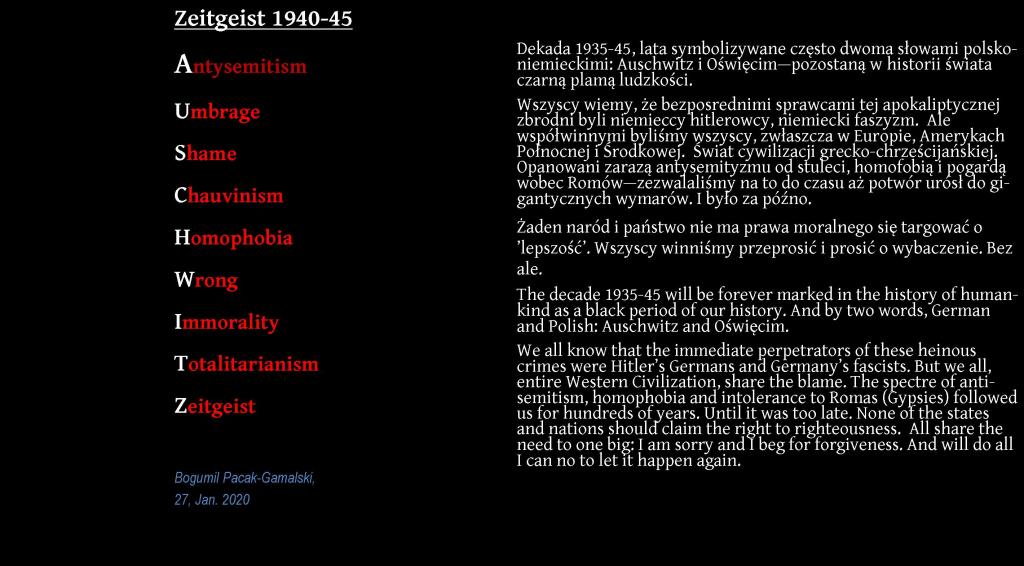
In 2020 there were some events concentrated on the most abhorrent and evil time and place in modern history: Auschwitz. The German concentration camp in the town of Oświecim in Poland. Treblinka was an extension of that ‘Factory of Death’.  That’s when I constructed a literary piece called ‘Zeitgeist’.  For people to build such a place, for leaders to want it to be built – it must be a zeitgeist: time and place for it.

In the last decade, I see a powerful wave of xenophobia raising its head all over the world. Growing trend of populism. And I do call it a new zeitgeist.  Trump in US; new type of angry, populist conservative leaders in Canada’s politics (Poilievre in federal politics; Scott Moe in Saskatchewan; Danielle Smith in Alberta – to name a few most dangerous ones). It is not only xenophobia – with it homophobia is rising, racism (often covertly), and islamophobia, to name a few.


There is a group of people, who suffered in the last hundred years tremendously. People, who were stateless, become through centuries settlers, and nomads settling other states, mixing with their populace. But maintained to a large degree their difference. Mainly because of religious devotion and cardinal religious schism between the old one (Judaism) and the new one (Christianity). It wasn’t the language (most of them over time could not communicate in their old Hebraic language) or looks, but precisely the religious schism that laid the foundation of antisemitism, that created pogroms.

I have always had a special affinity and sentiment toward Jews. After all – Poland for centuries was a safe refuge for them compared to other countries in Europe. I was sad that being born after the 2 world war – I was robbed of their distinct presence in Polish towns, and cities. A presence that was still felt very much, was talked about by your parents, and grandparents, and was filled in entire Polish literature, and art. Detested angrily the act of violence perpetrated against them (the very few who survived) in new Poland after the fall of Hitler.

And something happened that forced me to see a different Jew. An Israeli Jew. A settler. October 7,  2023.

 Hamas–led terrorist attack on Israeli kibbutzes on occupied Palestinian land resulted in the brutal murder of about 1200 Israelis and some foreign nationals. They also took about 240 (according to Israeli count) hostages back to Gaza. Everyone was shocked. Not by that attack itself – after all Palestinians have a right to fight for at least an internationally recognized part of old Palestine. The part that was internationally reserved for a Palestinian state. Every nation on Earth has a right to self-determination and a right to fight for it. What was shocking was the brutality of it, the massive failure of the Israeli army and police (one of the best-equipped army in the world) to protect the civilian Jewish population. The assault was a ghastly way of murdering civilians. Many states (unanimously in Europe and North America) condemned the attackers.

But what followed in a wake of Israel’s military response – shocked everyone even more. And harshly polarized the opinion of the majority of the world, even within one state. In a short few weeks a non-stop air, artillery, and missile attacks on the entire population and infrastructure of Gaza left Gaza City, it’s services (medical, sanitary, and everything else) were reduced to ruins. The civilian population was not spared the onslaught of bombs. Quickly, the deaths counted in thousands. Approximately 7000 kids were slaughtered.  All border crossings (controlled by Israel) were shut down. Nowhere to escape. Nowhere to search for food, nowhere to ask for medical help for thousands more wounded, nowhere to search for water to drink.

And I saw the shadow of enormous Zeitgeist hovering over the entire Middle East.  Black, angry, spewing ashes and flames.


above – Left panel: a kid in Warsaw in 1945; right panel: a kid in Gaza in 2023

Nagba. Scenes of history.

Idea of this article came to me around November 11, Remembrance Day. I was going to write about places and people I knew, who took part in both the I and II world wars. I was lucky enough to know veterans of both wars. Either as family members or personal friends. Now they are all gone. Although I see their faces still etched in my memory. But, as I started writing, the text changed. Wars change inevitably to exoduses, expatritions, expulsions. The suffering of civilians. The Nagbases. Therefore I decided to write a series of scenes depicting the most important ones. Like in a theatre dramats. As I was writing I noticed how things often change, how oppressors become victims and vice versa.

Scene #1

It is 1914 in Galicia,  on a train at railway station in Kiev, in Ukraine. Front line of Austro-Hungarian Empire and Russian Empire. Young nurse is tending to wounded and bloodied soldiers on that train. Zofia Lejmbach is that nurse. One of my great aunts. She learnt how to be a nurse in a Polish military organization called Rifle Groups  (Drużyny Strzeleckie) organized by Polish independence movement few years prior to that war. Those wounded soldiers were not Polish soldiers, Poland did not exist as independent nation yet.  Not until exactly 11 of November 1918. But it doesn’t matter for her what nationality are these soldiers – they needed help, that was all that matter. Later she will become one of the leading Polish pediatricians, professor and v-ce Rector of Warsaw Medical Academy. That was many years later, though. After 1945.

Scene #2

It is thirty years after her experience as a nurse in Kiev. It is 1944. Different world war,  #2. August in  German occupied Warsaw.  Soviet armies are marching west through Poland, battling the German Nazi Empire of Evil. Polish Underground Home Army (AK) starts the tragic Warsaw Uprising, trying to liberate Warsaw from Germans before the Soviet Army enters the city.  Young doctor Zofia Lejmbach is the Chief of the Underground Army Sanitary Department for the entire Warsaw District. Organizes make-shift hospitals for wounded partisans of Warsaw.  The Polish Underground Home Army (AK) represents Polish Republic  Government In- exile in London. The Soviets don’t want them to liberate Warsaw in the name of that democratic government. They stop their advance and allowed the Germans to smash the Uprising. And Germans did. In atrocious and merciless way.  Doctor Zofia Lejmbach and her medical teams did what they could, in indescribable circumstances. In Wola district was a hospital full of wounded Polish fighters. Zofia Lejmbach was wounded herself but not seriously and turns all her attention to treating the boys of the Uprising. She got a news that Nazi units just massacred another hospital killing all medical staff and patients. Somehow was able to commandeer a large horse drawn carriage and filled it with her patients and escaped the inevitable death taking them through the ruins to her father estate outside of Warsaw, in Skorosie.  By the time they have settled in that estate – the Uprising was over. The Germans ordered the rest of the entire population of Warsaw to live their burning city and long columns of of Warsovians march toward small city of Pruszkow, where the occupiers told them to settle. They could take with them only what they could carry. Behind them was burning Warsaw. When the smoked cleared somewhat – almost nothing was left of the city. Germans burnt and detonated it street by street, house by house.

Scene #3

                Nakgba. Year is 1948. Nakba means in Arabic a catastrophe –  to be expelled, evicted with no right of return[i]. One of the most pivotal word in describing Palestinian people situation in Palestine. It precedes any other explanations, political and military context. It seats at the very centre, at the core of this tragedy. To be precise is started in 1920 in Haifa, when the British seized Palestinian Arabs houses and property and gave it to Jewish settlers brought by them. The Arabic Palestinians did not even receive any compensation. That process continued through the 1930. But 1948, with the creation of Israel it become massive and on unprecedented scale. It wasn’t just houses, private property – it meant territory.  Old Palestine as a huge territory that was home to many groups of people (majority were Palestinians but by 1948 the Jews formed the second largest group) ceased to exist. One of the most prominent symbol of Nakba is a key. Regular, ordinary old type of iron key to an old house. A key that countless of Palestinian families took with them in their long exodus. I remember meeting Palestinian refugees (the original old ones with their children and grandchildren, who were born outside of Palestine) living in Canada, who were showing me their old, rusted key to their lost house in Jerusalem.

Scene #4

                Warsaw. The year is 1942. For more than a year all Jews from Warsaw and smaller towns and villages near-by are moved by German authorities to big space in central Warsaw. The infamous Warsaw Ghetto. At its height the Ghetto housed closed to 0.5 million Warsaw’s  Jews. It was separated by walls and gates from the rest of Warsaw (so called ‘Aryan side’). The time comes for Germans to start in earnest their satanic ‘Final Solution’.  Who didn’t die of hunger or wasn’t shot by Hitler’s henchmen at the slightest opportunity – was going to be deported to Treblinka near Auschwitz. To gas chambers. Long lines of tired and sick people formed columns and march to train station under the watchful eye of the oppressors. Those, who were too weak to march or have fallen down while marching are dealt by German soldiers and Jewish Judenrat (Jewish local administration and police formation organized forcefully by German authorities) – by a blow to the head or single shot. The end of Jewish existence in Warsaw – existence spanning hundreds of years.

Scene #5

                Year is 1945. Soviet Union is in full control of huge territories of Eastern Poland (parts of today Lithuania, Belarus and Ukraine). The Yalta Conference of Roosevelt, Churchill and Stalin decided to change the borders on Central and Eastern Europe on a massive scale. None of the countries involved were consulted and none of the millions of people were asked their opinion. It was truly a march of nations. Since the end of Middle Ages Kingdom of Poland had its borders expanded through treaties, dynastical agreements and wars eastward. The new Polish Republic from 1918 to 1945 did not hold as massive eastern territories as did the Kingdom. But territories were Polish element was in majority or very close to it – were still part of Poland. The Vilnius District, western Belarus and Western Ukraine were considered as the centres of Polish science, art and culture (especially Lvov and Vilnius with its highly regarded universities). Now the old world collapsed. Millions of Poles were expatriated from lands and homes they lived in for generations.  The entire immediate and extended family on my father side pack what they could, left their houses and cemeteries where generations of their grandfathers were buried. I remember them all very well. They – as the old Palestinians from Jerusalem – never forget their cities: Vilnius, Lvov, Sluck, Luck …  Big part of my heart is in Vilnius, too.

Scenie #6

                Year is 2023. Now. Gaza in tiny scrap of land of new Palestine. Very narrow bridgehead strip squeezed between Meditearrean Sea and Israel . One of the most populated piece of land in the world. Separated by Israel from larger piece of land govern by Palestinian Authority in Ramallah in West Bank. That separation made it practically impossible by the Authority to exercise control of Gaza (internationally the Palestinian Authority is recognized as representative political and administrative body of all Palestinian territory: West Bank and Gaza) and allowed for much more aggressive movement of Hamas to take control of Gaza. Hamas political arm become radicalized and it’s armed forces are closer today to jihadist ideas than to original goals of Palestinians struggle for independence.

On the 7 of October Hams launched an attack on Israeli town near Gaza killing hundreds of people (the number of executed Israelis in in the vicinity was 1200 victims) and taking hundreds more  back to Gaza. The atrocity and extremely brutal way of conducting the operation stunned the world.  It’s incomprehensible to understand how such an operation was possible to succeed given the military prowess of Israelis armed forces and once that attacked commenced that it was allowed to continue for hour on end.  Basically speaking the government of Israel was totally missing in action and failed to protect its land and citizens. Once the attackers returned to Gaza, Israel Forces begun full military operation. For weeks Gaza was subject to non-stop bombardment of air forces, artillery and missiles. It was immediately clear that civilian casualties will be very high. Israel cut off all contact of Gaza with external world, cut off food, water, fuel and medicine supplies. People who were trying to leave in this tiny strip of land from north to south were subjected to air attacks. The civilian casualties were growing day by day.  First by hundreds, than by thousands.  Women and children. Old and sick. Non ending groups of people trying to escape bombardment  and death, with meagre belongings hauled first by cars (until fuel run out), on foot, with crying children, with elderly. In search of food, fresh water. On a journey to nowhere. No escape. Some tried to look for safety in hospitals. To no avail – the hospitals become target of constant attacks. Foreign doctors from UN, Red Cross and Doctors Without Borders become victims themselves, some were murdered by Israeli strikes. Hospitals started running out of basic medicine, finally the fuel run out. Some doctors described how they were being shot by Israeli snipers. Scenes like from Dante’s Inferno .  The world watches still in disbelieve. Thousands of children were being murdered and their bodies are being placed in shallow mass graves. As the world watches. Every possible law of war is broken. Crimes against civilians, hospitals and humanity are being committed daily. And the world watches. One of Netanyahu cabinet ministers publicly demanded that an atomic bomb be dropped on Gaza. I thought that the world went crazy, no stop. And that minister is still a minister in Israel’s government.  More or less the Palestinians in Gaza were dehumanized the way Jews were dehumanized by Hitler’s Germany eighty years ago.

Final reflection: how strangely and sad it is that depending on circumstances a yesterday’s victor becomes an oppressor and oppressor becomes a victim.


[i] United Nation document: https://www.un.org/unispal/about-the-nakba/#:~:text=The%20Nakba%2C%20which%20means%20%E2%80%9Ccatastrophe,the%201948%20Arab%2DIsraeli%20war.

‘List solidarnościowy w sprawie mediów w Izraelu i Strefie Gazy’ i komentarz o Liście


Podpisałem list solidarnościowy w sprawie mediów w Izraelu i Strefie Gazy.

Podpisałem, nawet jeśli pewnie nie podzielam w pełni perspektywy, z jakiej niektórzy sygnatariusze patrzą na konflikt izraelsko-palestyński. Bo list podpisać można z różnych powodów.

Podpisałem, bo życzę klęski faszystom z Hamasu, ale tego nie osiąga się, jak chciałaby armia izraelska, mordowaniem cywilów, wliczając w to rzeź dzieci, wśród których liczba ofiar w kilka tygodni już parokrotnie przerosła tę, jaką znamy z Ukrainy, gdzie wojna trwa ponad półtora roku.

Podpisałem, bo życzę klęski faszystom z izraelskiego rządu, ale tego nie można osiągnąć, jak chciałby Hamas, mordowaniem cywilów, porywaniem innych, obwożeniem po miastach nagich ciał przy wtórze okrzyków o Bogu, a wreszcie braniem za zakładnika i żywą tarczę swojej własnej ludności.

Poparcie dla działań Hamasu to przyzwolenie na zbrodnie, zbyt często bagatelizowane przez część zachodniej lewicy, która kolejny to już raz (po sprawie Ukrainy) całkowicie się kompromituje, tym razem, w dziecinadzie swojej antyamerykańskości, usprawiedliwiając przemoc opowieściami o „dekolonizacji” i przesłaniając rzeczywistość pojęciowymi kalkami, jak osiągająca wyżyny absurdu Butler, która uznała Hamas za część globalnego ruchu lewicowego (co?!), albo jak wszyscy, którzy w propalestyńskich hasłach znajdują dozwoloną formę wyrażania swojego antysemityzmu, którego fala przyjmuje obecnie też formy całkowicie otwarte, a jego skala tylko narasta. Jakkolwiek by nas nie przekonywano, kiedy mówi się nam, że w demonstracjach solidarnościowych z Palestyną chodzi tylko o upomnienie się o ofiary, to jednak trzeba brać odpowiedzialność za słowa, a rozbrzmiewające podczas tych demo hasło „From the river to the sea Palestine will be free” jest niczym innym niż wezwaniem do eksterminacji Żydów, której Hamas by się dopuścił, gdyby tylko dysponował odpowiednimi środkami.

Poparcie obecnej polityki Netanjahu to z kolei sankcjonowanie pogromów (Zachodni Brzeg) i zbrodni wojennych, które mogą przerodzić się w ludobójstwo (tak brzmi notabene stanowisko ONZ). Obecnymi działaniami rząd Izraela daje paliwo do nowych pokładów antyizraelskiej nienawiści, która może nie wygasnąć latami, a w tym sensie polityka ta jest całkowicie kontrskuteczna, napędza tylko nową spiralę przemocy, po którą sięgną spragnieni rewanżu bliscy obecnych ofiar. Zatwardziałość, z jaką jako Zachód obstajemy przy działaniach Netanjahu i z jaką dokładamy rękę do medialnej asymetrii na korzyść Izraela, jest autosabotażem, który wytrąca nam samym z ręki argumenty (jaką skuteczność może mieć gdzie indziej wołanie o prawa człowieka, jeśli tu je mamy w nosie?), a do tego wpycha cały świat arabski w ramiona Putina. W tym sensie wspieranie przez nas obecnych działań izraelskiego rządu to przejaw piramidalnej krótkowzroczności, „to gorzej niż zbrodnia, to błąd”.

Żadna z grup biorących udział w konflikcie nie jest monolitem. Tak samo jak nie ma znaku równości między pojęciami „Izrael” i „Żydzi” oraz między „rząd izraelski” i „Izraelczycy” (przecież kilka miesięcy temu Izrael stał na progu wojny domowej na linii społeczeństwo Vs Netanjahu), tak samo słowo „Hamas” nie jest tożsame ze zbiorem „Palestyna”.

Celem jest więc powstrzymanie tej rozkręconej przez faszystów z obydwu stron jatki. Jakkolwiek Izrael może pokonać Hamas militarnie, może wybić jego kierownictwo i zlikwidować samą organizację, nie zniknie stojąca za nią emocja, która za kilka lat obrodzi nowymi organizacjami mordującymi Żydów. Dlatego jedynym rozwiązaniem (jakkolwiek całkowicie niewyobrażalnym z obecnej perspektywy), jest ustanowienie porządku, w którym możliwa byłaby jakaś forma faktycznego współistnienia na tamtym terenie Żydów i Palestyńczyków, pod auspicjami wreszcie respektowanych umów międzynarodowych. „Faktycznego” to znaczy takiego, w którym Izrael nie prowadzi wobec Palestyńczyków polityki apartheidu, nie zasiedla swoimi kolonistami ziem palestyńskich i nie wykorzystuje swojej przewagi ekonomiczno-militarno-technologicznej, Palestyna z kolei rozbraja Hamas, wyrzeka się agendy politycznej kwestionującej istnienie państwa Izrael i zrywa kontakty z różnymi antyizraelskimi, a tak naprawdę antysemickimi donatorami.

Oczywiście, domaga się to też od obydwu stron ustąpienia z części własnych roszczeń, Oczywiście, pamiętam, jaki los spotkał tych, którzy do podobnych porozumień doprowadzili. Dlatego koniecznym warunkiem ew. umów pokojowych jest nie tylko wyznaczenie wreszcie respektowanych granic między dwoma państwami, ale też dojrzałość, która pozwoliłaby spacyfikować ultrasów z własnego obozu.

I nawet jeśli czasem wydaje mi się, że moje stanowisko („mesjański liberalizm” – creditsy za stworzenie terminu wędrują oczywiście do Adama Lipszyca!) podziela piątka znajomych, to czasem myślę też sobie, że jest nas może więcej, może nawet tyle, ile chciał Derrida.

Otóż Derrida, Żyd ze skolonizowanej przez Francuzów Algierii, który uchodził w oczach wielu za „złego Żyda”, po wykładach na Uniwersytecie Hebrajskim w Jerozolimie zwykł odwiedzać przyjaciół w palestyńskim Ramallah. W wykładzie wygłoszonym kilka miesięcy przed śmiercią (2004 r.) mówił o tym, jaka mu się marzy Europa:

„Europa, w której można krytykować politykę Izraela, […] nie będąc przy tym oskarżonym o antysemityzm czy judeofobię.Europa, w której można wspierać uzasadnione aspiracje narodu palestyńskiego do uzyskania przez niego swoich praw, ziemi i państwa, nie aprobując samobójczych ataków [palestyńskich terrorystów – przyp. P.S.] i antysemickiej propagandy, która często – zbyt często – dąży w świecie arabskim ku okazaniu na nowo uznania dla potwornych „Protokołów mędrców Syjonu”.Europa, w której, bez antyamerykanizmu, bez antyizraelizmu, bez antypalestyńskiej islamofobii, można sprzymierzać się z tymi, którzy, czy byliby to Amerykanie, Izraelczycy czy Palestyńczycy, krytykują w sposób odważny, a czasem nawet bardziej czujny niż my sami – rządy czy siły dominujące w ich własnych krajach. […]

Oto moje marzenie. […] Miliardy ludzi współdzielą ze mną to marzenie. Powoli, wśród mozołu i bólów porodowych, wydobywają je oni na światło dnia, pięknego dnia”.


APEL

Pragniemy wyrazić naszą solidarność z dziennikarzami i dziennikarkami pracującymi w Izraelu, Strefie Gazy i w innych palestyńskich terytoriach okupowanych.

To szczególnie ważne w obliczu tego, jak 20 października 2023 r. Minister komunikacji Izraela Szlomo Karhi ogłosił projekt rozporządzenia umożliwiającego zamknięcie kanałów informacyjnych, jeśli te uznane być mogą za „szkodzące bezpieczeństwu narodowemu”. Przepisy te zostały zatwierdzone 1 listopada. Wydają się być wymierzone w działalność kanału al-Dżazira, jednak Międzynarodowa Federacja Dziennikarzy obawia się, że prawo to może posłużyć władzom izraelskim do zamykania innych mediów działających w Izraelu oraz na okupowanych terytoriach palestyńskich.

Rozporządzenie to jest jawnym ograniczeniem wolności prasy oraz wolności słowa, a można je interpretować także jako formę zastraszania, co z kolei łamie artykuł 19. Powszechnej Deklaracji Praw Człowieka, który stanowi, że

„Każda jednostka ma prawo do wolności poglądów i wypowiedzi; prawo to obejmuje nieskrępowaną wolność posiadania poglądów oraz poszukiwania, otrzymywania i przekazywania informacji oraz idei, wszelkimi środkami i bez względu na granice”.

Kilka dni po przedstawieniu projektu wspomnianego rozporządzenia, 25 października 2023 r., izraelskie siły zbrojne zbombardowały dom szefa biura al-Dżaziry w Gazie, Waila Dahduha. W ataku zginęła jego żona, córka, syn i wnuk. Pragniemy wyrazić nasze najszczersze kondolencje.

Stajemy solidarnie z uprowadzonym przez Hamas izraelskim dziennikarzem Odedem Lifszicem, zasłużonym opozycjonistą, który przez dziesięciolecia działał na rzecz pokoju i uznania praw Palestyńczyków. Apelujemy o jego niezwłoczne uwolnienie w związku z publicznym oświadczeniem rzecznika Brygad Izz ad-Din al-Kassam o gotowości do jego bezwarunkowego oswobodzenia.

W obliczu ataków na dziennikarzy Międzynarodowa Federacja Dziennikarzy (IFJ), Międzynarodowa Konfederacja Związków Zawodowych oraz UNI Global Union wystosowały list do UNESCO z prośbą o dołożenie wszelkich starań mających na celu ochronę dziennikarzy i cywilów. W swoim apelu piszą o tym, że:

„Żadni zagraniczni dziennikarze aktualnie nie relacjonują z terytorium Strefy Gazy, ani nie mają możliwości wjazdu na jej teren, aby relacjonować bieżące wydarzenia. Tylko dziennikarze palestyńscy mogą informować o tym, co się dzieje. Dlatego też ważne jest, aby Organizacja Narodów Zjednoczonych, a w szczególności UNESCO, chroniła tych dziennikarzy i ich prawa oraz utrzymała ich dostęp do Internetu i innych środków komunikacji, aby mogli informować lokalną ludność palestyńską i świat o wojnie w Strefie Gazy”.

Apelujemy o ochronę wszystkich dziennikarzy i dziennikarek oraz pamięć o trzydziestu sześciu zabitych między 7 października a 3 listopada 2023 r.:

Czterech izraelskich dziennikarzach i dziennikarkach: Roim Idanie, Janiwie Zoharze, Ajelet Arnin oraz Szai Regew.

Trzydziestu jeden palestyńskich dziennikarzach i dziennikarkach: Ibrahimie Mohammadzie Lafim, Mohammadzie Dżargunie, Mohammadzie al-Salhimie, Assadzie Szamlachim, Hiszamie al-Nawadżim, Mohammadzie Sobhu, Sajidzie al-Tawilu, Mohamedzie Fajezie Abu Matarze, Ahmedzie Szehabi, Husamie Mubaraku, Salamie Memie, Jusufie Maherze Dawasie, Abdulhadim Habibim, Issamie Bharze, Mohammadzie Baluszim, Samehu al-Nadimie, Chalilu Abu Atarze, Mohammedzie Alimie, Roszdzie Sarradżu, Mohammadzie Imadzie Labadzie, Dua Szaraf, Sajidzie Al-Halabi, Ahmedzie Abu Mhadim, Salimie Mchaimerze, Jasirze Abu Namusie, Nazmim al-Nadim, Madżedzie Kaszko, Imadzie al-Wahidim, Ijada Matara Madżda, Fadla Arandasa, Mohammeda Abu Hataba.

Oraz libańskim dziennikarzu Issamie Abdallahu.

Pragniemy zauważyć, że w polskich mediach nie pojawiły się do tej pory żadne głosy dziennikarzy obecnych na okupowanych terytoriach palestyńskich — w Gazie oraz na Zachodnim Brzegu — codziennie ryzykujących swoje życie, by relacjonować na bieżąco wydarzenia, których są świadkami i świadkiniami.

W związku z apelem Organizacji Narodów Zjednoczonych z dnia 19 października 2023 r. wzywającym do zapobieżenia możliwemu ludobójstwu w Gazie wzywamy wszystkich, których może to dotyczyć, do przestrzegania zasad etyki dziennikarskiej, w tym obowiązku:

1. Niepowielania niezweryfikowanych informacji, wprowadzenia praktyki sprostowania tych uprzednio powielonych fałszywych lub dementowanych.

2. Weryfikacji oraz umieszczania źródeł wszelkich informacji.

3. Wyraźnego odróżnienia informacji opartych na faktach od komentarzy i krytyki własnej.

4. Dołożenia wszelkich starań, by wiernie odtworzyć wypowiedzi danych osób publicznych i niepublicznych.

5. Rozpowszechniania informacji lub opinii, w taki sposób, by nie przyczyniać się do szerzenia mowy nienawiści, uprzedzeń, stereotypizacji, a także dołożenia wszelkich starań, aby przeciwdziałać szerzeniu się dyskryminacji ze względu na takie czynniki, jak pochodzenie geograficzne, społeczne lub etniczne, rasa, religia i inne.

W przeciągu ostatnich kilku tygodni w publikowanych w języku polskim materiałach pojawiło się wiele nieprawdziwych, bądź niepotwierdzonych informacji, które w oczywisty sposób przyczyniają się do szerzenia się mowy nienawiści oraz demonizacji i stereotypizacji Palestyńczyków. Wydarzenia niejednokrotnie przedstawiane są w sposób jednostronny i ignorujący jawne naruszenia prawa międzynarodowego przez Izrael. W związku z powyższym pragniemy przywołać fragment wspomnianego wcześniej oświadczenia ekspertów Organizacji Narodów Zjednoczonych: 

„Izrael prowadzi kampanię, której skutkiem są zbrodnie przeciwko ludzkości w Gazie. Biorąc pod uwagę oświadczenia izraelskich przywódców politycznych i ich sojuszników, którym towarzyszyły działania wojskowe  w Gazie oraz eskalacja aresztowań i zabójstw na Zachodnim Brzegu, istnieje również ryzyko ludobójstwa na narodzie palestyńskim”.

Wierzymy, że wspólnymi siłami możemy przyczynić się do tworzenia rzetelnych i obiektywnych informacji, które będą służyć społeczeństwu. 

Poniżej podpisane osoby/organizacje wyrażają swoje poparcie dla tego listu otwartego.

Sygnatariusze i sygnatariuszki

Anna Alboth, dziennikarka i aktywistka; Adam Andrzejewski, filozof; Bartosz Bartosik, dziennikarz; Wiktoria Beczek, dziennikarka; Karolina Bednarz, wydawczyni; Marek Beylin, publicysta; Dominika Blachnicka-Ciacek, socjolożka, Wydział socjologii UW; Monika Bobako, filozofka, UAM; Artur Boruc, były członek reprezentacji Polski w piłce nożnej; Sara Boruc, blogerka modowa i osobowość telewizyjna; Milena Bryła, dziennikarka; Piotr Bystrianin, prezes zarządu Fundacji Ocalenie; Marta Byczkowska-Nowak, dziennikarka Wprost’; Max Cegielski, dziennikarz; Agata Chmielecka, wydawczyni; Anna Chmielecka, członkini zarządu Fundacji Ocalenie; Kalina Czwarnóg, członkini zarządu Fundacji Ocalenie; Maja Chitro, dziennikarka;Sylwia Chutnik, pisarka; Anna Cieplak, pisarka, animatorka kultury; Katarzyna Czarnota, socjolożka, badaczka w Helsińskiej Fundacji Praw Człowieka; Beata Czuma-Hyk, wirtualnemedia.pl; Julia Dauksza, dziennikarka; Anna Dąbrowska-Zembik, dziennikarka; Artur Domosławski, pisarz i dziennikarz; Olga Drenda, pisarka, dziennikarka; Jędrzej Dudkiewicz, dziennikarz freelancer; Marek Dziekan, nauczyciel akademicki, Uniwersytet Łódzki; Anna Dąbrowska, Stowarzyszenie Homo Faber; Wojciech Faruga, reżyser i Dyrektor Teatru Polskiego w Bydgoszczy; Filip Fierek, wydawca; Miłka Fijałkowska, dziennikarka; Bartosz Frąckowiak, Fundacja Biennale Warszawa; Magdalena Fusiek, dziennikarka; Olga Gitkiewicz, pisarka, reporterka; Daria Głowacka, animatorka kultury; Karol Grygoruk, fotograf; Agata Grzybowska, dokumentalistka; Ewa Górska, akademiczka; Olga Hund, pisarka, tłumaczka; Karolina Hytrek-Prosiecka, dziennikarka; Cecylia Jakubczak, działaczka społeczna; Oliwier Janiak, dziennikarz;Mateusz Janicki, aktor; Damian Jankowski, dziennikarz; Marek Jedliński, redaktor; Hanna Jewsiewicka, dziennikarka; Agnieszka Jucewicz, dziennikarka; Gosia Juszczak, reżyserka; Ewelina Kaczmarczyk, Katarzyna Makarowicz, Weronika Szczurko (Salam Lab); Julia Kamińska, aktorka i piosenkarka; Magdalena Kicińska, dziennikarka; Lena Khalid, reportażystka; Tatiana Kolesnychenko, reporterka; Szczepan Kopyt, poeta; Karolina Korwin-Piotrowska, dziennikarka; Justyna Kosela, dziennikarka; Agnieszka Kosowicz, prezeska Polskiego Forum Migracyjnego; Mela Koteluk, piosenkarka; Sylwia Kuca, adwokat; Kamila Kunda, terapeutka; Roman Kurkiewicz, dziennikarz; Rut Kurkiewicz, reżyserka, dziennikarka; Danuta Kuroń, prezeska zarządu Fundacji Edukacyjnej Jacka Kuronia; Dominika Lasota, aktywistka, Inicjatywa Wschód; Katarzyna Lazzeri, dziennikarka; Andrzej Leder, filozof; Justyna Kowalska-Leder, kulturoznawczyni; Aleksandra Lipczak, pisarka, dziennikarka; Hanna Lis, dziennikarka; Hanna Machińska, nauczycielka akademicka UW, członkini rady Fundacji Helsińskiej i Fundacji Batorego; Rafał Madajczak, redaktor naczelny Gazeta.pl; Maciej Mahler, współzałożyciel stowarzyszenia “Stacja Muranów”; Galopujący Major, bloger, felietonista; Katarzyna Malarowska, reporterka; Małgorzata Jamrozy Margaret, piosenkarka; Patryk Michalski, dziennikarz; Tadeusz Michrowski, dziennikarz; Dalia Mikulska, reporterka; Anna Mikulska, dziennikarka; Paweł Mościcki, pisarz, eseista; Joanna Musiatewicz, nauczycielka akademicka UW; Bartosz Nalazek, operator filmowy; Dorota Nowak, redaktorka, wydawczyni; Karolina Ochab, dyrektor naczelna Nowego Teatru; Janina Ochojska, posłanka do Parlamentu Europejskiego; Maja Ostaszewska, aktorka; Joanna Ostrowska, historyczka; Katarzyna Pachniak, nauczycielka akademicka UW; Antoni Pawlicki, aktor; Marcin Perchuć, aktor i były dziekan AT; Ada Piekarska, kuratorka sztuki; Natalia Pitala, ekolog; Aleksandra Popławska, aktorka; Aneta Prymaka, reporterka; Kaja Puto, dziennikarka; Mikołaj Ratajczak, filozof; Karolina Rogaska, dziennikarka; Bartosz Rumieńczyk, dziennikarz; Aleksandra Rutkowska, dziennikarka; Magdalena Różczka, aktorka; Bartek Sabela, reporter; Piotr Sadzik, wykładowca UW; Janusz Schwertner, dziennikarz; Beata Siemaszko, aktywistka; Sławomir Sierakowski, Krytyka Polityczna, Onet.pl; Jakub Skrzywanek, reżyser, Dyrektor Artystyczny Teatru Współczesnego w Szczecinie; Anita Sokołowska, aktorka; Filip Springer, pisarz; Olga Stanisławska, pisarka, reportażystka;  Franek Sterczewski, poseł na sejm RP; Krzysztof Story, dziennikarz; Bogna Świątkowska, NN6T; Witold Szabłowski, pisarz; Patryk Strzałkowski, dziennikarz Gazeta.pl; Krzysztof Szczepaniak, aktor; Małgorzata Szczurek, wydawczyni, Wydawnictwo Karakter; Mariusz Szczygieł, reporter; Małgorzata Szczęśniak, scenografka i kostiumolog w Operze; Krzysztof Tubilewicz, dziennikarz; Mateusz Trusewicz, natemat.pl; Anna Trusewicz, Gazeta.pl; Grzegorz Uzdański, pisarz; Adam Wajrak, dziennikarz; Marianna Wartecka, członkini zarządu Fundacji Ocalenie; Krzysztof Warlikowski, reżyser teatralny i operowy, dyrektor artystyczny Nowego Teatru; Jacek Wiaderny, redaktor, Mały Format; Miłosz Wiatrowski-Bujacz, dziennikarz; Przemysław Wielgosz, redaktor, Le Monde diplomatique – edycja polska; Karol Wilczyński, wykładowca UJ; Ilona Witkowska, poetka; Paweł Wodziński, reżyser, kurator; Martyna Wojciechowska, dziennikarka i pisarka; Aleksandra Wojtaszek, pisarka, dziennikarka, tłumaczka; Xawier Woliński, wolnelewo.pl; Ewa Wójciak, Teatr Ósmego Dnia; Weronika Wysocka, artystka; Natalia Żaba, dziennikarka; Konrad Żurawowicz, aktywista; Beata Żak, medyczka; Agnieszka Żądło, dziennikarka, dokumentalistka; Marcin Żyła, dziennikarz; Katarzyna Maniak, antropolożka kultury UJ; Justyna Marcinkowska, antropolożka kultury UAM;

Media i organizacje

Fundacja Instytut Reportażu; Fundacja Ocalenie; Fundacja Polska Gościnność; Fundacja Strefa WolnoSłowa; Fundacja w Stronę Dialogu; Fundacja Ari Ari; Inicjatywa Wschód; Mały Format;  NOMADA – Stowarzyszenie na Rzecz Integracji Społeczeństwa Wielokulturowego; Stowarzyszenie Homo Faber; Stowarzyszenie Laboratorium Działań dla Pokoju (Salam Lab); Wydawnictwo ArtRage; Wydawnictwo Drzazgi; Wydawnictwo Tajfuny;