Bogumił Pacak-Gamalski
Reading again the masterwork of Thomas Mann titled “Death in Venice”[i] took me to the edges of my agony of Love and Desire impossible. Of dreams and fears realized intellectually, but holding you emotionally as a powerless prisoner nonetheless.
Where is the line, the edge beyond which we are too weak to venture – and yet, we are crossing the borders all the time, becoming the papier-mâché dolls, whose strings are pulled by the demons and angels alike? Love and desire are narcotics, and we are the addicts. It is an ageless addiction, timeless struggle.
Mann’s writing is his Shakespeare’s “Romeo and Juliet”, his Dante’s ‘Divine Comedy’. But don’t be fooled by it as the only cornerstones of the emotional battles for they are also rooted in “Tristan and Isolde” of Wagnerian genes (through the musically insane “The Ring of Nibelung”). What is interesting is the fact that Wagner, due to his own romantic upheavals and problems, had to escape to … Venice to finish composing ‘Tristan and Isolde’. If Wagnerian music is added to the old Germanic mix (certainly known to Mann), than we can’t escape the influences of Valhalla! You imagination easily conjures the terrifying images of heavy hooves of heavy horses crossing the Alps, steam and foam escaping their nostrils, as they are marching to plunder and murder Greco-Italian vestiges of elegance and order. They are not galloping to discuss the politics and laws on Capitol nor the philosophical counterpoints on Agora in Athens. They are galloping to wash Rome and Athens with Roman and Grecian blood! The horses of Apocalypse at the end of times[ii].
Let us go back to temporary time. Here and now, to Moodswing Café in New Westminster[iii]. Pandemonium in my café, where I go on almost daily routine to write and to have my coffee. Always the same coffee – almost boring – but also a small sign of some order in my chaotic life, some ordinary habit. I came for that coffee and to finish reading Mann’s short story from Venice.
And I encountered pandemonium in that regularly quiet café: hardly a standing spot anywhere. Throngs of bodies, all sitting places taken. Gathering of folks from Rainbow Coalition.
By my table just a solitary fellow. I push few standing gatherers aside and sat by that table next to him. I placed my coffee there, ordered a snifter of wonderful Hennessy, took out my notebook, a pen and put it all on that little table. There was certainly very little place left for this fellow and his drink. He looked perplexed and asked me (without a hint of malice or any anger) very simple question: are you going to write in all that noise and crowd? I gave him a perplexed look and answered without any malice neither: Why wouldn’t I? I am w writer and writing is what I do, I’m not a mingler or joiner of crowds. I write here, by exactly this table. He seemed almost amused by my answer and continued slightly ironically: I didn’t realize it was your table (with the accent on the word ‘your’), should I move somewhere else? I completely disregarded the ironic tone of his question and turned my eyes to his face answering in matter-of-fact tone: Why? That is very kind and very understanding of you. Thank you very much. For a second or two he was speechless and shocked by my candor, than stood up, looked down at me and asked tersely: are you satisfied now? To which I promptly and honestly replied: But of course! And once again – thanks for your understanding. And I returned to scribbling my notes, as he walked away with a shrug of his arms. You can’t blame me for being honest.
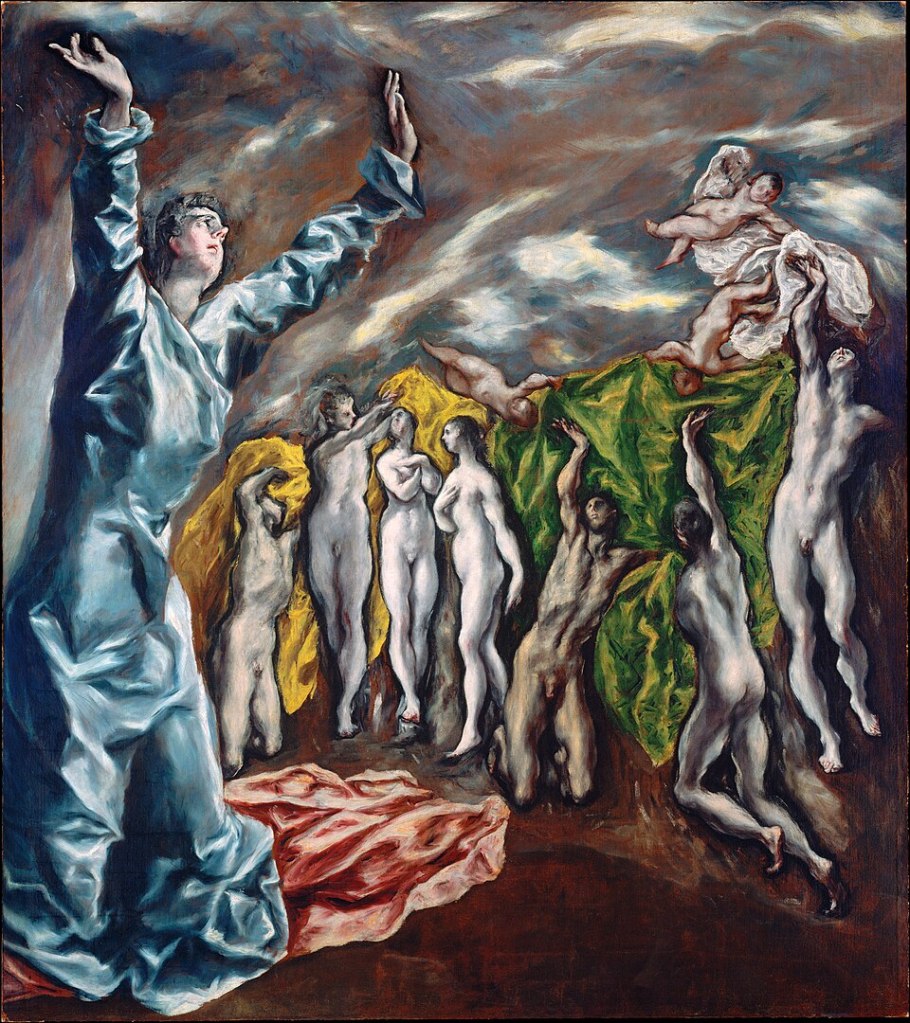
Mann conjures all the mastery of Spanish painters in a Goya’sque[iv] style of the turn of XVII and XIX century: the elongated faces, the eyes full of mysticism or terror as in his famous painting ‘Saturn devouring his son’. He sees and feels Albrecht Dürer[v] depictions of Hell few hundred years prior to Goya.The writer is an opposite – one would assume – of terror or chaos. He is from elegant and very bourgeois Munich – just stone throw away to majestic and also stately Austrian Alps. Yet … yes, there is always an ‘alas’!

Suddenly the elegant world of Herr Aschenbah[vi] collapses. From the stately Bavarian city, the elegant slopes of Austrian Alps, from the elegant hotel in Venice, he takes us to the rocks of Tartarus[vii]. Ang[viii], an ungodly proto-Germanic god dons the mask of hoofed Pan[ix] leading a dancing caravan to the edge of desire, of want unfettered by ethics constructed over millennia to constrain lust and primordial instincts. Greed to posses the ‘other’ – his or her body. Almost like today in my café: noisy, talkative, music pulsating, vibrating, desires shielded from being recognized, yet existing, breathing, sweating.
Mann-writer dons the coat of suitor-painter. Hoofed Pan leads Bests and human folk to dance macabre, bodies twisted by primordial instincts of need and warm mist.
Gustav von Aschenbach watches with fascination, yet with terror, as the body count in diseased Venice climbs. Bu so does the throngs of strange animalistic crowd descending from the slopes of the mountains.
I am myself getting tired of Venice, of the sound of hoofs, strange creatures and I leave my café and go to my apartment shielded from all the pandemonium. Leave Tadzio, leave Venice and Valhalla, leave Thomas Mann and his desires. Adieu to all, I am off to bed.
Next day. I left and slept. But gods, the hoofs, the desires beautifully-innocent and the animalistic – they stayed up, waiting for me to finish their story.
Went again to Moodswing Café. All the creatures and characters from the book waited for me. Why should I write your stories? Because the reader?! What more does the reader need to know? An orgy in Elysian Fields[x]? Eurydice turning her back to Orpheus? The River of Forgetting?
No! I have much darker future to foretell you. On my own will, not forced by powers untold.
I wish upon you a march, a cavalcade if you will through the boring meadows of mundane, fields of ordinary days and nights without dreams. Maybe even worse – memories of youth vanishing bit by tiny bit until the Etruscan vases from red clay will dry up. You will no longer remember Alexander and his lover, whom he made himself a living god; you will not recognize young Tadzio sitting on Lido in Venice. But you will survive. You will not die there. You will live a long life somewhere in boring Bavaria forever regretting your cowardice and asking why did you not taste the sweetness of Tadzio’s lips? Never.
Trust me – that torment is hundredfold more terrifying than sudden death in Venice. Thus spoke Zarathustra[xi]. And who would dare to challenge god?
[i] T. Mann, “Death in Venice”, trans. by J. Neugroschel; pub. by VIKING in 1998
[ii] from Biblical ‘Book of Revelation’.
[iv] Francisco Goya | Biography, Art, Paintings, Etchings, & Facts | Britannica
[v] Albrecht Durer | Biography, Prints, Paintings, Woodcuts, Adam and Eve, & Facts | Britannica
[vi] Mann’s – no doubt – self portrait in ‘Death in Venice’
[vii] Tartarus: The Greek Prison at the Bottom of Universe | History Cooperative
[viii] ANGST Definition & Meaning – Merriam-Webster
[ix] Pan • Facts and Information on the God Pan
[x] ELYSIUM Definition & Meaning – Merriam-Webster
[xi] Thus Spake Zarathustra – Wikisource, the free online library

 > > Pogwarki < <