Thomas Mann raz jeszcze. Z pytaniem.

“Tristana” Tomasza Manna było mi trudno czytać. Więlokroć po jednej-dwóch kartkach odkładałem zmęczony tym, znużony. W zasadzie zły, że pisze tym mieszczańskim językiem Weimaru. Gorzej – rzekłbym językiem drobnomieszczańskim z pretensjami do mieszczańskiego. Prowincjusze udający berlińczyków. Pytałem sam siebie, po co on to pisał, co gorsze: po co opublikował? On, Mann – pisarz extraordinaire.

Nudne, jak flaki w oleju, jedno z setek pisanych wówczas, a dziś niepamiętanych przez nikogo opowiadań drobnomieszczańskich. Taki pseudo-literacki bidermajerek: kanapa niby wygodna, ale pachnąca kurzem i upudrowanym potem i herbata koloru żółtej słomki (brrrr…) w filiżankach ustawionych na wylakierowanym stoliku a’la Ludwik XIV (kiepska kopia). Wiecie, taka wizyta, gdy bierze się udział w rozmowie tylko po to, by nie zasnąć ze znudzenia. Dlatego chyba czytałem tak po dwie kartki, z cichą jednak nadzieją, że gdzieś Manna-pisarza odnajdę.

                I nie pomyliłem się, nie zawiodłem, choć w niczym nie zmienia to mojej opinii o wstępie i sporej części opowiadania. Otóż nadchodzi (w końcu!) moment, gdy wysuszona z pragnień, marzeń i zdrowia (choć nie jest kobietą starą) pani Kloterjahnowa, za namową osoby bardziej jeszcze przegranej życiowo (nieudany pisarz i dość odpychający fizycznie), pana Spinella, zasiada za fortepianem. Po raz pierwszy od czasów dzieciństwa i wczesnej młodości.

Fortepian, Chopin, wizja Schillera – zmienia wszystko w okamgnieniu. Wraca za sprawą muzyki do tejże młodości i szczęśliwego dzieciństwa przy boku troskliwego ojca. Ich domu rodzinnego, który był oazą dobroci i bezpieczeństwa. Czasu, gdy była szczęśliwa, radosna; do Wagnera i jego pieśni o Tristanie i Izoldzie – arturiańskiego eposu z czasów Rycerzy Okrągłego Stołu.

Wie, że nie może, nie ma prawa ni podstaw narzekać na swoje małżeństwo, na statecznego i zamożnego męża mającego mir w otoczeniu. Ale tu, teraz w tym sanatorium za namową biednego pana Spinella zasiada do swojej muzyku, którą pamiętała ze świata tamtej młodości, gdy nie nazywała się Panią Klotherjahnową. Nie, wtedy była sobą, miała swoje własne nazwisko, miała swoje własne marzenia.  /…/

Więc jednak Tristan i Izolda, jednak powrót do tęsknoty, do marzeń o szczęściu, do schillerowskiego sehnsucht[i].

W dobrej literaturze na ogół zawsze gdzieś snuje się cień pytania, bez względu na zasadniczy nurt powieści lub poematu, o poszukiwanie siebie. O powrocie do dzieciństwa, do młodości i pytanie: co we mnie zostało dziś z tamtego mnie? Czy ‘zdradziłem’ siebie, czy pozostałem sobie wierny? Pamiętam tamtego, ale czy tamten by mnie dziś poznał? I nie chodzi wszak o osobę, raczej o osobowość.

Historia Frau Klotherjahn z „Tristana”[ii] Manna te pytania postawiła i przede mną. Nie tylko ta historia i nie po raz pierwszy. Nigdy nie jestem w stu procentach pewny, czy znalezione odpowiedzi były prawdziwe, lub czy były autentycznie szczere. Zakładałem, że były. Wydaje się, że kłamać sobie samemu jest bezsensowne. Ale może odpowiedzi były sentymentalnym chciejstwem, a nie logiczną i racjonalną analizą? I czy bycie jest istotne, potrzebne?

Czasem zmęczony jestem próbowaniem bycia. Znudziło mnie bycie sobą. Tyle lat już to robię. A bycie sobą wcale nie jest ani proste ani łatwe, ani niewymagające czasu. Wydaje mi się, że dla wielu to brzmi dziwnie: cóż jest prostszego od bycia sobą?! Przecież wystarczy rano wstać i już nic więcej. Nikogo nie musisz udawać, grać jakiejkolwiek roli, po prostu bądź sobą!

I zaraz wątpliwość się wślizguje w ten tok myślenia: a skąd wiesz kim jesteś? Czy jeszcze pamiętasz? Od dziecka pakują ci w głowę formułki, konwenanse, zasady, normy. Człowiekowi bardzo młodemu łatwo wpaść w tą rolę, ten algorytm. Ale czy to ty? Czy jesteś?


[i] Sehnsucht, by Veronica Esposito | World Literature Today

[ii] ze zbioru „Death In Venice and other tales”, Viking Press 1998; s.105

Mann, Pandemonium and Tadzio

Mann, Pandemonium and Tadzio

Reading again the masterwork of Thomas Mann titled “Death in Venice”[i] took me to the edges of my agony of Love and Desire impossible. Of dreams and fears realized intellectually, but holding you emotionally as a powerless prisoner nonetheless.

Where is the line, the edge beyond which we are too weak to venture – and yet, we are crossing the borders all the time, becoming the papier-mâché dolls, whose strings are pulled by the demons and angels alike? Love and desire are narcotics, and we are the addicts. It is an ageless addiction, timeless struggle.

Mann’s writing is his Shakespeare’s “Romeo and Juliet”, his Dante’s ‘Divine Comedy’. But don’t be fooled by it as the only cornerstones of the emotional battles for they are also rooted in “Tristan and Isolde” of Wagnerian genes (through the musically insane “The Ring of Nibelung”). What is interesting is the fact that Wagner, due to his own romantic upheavals and problems, had to escape to … Venice to finish composing ‘Tristan and Isolde’. If Wagnerian music is added to the old Germanic mix (certainly known to Mann), than we can’t escape the influences of Valhalla! You imagination easily conjures the terrifying images of heavy hooves of heavy horses crossing the Alps, steam and foam escaping their nostrils, as they are marching to plunder and murder Greco-Italian vestiges of elegance and order.  They are not galloping to discuss the politics and laws on Capitol nor the philosophical counterpoints on Agora in Athens. They are galloping to wash Rome and Athens with Roman and Grecian blood! The horses of Apocalypse at the end of times[ii].

                Let us go back to temporary time. Here and now, to Moodswing Café in New Westminster[iii]. Pandemonium in my café, where I go on almost daily routine to write and to have my coffee. Always the same coffee – almost boring – but also a small sign of some order in my chaotic life, some ordinary habit. I came for that coffee and to finish reading Mann’s short story from Venice.

And I encountered pandemonium in that regularly quiet café: hardly a standing spot anywhere. Throngs of bodies, all sitting places taken. Gathering of folks from Rainbow Coalition.

By my table just a solitary fellow. I push few standing gatherers aside and sat by that table next to him. I placed my coffee there, ordered a snifter of wonderful Hennessy, took out my notebook, a pen and put it all on that little table. There was certainly very little place left for this fellow and his drink. He looked perplexed and asked me (without a hint of malice or any anger) very simple question: are you going to write in all that noise and crowd? I gave him a perplexed look and answered without any malice neither: Why wouldn’t I? I am w writer and writing is what I do, I’m not a mingler or joiner of crowds. I write here, by exactly this table. He seemed almost amused by my answer and continued slightly ironically: I didn’t realize it was your table (with the accent on the word ‘your’), should I move somewhere else? I completely disregarded the ironic tone of his question and turned my eyes to his face answering in matter-of-fact tone:  Why? That is very kind and very understanding of you. Thank you very much. For a second or two he was speechless and shocked by my candor, than stood up, looked down at me and asked tersely: are you satisfied now? To which I promptly and honestly replied: But of course! And once again – thanks for your understanding. And I returned to scribbling my notes, as he walked away with a shrug of his arms. You can’t blame me for being honest.

Mann conjures all the mastery of Spanish painters in a Goya’sque[iv] style of the turn of XVII and XIX century: the elongated faces, the eyes full of mysticism or terror as in his famous painting ‘Saturn devouring his son’. He sees and feels Albrecht Dürer[v] depictions of Hell few hundred years prior to Goya.The writer is an opposite – one would assume – of terror or chaos. He is from elegant and very bourgeois Munich – just stone throw away to majestic and also stately Austrian Alps. Yet … yes, there is always an ‘alas’!

Suddenly the elegant world of Herr Aschenbah[vi] collapses. From the stately Bavarian city, the elegant slopes of Austrian Alps, from the elegant hotel in Venice, he takes us to the rocks of Tartarus[vii]. Ang[viii], an ungodly proto-Germanic god dons the mask of hoofed Pan[ix] leading a dancing caravan to the edge of desire, of want unfettered by ethics constructed over millennia to constrain lust and primordial instincts. Greed to posses the ‘other’ – his or her body. Almost like today in my café: noisy, talkative, music pulsating, vibrating, desires shielded from being recognized, yet existing, breathing, sweating.

Mann-writer dons the coat of suitor-painter. Hoofed Pan leads Bests and human folk to dance macabre, bodies twisted by primordial instincts of need and warm mist.

Gustav von Aschenbach watches with fascination, yet with terror, as the body count in diseased Venice climbs. Bu so does the throngs of strange animalistic crowd descending from the slopes of the mountains.

I am myself getting tired of Venice, of the sound of hoofs, strange creatures and I leave my café and go to my apartment shielded from all the pandemonium. Leave Tadzio, leave Venice and Valhalla, leave Thomas Mann and his desires. Adieu to all, I am off to bed.

                Next day. I left and slept. But gods, the hoofs, the desires beautifully-innocent and the animalistic – they stayed up, waiting for me to finish their story.

Went again to Moodswing Café. All the creatures and characters from the book waited for me. Why should I write your stories? Because the reader?! What more does the reader need to know? An orgy in Elysian Fields[x]? Eurydice turning her back to Orpheus? The River of Forgetting?

No! I have much darker future to foretell you. On my own will, not forced by powers untold.

                I wish upon you a march, a cavalcade if you will through the boring meadows of mundane, fields of ordinary days and nights without dreams. Maybe even worse – memories of youth vanishing bit by tiny bit until the Etruscan vases from red clay will dry up. You will no longer remember Alexander and his lover, whom he made himself a living god; you will not recognize young Tadzio sitting on Lido in Venice.  But you will survive. You will not die there. You will live a long life somewhere in boring Bavaria forever regretting your cowardice and asking why did you not taste the sweetness of Tadzio’s lips? Never.

Trust me – that torment is hundredfold more terrifying than sudden death in Venice. Thus spoke Zarathustra[xi]. And who would dare to challenge god? 


[i] T. Mann, “Death in Venice”, trans. by J. Neugroschel; pub. by VIKING in 1998

[ii] from Biblical ‘Book of Revelation’.

[iii] Moodswing Coffee + Bar

[iv] Francisco Goya | Biography, Art, Paintings, Etchings, & Facts | Britannica

[v] Albrecht Durer | Biography, Prints, Paintings, Woodcuts, Adam and Eve, & Facts | Britannica

[vi] Mann’s – no doubt – self portrait in ‘Death in Venice’

[vii] Tartarus: The Greek Prison at the Bottom of Universe | History Cooperative

[viii] ANGST Definition & Meaning – Merriam-Webster

[ix] Pan • Facts and Information on the God Pan

[x] ELYSIUM Definition & Meaning – Merriam-Webster

[xi] Thus Spake Zarathustra – Wikisource, the free online library

My Three Loves

My Three Loves

My Three Loves never left me. I have never left them, nor have I forgotten them. Through all my early years as a teenager, in an old country on the old continent, country that was greyer than the buildings sorrowing people, who lived there.
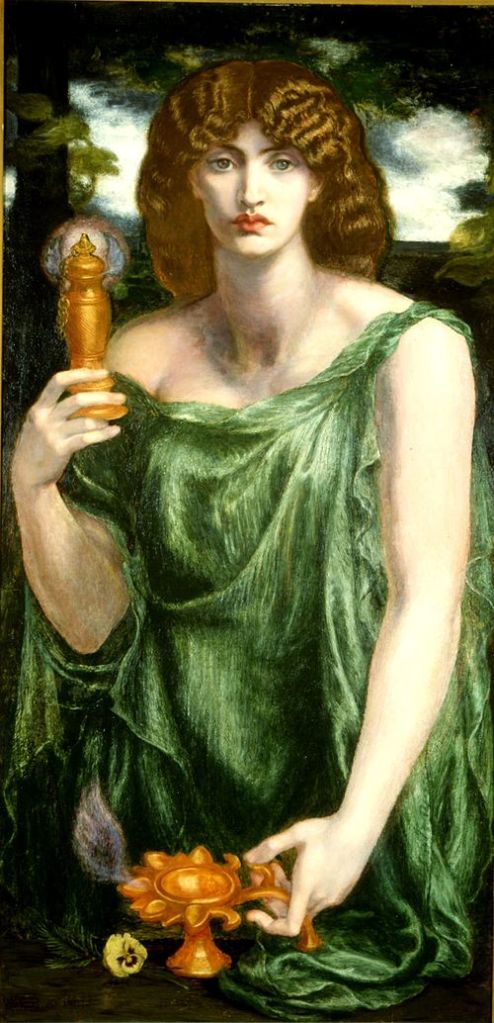
Mnemosyne

(by Dante Rossetti)

But my first love that had sprouted in my heart made it flowering, singing above the roofs of these grey buildings. The city of grey buildings, that rose from the ashes of the worst war that fell upon humankind. Yet – my first love gave it a warm embrace that belongs to the titanic Mnemosyne, mother of all the muses, daughter of Uranus and Gaia[i]. She was not the most sympathetic and meek of Titans with a slightly twisted taste in romantic escapades, after all she also bedded Zeus himself, who was logically speaking … her brother. But who’s blaming anyone? Not the Greek gods (or any gods, god forbid!) for their erotic (diss)behavior. I am merely a human, nothing more. For me then, in the grey city of my grey youth, Mnemosyne was the mother of Muses. That cleared her of any other crimes or indiscretions. Who would anyway, any other way? Surely, not when you are fifteen, seventeen or twenty! Love disregards all and any boundaries. And I was in love! Purely platonic, but fearless and furious; intellectually and emotionally on equal basis. And that love, otherwise called ‘friendship’, stayed with me my entire long life. I have never left her, she stayed with me in my traveling luggage all these decades.

My two other loves happened years after the first one. The next one happened almost unknowingly to my senses. It happened in that old country, still very much grey and poor, but on a threshold of new-found freedom, with dreams and appetites for brighter and greener fields ahead. A boy was borne of familial spring, just like the nymphs chasing after the image of Hyacinthus immortalized by songs of his Olympian lover – the God of Love Itself.  But beware of love offered by gods, my dear boy! They never end well for lesser lovers. I’ll tell you a story here, later on, in the last chapter, of the price I paid for asking for, and being granted the Love Immortal. The grief is as deadly, as the disk of Apollion that killed his lover – Hyacinthus. But wait, I take back these warnings and the words of sorrow and grief. For Love Eternal outlasts grief and sorrow. Each time and every time. Lament is temporary and is a sign of temporarily losing your perspective. If you grief losing a lover – the lover’s love will come back to you in time, for love can’t be solitary. It will seek and enter the other lover’s soul, because Love needs a nest.  

Alas, we went too far in this true fable, the allegoric story of my ordinary life and my Loves Immortal.

Boy was born in the Old Country, as I said. We all rejoiced. Remember walking with my parents, his older sister (a child herself), and the little boy in a walking stroller, a long walk through the countryside near Warsaw, through fields and meadows, to an old palace of some aristocratic imminence and a beautiful stream running through the meadows. Of course, we all loved the new boy. But I had no idea how important, how encompassing, and not always easy at all, that love would be. Didn’t have to wait very long, though, just few more years, few more of my returns to that old familial country and I knew. It was unspoken, unexplained, but very clear. She sprung not suddenly and unexpectedly, didn’t come from ‘the bolt in the sky’ (as it did happen in my last Love Eternal).

It was warmly growing inside me, flowering with tenderness. He was still a child, whom I could carry on my shoulders, as we walked through the streets of that old city that used to be so grey in my youth. But now the city was truly beautiful, transformed by modernity and embracing Western Europe. With that, it embraced the traditions of old Greece, of Zeus and Plato, and Plato’s talks with the boy Phaidros. The sweet youth, who desired his teacher, the old Socrato, and a thought that there must be something wrong with him, since his beloved teacher would not accept the gift of his pupil’s young body. But Socrates was wiser than simple desire. He knew that the boy deserves better than a tired body of not very attractive nor a rich old teacher. That in itself, without any further arguments, proves that Socrat was perhaps in love with that youth and choose of his own will a chanced possibility of better future for Phaidros. A sacrifice, if you will.

Not unlike relationship between Herr Aschenbach and sweet adolescent Tadzio, in “Death in Venice”[ii]. Sweet, tender and innocent – until one afternoon Aschenbach runs away from Tadzio to a park, exhausted and ashamed of himself collapses on a bench and hears himself saying aloud the dreaded proclamation: I love you. But once you say it aloud there is no escape, no turning time back. Ha! That ‘thing’: your desire, your dream could be the abyss of torment. Bliss and condemnation eternal.

What happened in that novella, if it happened and why, is totally irrelevant to our discourse on Love Immortal.  If you want to – buy or borrow that booklet from a library. It is not very long, but definitely it is master class of literature.

Hence – back to our story, my Second Love eternal to that boy from an old capital in Central Europe. Years (not that many in my calendar, but must have felt like an eternity in a teenager’s life of that boy) have passed and that boy, in a pivotal time of transformation into adulthood, comes to me in the New World, across the vast ocean and entire continent in search of his destiny(?), his ways through life. In short: in search of himself. At that time I was already well established, secured and totally committed and enthralled with my lifetime Love Eternal, one that consumed me happily, engulfed, and enthralled me without any hesitation. The one that was romantic and erotic. That boy from the Old Country came here exactly for these reasons, too. Firstly, he knew that I love him dearly and sincerely and I would not offer him anything that would be false, or based on pretense or judgment; would protect him, in as much as I could, from any harm that a sudden freedom can bring too.

That was the time, when my Love for that boy transformed to my Love Eternal: when he stopped being a boy from an Old Country, a nephew, for whom you care enormously – he became my Prodigal Son. Without any too strict connotation to the biblical story (of course, if needed, mistakes and transgressions would be forgiven – what proper father would not?). With another number of years the boy become a mature, well established, and educated man. For any parent, biological or emotional, it sounds like a solid reason to be proud. I am.

My Third Love

How should I name you, how should I call you, by what name? Who you are, who you were, where are you?

I can call you by my name for you are me. I can call you by your name for I am you. I can call you Love for you are My Love. Encompassing all my days and nights. Quivering like a blade of grass on summery meadow. Quivering and fluttering like my heart, when I call your name. I won’t be scared whispering to you: I love you – I will be brimming with pride, when I say it. You, who crossed the continent with me, to be with me. When I asked you, where we should settle for our sunset years, you answered: anywhere where you are going to be, because you are my Home.

When we met at the foothills of majestic Cordillera, bellow the amazing peak of Assiniboine Mountain, on the meadows flowing from the enormous Mount Temple, when we walked in the shadow of Mount Robson I wanted to hold your hand in mine. Wanted to show you how beautiful you look in the glory of these peaks surrounding you. Wanted to ask the angels floating around these peaks to come down and embrace you in their warm, godly wings. Just as I would, if I was a god. Maybe we were the gods? Didn’t we possess the most important attribute of deity: Love Eternal? Love that is everlasting. The Black Angel of Mercy in Hyde Park on Manhattan told us so, when we went on sunny October day to visit him.

When we walked the beaches of Northern Pacific in Tofino telling the anemones the story of our love – they danced in waves of happiness; when we walked the white beaches of Eastern Shore on Atlantic coast of Nova Scotia – the eagles danced above our heads and parasailors smiled seeing us traversing the beach.

You – my Third Love were the epitome of love, the Mount Everest of being alive. If I ever would lose the sense of smell – I would still remember the smell of your skin. If I ever lose my sight – I would still clearly see your eyes. If I ever lose my memory – I would want to not know who I am at all, because I would be nothing without the memory of Our Love.


[i] parents of Zeus

[ii] a novella by Thomas Mann