Yesterday, yesteryear and eons ago

Bogumil Pacak-Gamalski

Walks into yesterdays. Most of my walks lead to trails of the past. Truly, these are the only remnants of familiar vistas, touches, smells and shapes. I go through city parks and kick rotten molds of brown and yellow leafs. Maybe some zephyr will still rise them up – once in the air they will start again whirling round and round: let them feel the fresh air so different from the decayed air of autumn, be full of promise. Just yesterday they were still green, vibrating on the tiny branches of the trunks of their home tree. They rustled in unison with the flutes and clarinets of birds, sojourning on tree branches.

The autumn wind chased me from home, too. It led me to funny memories of my second happiest day of my life: the day of our wedding.  The second, because the first one happened years earlier, when I saw you the very first time. A little gay pub, right by the bridge on 14 Street in Calgary. It was a slow evening. I sat on one end by the bar and two guys were sitting at the other end. No one else. I was overtaken by his face and kept looking at him. The other guy finally spoke to me: let me introduce you to my brother, his name is John. That was it. Never let him off my sight until he died in my arms decades later. It truly is just magical how you can recognize a soul mate right away, when you are lucky enough to meet him.

Years later we got formally married in Surrey. I wasn’t particularly excited about that ceremony. Was a bit angry at society that we couldn’t do it in the 80ties, although Canada truly was the first country to introduce (Holland, for procedural reasons, was able to beat us with their first official marriage license – ours didn’t pass the parliamentary procedures in time to be officially first, and took the formal second place in the world) marriage equality. Therefore I didn’t want the ceremony to overshadow our union that existed for many years already. But truth to be told: I was overtaken with emotions, when I had to say ‘yes’ to the City Clerk in front of my family, John’s family and so many friends. That was magical. 

Right after our wedding we were send off by our families to special, beautiful boutique hotel right in centre of Downtown Vancouver, steps from Art Gallery on Robson.
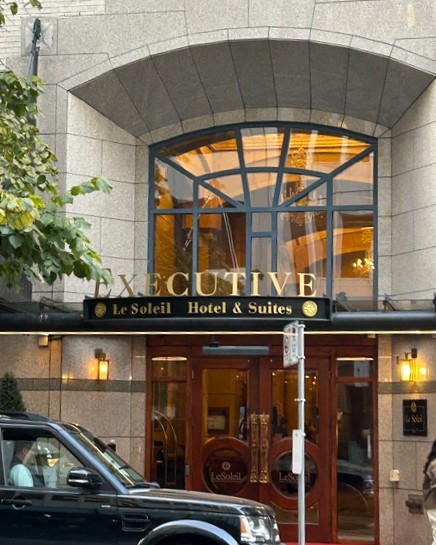
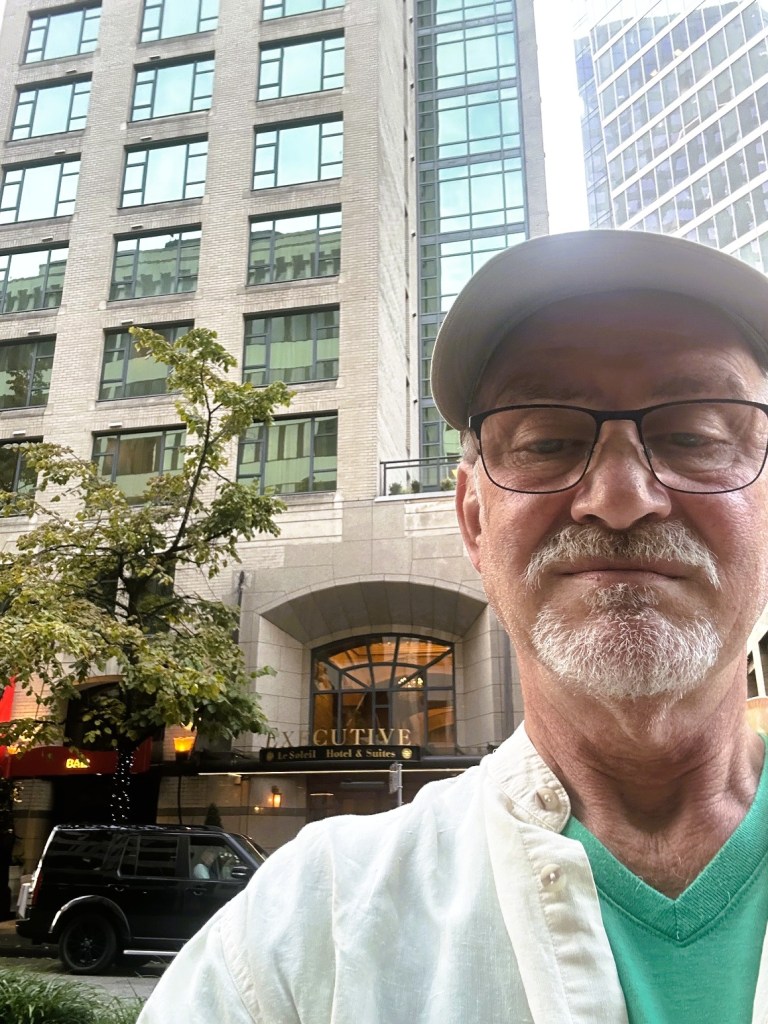
So the autumn wind chased me today to that hotel. Our formal first night as a formally married couple happened there. It didn’t dampen or made less important our first meeting and years of being together. It made it somehow stronger, if possible.

After that I walked to our Davie Street through the Nelson Park and the little enchanted walkway on Mole Hill. Was I sad at times? I am sad and happy all the time. It is just the way it is. It took me a while to get to the point of not being just sad all the time, of actually despising being alive. I don’t cling to it, to that life of mine, but I don’t detest it anymore. I have learnt to love Love. From songs, from poems, movies, from observing couples walking together holding hands.

We walk through galleries of life:

a picture on the wall here,

a bust of lovely youth there.

We enter concert halls of life:

a longing cry of violin here,

bravado of mature pianist there.

What do we do at night,

between long lonely hours

from crimson dusk to pinky dawn?

We dream of kiss, of love.

We wait in our nightly sleep

for a white dove to sit on our pillow.

A dove that brings a song

of upheavals and song of peace.

Song dreamt of by cosmic

choir of see-trough angels,

who cry and rejoice in unison

For such is Cosmos: a star is born

                               when a star dies.
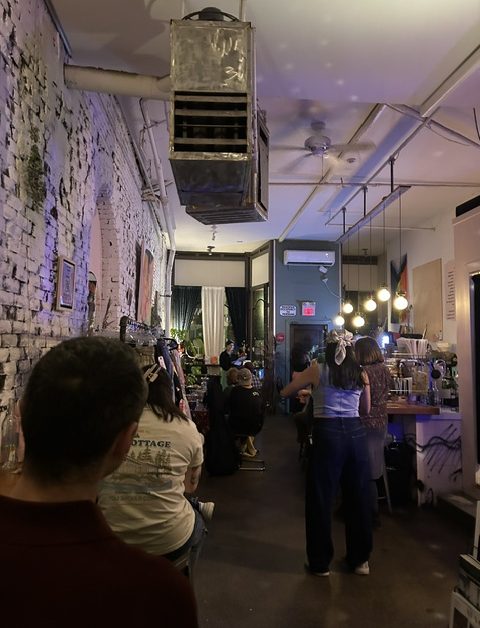
            On y way back home I have stopped for my cup of Americano in ‘my’ café ‘Moodswing’ on Front Street in New Westminster. My second home, so to speak. A places where many my poems were written, many books read.

I was at first a bit disappointed: the narrow room was full of people. After searching a little bit, I have found a spot to sit right by the wall, by narrow shelf that can hold a cup. As I was sitting and looking through my back for my wallet, so I can go and order at least my coffee, Ricky the co-owner arrived with my hot coffee the way I like. Nice gesture, since I didn’t have to go through the throng to the ordering spot (there is no table service in there if you order just the coffee, which suits me fine) for it. A kind gesture, knowing that he must be very busy.
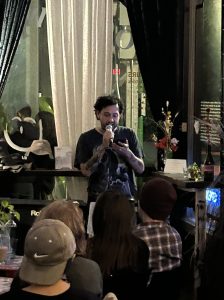
I thought it was some sort of meeting that happens there from time to time. But next thing I see there is a woman reciting poetry, than a young fellow goes to the mike and does the same. Than Ricky goes there himself and recites his poem! For all these months I was sitting there writing my things and our typical talks – he never mentioned that he writes poetry, too! Later I gave him a verbal lashing for hiding it from me, LOL.  He promised me to show me more and I probably will publish it here, on my blog.

So, as it happens it was a poetry slam. I just never noticed any info about it – I hardly ever read the board with announcements. Just like to have small chats, drink my coffee and write in my notebook He asked me if I will read something mine. Didn’t have any with me, but than remember that I can search on my phone my blog and found something there. It was probably the very first time I read publicly my poem from … my phone screen, LOL.  How modern, ha ha ha. Of course the first in English that I found and the one I read was rather long and difficult one, full of historical parables to of Hannibal and Alexander the Great, all dedicated to French genius Andre Gide. Hopefully it didn’t look like I was a pompous ass.

Below is the poem dedicated to Andre Gide.

Winter time in a small village in Pyrenees.

Night comes quickly and darkness covers

the valleys and peaks. Suddenly, the windows

off a small stony church lights up in delicate

orange glow. From the top of the church steeple

comes the song of its bells: big bam! Big bam!

big!, big! big! Bam! Bam! Bam! Baaaam-mmm!

The air vibrates with each tone of the big bell

and sends  bronze-coloured sounds to the valleys.

Archangel Michael blows into long, golden trumpet.

The music envelopes the meadows, climbs up the hills.

The call of God, the call of the Shepherd: 

come and be enlighten in the mystery of life

 and promise of death merciful that claims us all.

They run – the tired travelers, the herds of goats.

They cry and hope, as the trumpet sounds again

and dies suddenly like the last drop of now empty goblet.

The church becomes a masjid and archangel becomes muezzin,

that intones to all: Allāhu ʾAkbar. In Pyrenees Hannibal’s army

stop their march and rise their tusks and trunks: they sense the pitch

of the hymn and the psalm as the far flung peaks of Alps slowly

cover the church, the mosque and streams in the valleys.

The curtain call of History. Birth and death of Love.

Moodswing Café, 29. 05.26

B. Pacak-Gamalski
Thomas Mann in another part of the forest

Thomas Mann and Klaus Mann – father and son – have brought me back to reading novels. I have mentioned long time ago, that I have given up that old habit quite a few years ago. 

After you consume rather large amount of certain dishes – you got tired of it. You recognize the same sauces, the same spices and little culinary tricks repeated by all writers.

Granted, I am not very verse in all the current new titles – but it takes more than one generation and at least and epoch to change it substantially. I do still browse through the new titles a bit at the beginning, a bit in the middle, and the epilog. It is very predictable, even if put nicely together. 

But Klaus Mann, whom I have not read that much in years gone long ago, sparked my interest again in novel. I have written about it on these pages very recently, therefore I will not expand on it again.

Suffice to say, due to my own tragedy of immense Loss, his treatment and writing on the subject of love brought back to me the beauty of love, the sorrow of its end – and absolutely undisputable power of that amazing feeling. No loss is ever going to be greater than the experience of love, and no price is too big to pay for it later.

His stories in three short novels, of Alexander the Great and of two friends and the absolute and delicate way he wrote and composed it were exquisite.  His tenderness of portraying these feelings gave me strength to write about them from my own perspective, my own experience. Somehow Klaus Mann became my friend, my confidante. My writing about Love and Loss was like meeting him in a café in Berlin or in Paris, perhaps even in New York and just talking about it. About his searches and mine. Books (good books) do that sometimes to you. Hence my posts were not per se reviews of young Mann’s books, but a case of mutual conversation, in a manner of speech, naturally. Below are links to this texts of mine:

Sprawa zakochania się w tekście literackim – > > Pogwarki < <

Vancouver sunsetting, Vancouver’s English Bay – > > Pogwarki < <

Na szczytach Olimpu z moim Hefajstionem – > > Pogwarki < <

Our talks in Babylon – > > Pogwarki < <

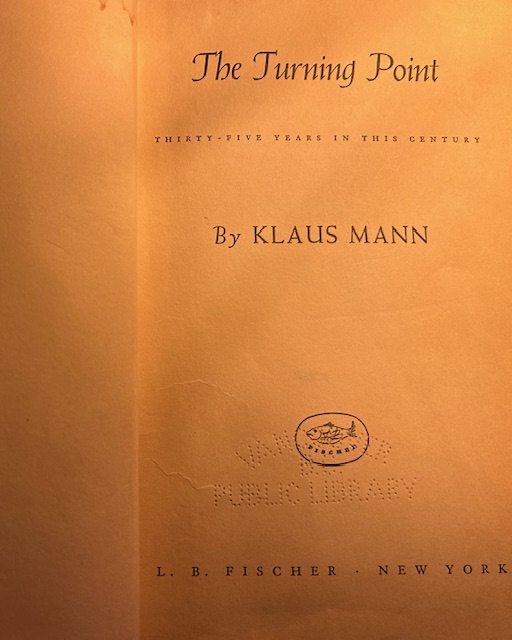
That prompted me to look for his big volume of memoires “The turning point. Thirty-five years in this century”[i].  I went to our Main Library in Vancouver to get that book. They didn’t have it on the shelf but brought it to me from some sort of warehouse room were some books spent for some reasons a solitary life. Not for eternity, mind you, LOL. Maybe it needed some fixing, repairs?  It was not in the best shape. After all – that book was published … 84 years ago! Since I liked Thomas already and knew that he wrote about French writer Andre Gide, who happens to be my very much liked writer – I asked for that book, too. This time it was supposed to be on shelf not in some purgatory warehouse. I got the coded number, went to right spot – and the book wasn’t there. Returned to that young library assistant, who got me the big book of Mann memoires and ask him if he could find me that book. He said with a smile: of course, just follow me. I did. But he was going to big section called “English Literature”. So, I stopped him and asked why is going there, instead to were Mann’s book should be. His answer just astonished me and made me giggle a bit. The answer was: well, this book is in English in our catalogue.

God have mercy!  – I almost shouted.  Instead, I just explained to him –  My dear young man, you have that book in English language, but it is a German writer. Therefore it is, as it should be, in “World Literature “section. The same as Victor Hugo, Pablo Neruda, Dostoyevsky and hundreds of other writers, who were of other nationalities and wrote in other languages. 

Let me remind you again dear reader – that young and pleasant fellow was an assistant in the Main Library in a very big metropolitan city. O, tempora, o mores …

Back at the right section he did re-checked the shelves from top to bottom and the book really wasn’t there.  Too bad, but of course it was not his fault. We were just about to leave when he noticed a book at the bottom and happily announced: there it is! That book about your Gide!  I have noticed that book earlier. No, it was not written by Klaus Mann. That was the reason I went to him to help me searching for the right one. That one he pointed to was by another well known writer and  I have read his book many, many years ago, when I was working on series of articles about the history of gay-themed literature written often by gay writers or scholars.

By then I was truly tired mentally and physically and my leg was hurting. His jumping the gun and prematurely announcing that fateful: I know proved that he didn’t know and didn’t listen, arrogantly thinking that he did.

 Was he an arrogant? Maybe that would be too harsh a judgment. But I wish he listened more acutely and paid more attention to question being raised. After all, he was a library assistant. And I did ask him about a book by Klaus Mann. Not another (albeit very famous in his own right) author.

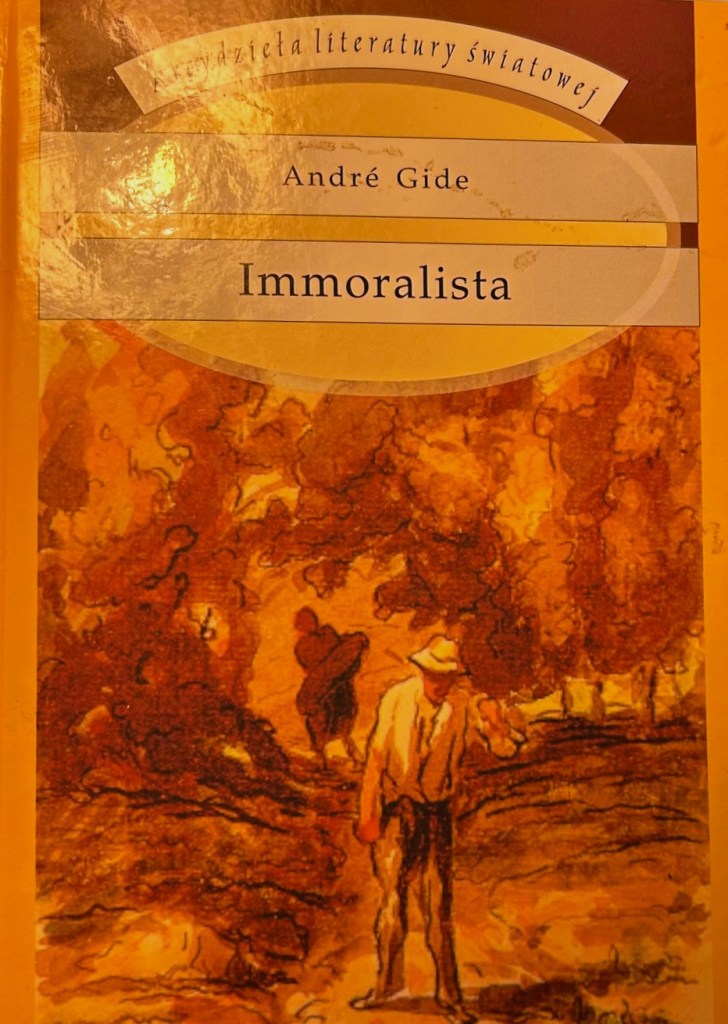
When I went home I reached to my bookshelves and retrieved from there my copy of Andre Gide “L ‘Immoraliste”[ii] and read it again. What a pleasure. 

At the end I was not angry. Actually, it was sort of amusing. I think that it was a good chance (remember – Main Library in major city) of him being a graduate of some university’s (or college, the very least) Humanities Faculty. My librarian in my Junior School was not the nicest lady. But she knew her stuff.  It meant she knew books. O tempora, o mores, my dear Cicero, LOL.

                Wouldn’t be myself if I have missed the possibility of being … arrogant about well know book. Yes, the very voluminous volume of Klaus Mann (with the help of his dear sister, Erika) autobiography “The turning point. Thirty-five years in this century”.  I have borrowed it and had to read it. Well, almost. I did huge portion of it, admittedly. Many scholars admire the book. I thought it was an awful way of writing autobiography. There are few ways to do it interestingly – he just mixed them all together, filled with thousands of totally unimportant details of country, cities he lived in (especially as a very young lad, well before becoming a writer), complicated  and not that influential on himself familial connections: just way too much to consume, page after page. I wish it was half as thick. All in a total contrast to a very concise way of writing his novels. There were certainly paragraphs, sections very important to know about him and his world, but at the end it was a dinner that had way too many side dishes. At times, you felt like a guest at a dinner, who just thinks o himself: is it ever going to end? If I still want to read his book about Andre Gide, it is for one reason only: Gide. Thomas was the last good writer (he was a good writer, as I said), who went to Paris and to spent time there and to get to know the great Gide. Gide was already very mature and older writer, decades older then young Mann.  Thomas told him, he will write a book about great Andre Gide. Gide, who knew Paul Verlaine and Arthur Rimbaud! All of it, young bisexual Klaus Mann, his adored French poet bisexual Andre Gide and his connection to scandalizing stars of homosexual Paris in XIX century of the decadent period.  A story from my forest, and a forest I spent many years of writing about and reading about all of them (except Klaus Mann, whom I just met his year, LOL).  Just like that absolutely glorious book published many years ago here in Canada: “Meanville , in another part of the forest”[iii].             


[i] “The turning point/thirty-five years in this century”, Klaus Mann, pub. by M.L.B. Fisher, New York, 1944

[ii] A. Gide, “Immoralista”, trans. by Izabella Rogozinska; wyd. Zielona Sowa; Krakow, PL, 2006

[iii] “Meanwhile in another part of the forest. Gay stories from Alice Munro to Yukio Mishima” edited by A. Manguel and C. Stephenson; pub. by Alfred A. Knoph Canada; 1994, Toront