Bogumil Pacak-Gamalski
It is the most beautiful time of the year in Vancouver, particularly in the West End and around the Lost Lagoon, the charming gateway to Stanley Park. On a sunny day is all a song, a poem. The time of flowering umbrellas of rosy cherry trees, of majestic magnolias, and the tiny flowers of children sprouting from the soil in multitude of colours. The singing birds returned to their nests, their homes on the branches of massive trees. Their colossal migration almost done, they are back at home. A reflection comes to mind: just as my migration finishes. Back home, all the way from the shores of mighty Atlantic, across the vast continent.
With a book in hand I read familiar story of another traveler: Alexander, the young king of Macedonia. I have read many accounts of the ancient story written by historian and writers. The story of conquests and of battles and a story of searching for love.
Yes, there were numerous battles small and great; there were many corpses of his soldiers and generals – but all of it does not matter. In the annals of history of man there are always battlefields and dead bodies strewn on the banks of some great rivers, on the shores of some seas.
But the quest for love is different than the quest for land, or hegemony. The quest for love is worthy of all and every battle and the only thing when murder and death are excusable. For what is greater than She after all? She gives meaning to live and She excuses death.
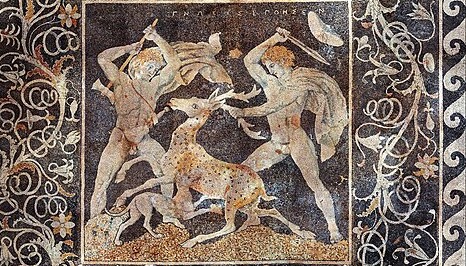
Alexander and Hephaestion
hunting a stag
As I read the story again[i] – the battles and the fallen soldiers and generals do not matter to me. It is the travel through lands unknown bringing chances of love and romances that matters to me. How had it changed him? Each culture enriched him, each lovemaking, with a woman or man made him different, too. He was no longer Alexander of Macedonia, no longer even Macedonian nor Greek. He was the Great Alexander. Man, who could have had anyone and anything. Did he? Did he quenched his thirst, filled his hunger?
At the very end: was it one, big irony that his conquer had defeated him? Whom should I ask? Gilgamesh[ii] or the great poet Rumi[iii] of XCCC century Persia?
Indeed funny, that it brings me to these names. Not to Shakespeare, or even Dante Alighieri – they are just famous copiers of stories of ancient Love Immortal, or very much deadly indeed – Love Mortal.
The story, a tale perhaps, as told by no one other than Klaus Mann (himself a hunter of love) brings me my own memory. As he (Mann) of Alexander’s stay in Babylon – the cradle of civilization – he recounts the young king visit and tribute to Ishtar[iv], who was so instrumental for the fate of Gilgamesh. Moreover, he mentions Alexander visit to the temple of Marduk [p. 89]. The temple was from the times of king Nebuchadnezzar[v] .
I have never been a sculptor. Yet, in the equally ancient time of my childhood, being maybe a boy of twelve, maybe thirteen, I did with my own hands sculpted from the red clay of Masovia a small figurine of Marduk sitting on a large throne, with his beard coiffure intricately in layers – the way the Bavylonians did in the time of Nebuchadnezzar. Ha! A friend of my father (who was, unlike me, a formally trained sculptor) grabbed that sculpture of mine, called it ‘marvelous’ and took it to some local small museum somewhere in or around Olsztyn in Masurian forest. Never seen it since, nor heard of it again, LOL. Perhaps it still is on some dusty shelf there (where exactly?), LOL. Sufficient to say I have never sculpted again. There is certainly enough of Rodins in Louvres of the world.
The old gods of Syria and Mesopotamia did not touched me and Marduk wasn’t exactly a god of love, more a god of war and revenge. Nonetheless, a god. But let’s go to our Alexander. Our lovely, terrifying, amorous, beautiful and merciless Boy-King in his quest for love. Love – the only thing that is immortal in the lives of silly kings and heroes through our entire history.
Mann states: ‘He wanted to be loved, and nothing was more important to him.’ [p. 89] .
I am not a sculptor, I am just a poet. Let me try to say it clearly in versed form:
In the Gardens of Semiramis love grew
in rows on cascading steps of all colours;
of aromas conquering their souls and hearts.
Was it forever mine to claim, cherish, to behold?
When my king will lead me to battle
and I will be slain by a sword or an arrow –
I will be happy to say: I have been loved
and I was in love. My destiny was fulfilled.
(by B. Pacak-Gamalski, March 2026)
Alexander galloping through Asia on his beloved Bucephallus comes to Egypt. There he wants his lover to be made a god. Immortal. Hephaestion is denied the transformation (as given previously for Alexander himself) and is forced to be contained with a lesser denomination as a hero. But it is of no use for him, he already was given the ultimate prize, the highest possibly – a love eternal from his Beloved himself – Alexander. When he dies Alexander weeps for days as he lays on the body of his friend and lover, when he dies. Soon after that tragic death, Alexander dies himself. Did he loved as much the young eunuch boy, so beautiful Bagoas? He did likely in the moment they were kissing, but his soul was already given totally to Hephaestion.
Gods are not very forgiving to people for their all-consuming great loves. It threatens the love and adoration they expect from men toward the gods, not other mortals. But gods are blind, too. They think too much of themselves, perhaps they love themselves too much? For everything is mortal: people, heroes and gods. The only thing immortal is Love itself.
I should know a bit about it, for I have met Love once in my short journey. Au Wiedersefen, Herr Mann, goodbye my dear god-like Alexander.
[i] Klaus Mann “Alexander”, pub. Hesperus Press Ltd; London, 2007
[ii] Gilgamesh | Epic, Summary, & Facts | Britannica
[iii] Rumi – World History Encyclopedia
[iv] Ishtar | Goddess, Worship, & Facts | Britannica
[v] Nebuchadnezzar II | Biography, Accomplishments, & Facts | Britannica
 > > Pogwarki < <