A poet from my cafe – Ricky Castanedo Laredo

Bogumil Pacak-Gamalski

You all know that a lot of my own poetry a lot of times starts life in one of my notebooks in one of my favored cafes: in Vancouver’s “Melriches”, in New Westminster’s in “Moodswing”, In Halifax in “Trident Bookstore Cafe”, in Warsaw in “Miedzy nami” Cafe on Bracka Street. Sometime in cafes in Frankfurt, Berlin, Hamburg.

Of course between coffees and cakes I get to to know all my baristas and waitresses from these cafes. We talk about things. Sometime we talk about literature or just about life. After all – life is literature, that was not written in a book yet. Not entire life anyway, just a little tidbits of it.

But I have not known yet any barista from such cafe, who was a poet. I mean – I do understand that a lot of people sometime write a short poem here and there – that does not make them a poet, though, just the same as someone, who plays guitar or piano is not neccessarily a composer.

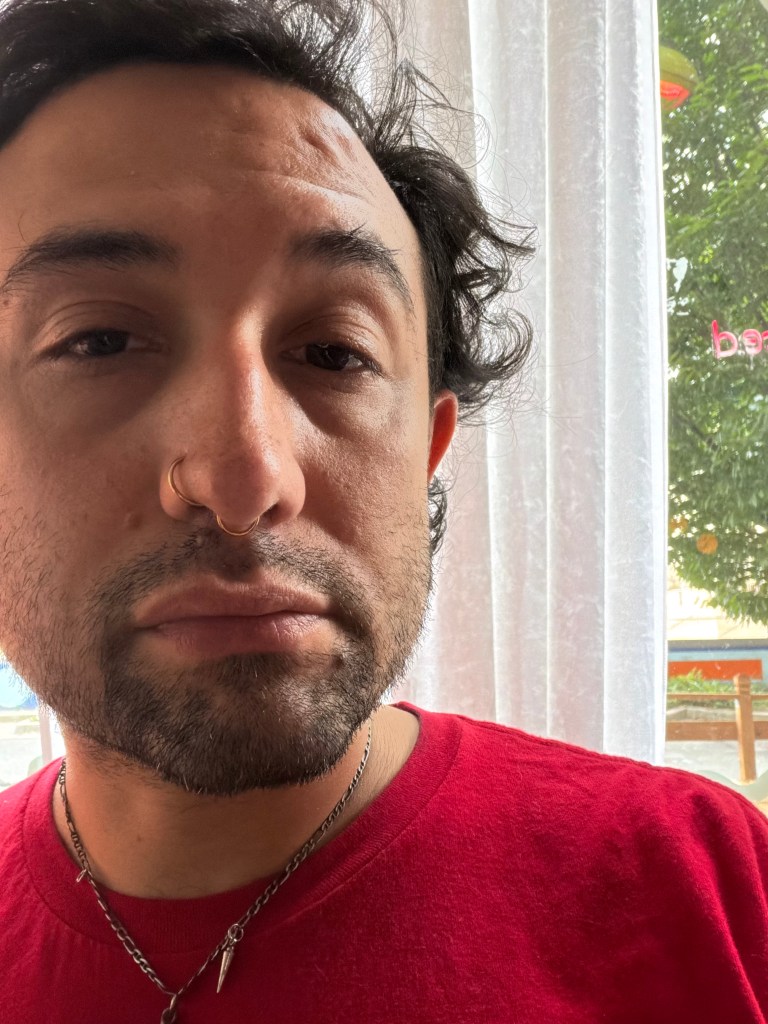
Ricky is my barista in the “Moodswing” cafe on the Front Street in New West. (clik for a link https://www.moodswingbar.com/)

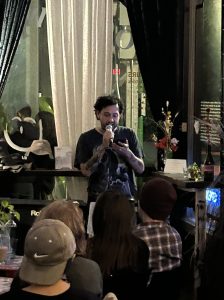
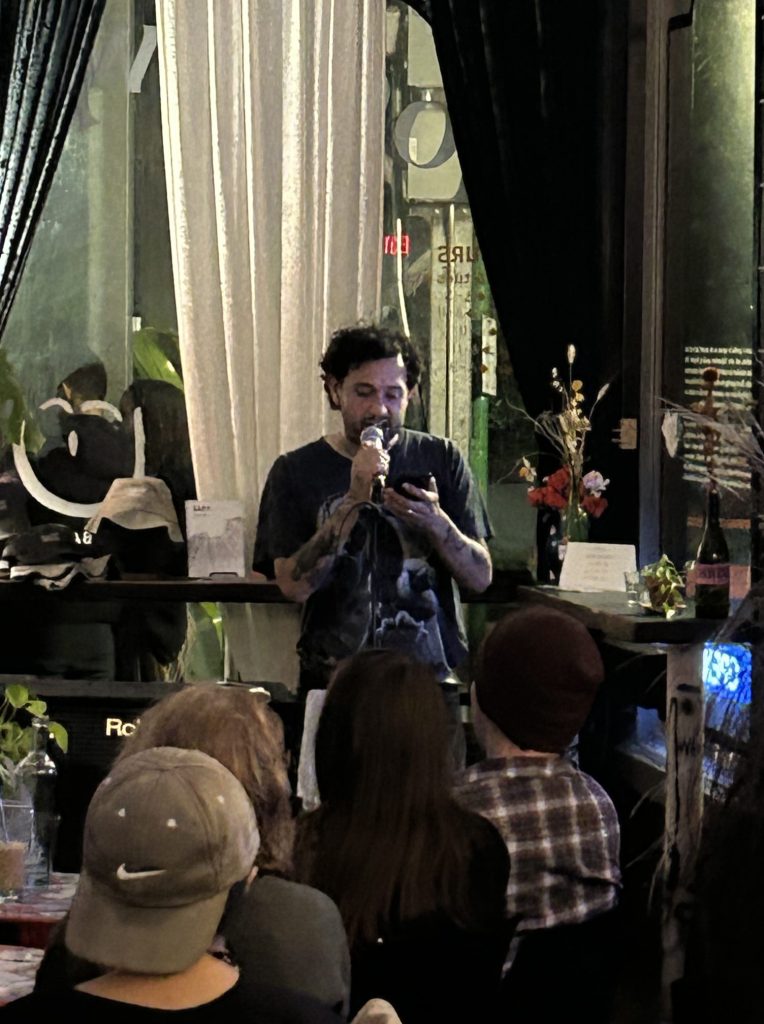
Sometime in these cafe some poets gather and have their poetry slam. Sometimes I partake. Well, the last one was a surprise for me since I didn’t expect it, just came for my daily coffee. At the end I did find on my phone one of my poems and recited it. But … the surprise came later. Ricky Castanedo Laredo, my barista, came to the mike and recited his. I liked it very much. I knew that he is a co-editor in one of local artistic magazines but never suspected that he also publishes his own poetry.

Therefore, ladies and gentlemen, without further ado, welcome to the poetry of Ricky Laredo
turn the world upside down

turn the world upside down
press your hands through the pane
the pain, unforgiving in it’s weight
both in breath and titanic
we must be afraid all of the time

unease, real as the slam of car doors in the woods
the slice of metal against blood
the ache of earthlings looking for a place to die
a heaven, a place by the sea
a place where I am not afraid all of the time

remembers your grandmothers hands
and her last words
pressure wash the memory
turn the world upside down
as the engine outside bellows
the keys live in the cupboard should you
ever need them

I can’t hold this all in mind
like the light you emit that only invites
the moths inside
I want to erase the path that leads you back
to me, and scuffs the traces
of my exoskeleton

turn the world upside down
I hope I don’t have enough time to do that for you
to stabilize the illusion
before they wipe the footage

shelf

I wanted a shelf for perdition
for all the lint from my pocket
a resting place from transition
like keys and debt and death
who’s lumbering outside?
who peers through the window?
we are surrounded every day
you leave through the back door
you bend out of frame
wired like wind through the house
at night I see you galloping
proving me wrong for the last time
yearning under darkness

shade grown

speak of faith in distant moments

necking shrines pouring

the umbre out

underneath the bells

underneath the pain

underneath the heavy

of death’s

aching jowl

repeat and return

throw shade and

bear witness because

you shouldn’t lose this

but what if I’m better off without

the world

respite if just for a day

fingernails on the bend

of my arm

envious of your youth

and

I cast a long shadow across the bed

I’m flowering

turbulent

shade grown

keep the fan on

even when it’s cold outside
Yesterday, yesteryear and eons ago

Bogumil Pacak-Gamalski

Walks into yesterdays. Most of my walks lead to trails of the past. Truly, these are the only remnants of familiar vistas, touches, smells and shapes. I go through city parks and kick rotten molds of brown and yellow leafs. Maybe some zephyr will still rise them up – once in the air they will start again whirling round and round: let them feel the fresh air so different from the decayed air of autumn, be full of promise. Just yesterday they were still green, vibrating on the tiny branches of the trunks of their home tree. They rustled in unison with the flutes and clarinets of birds, sojourning on tree branches.

The autumn wind chased me from home, too. It led me to funny memories of my second happiest day of my life: the day of our wedding.  The second, because the first one happened years earlier, when I saw you the very first time. A little gay pub, right by the bridge on 14 Street in Calgary. It was a slow evening. I sat on one end by the bar and two guys were sitting at the other end. No one else. I was overtaken by his face and kept looking at him. The other guy finally spoke to me: let me introduce you to my brother, his name is John. That was it. Never let him off my sight until he died in my arms decades later. It truly is just magical how you can recognize a soul mate right away, when you are lucky enough to meet him.

Years later we got formally married in Surrey. I wasn’t particularly excited about that ceremony. Was a bit angry at society that we couldn’t do it in the 80ties, although Canada truly was the first country to introduce (Holland, for procedural reasons, was able to beat us with their first official marriage license – ours didn’t pass the parliamentary procedures in time to be officially first, and took the formal second place in the world) marriage equality. Therefore I didn’t want the ceremony to overshadow our union that existed for many years already. But truth to be told: I was overtaken with emotions, when I had to say ‘yes’ to the City Clerk in front of my family, John’s family and so many friends. That was magical. 

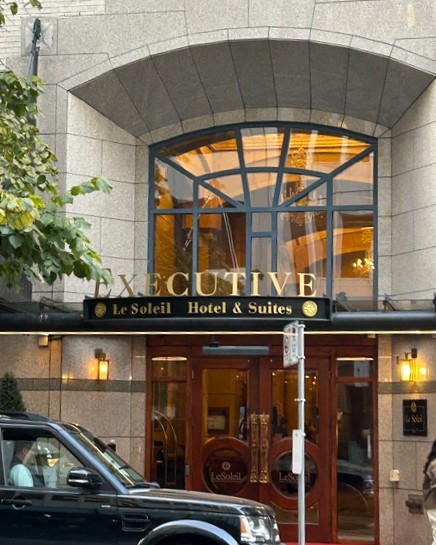
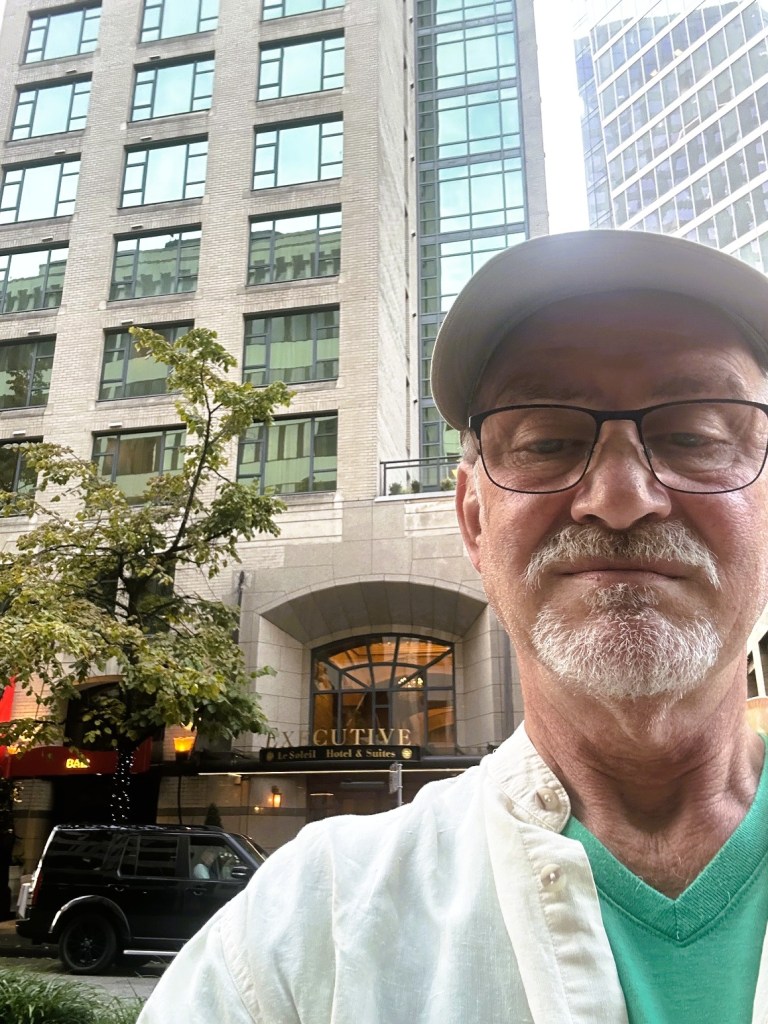
Right after our wedding we were send off by our families to special, beautiful boutique hotel right in centre of Downtown Vancouver, steps from Art Gallery on Robson.

So the autumn wind chased me today to that hotel. Our formal first night as a formally married couple happened there. It didn’t dampen or made less important our first meeting and years of being together. It made it somehow stronger, if possible.

After that I walked to our Davie Street through the Nelson Park and the little enchanted walkway on Mole Hill. Was I sad at times? I am sad and happy all the time. It is just the way it is. It took me a while to get to the point of not being just sad all the time, of actually despising being alive. I don’t cling to it, to that life of mine, but I don’t detest it anymore. I have learnt to love Love. From songs, from poems, movies, from observing couples walking together holding hands.

We walk through galleries of life:

a picture on the wall here,

a bust of lovely youth there.

We enter concert halls of life:

a longing cry of violin here,

bravado of mature pianist there.

What do we do at night,

between long lonely hours

from crimson dusk to pinky dawn?

We dream of kiss, of love.

We wait in our nightly sleep

for a white dove to sit on our pillow.

A dove that brings a song

of upheavals and song of peace.

Song dreamt of by cosmic

choir of see-trough angels,

who cry and rejoice in unison

For such is Cosmos: a star is born

                               when a star dies.

            On y way back home I have stopped for my cup of Americano in ‘my’ café ‘Moodswing’ on Front Street in New Westminster. My second home, so to speak. A places where many my poems were written, many books read.

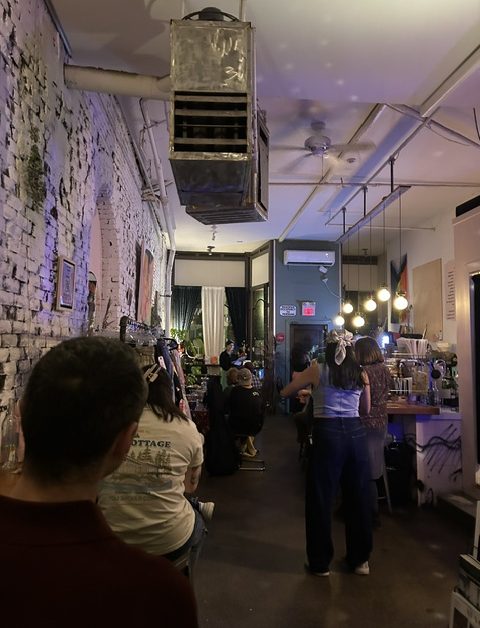
I was at first a bit disappointed: the narrow room was full of people. After searching a little bit, I have found a spot to sit right by the wall, by narrow shelf that can hold a cup. As I was sitting and looking through my back for my wallet, so I can go and order at least my coffee, Ricky the co-owner arrived with my hot coffee the way I like. Nice gesture, since I didn’t have to go through the throng to the ordering spot (there is no table service in there if you order just the coffee, which suits me fine) for it. A kind gesture, knowing that he must be very busy.

I thought it was some sort of meeting that happens there from time to time. But next thing I see there is a woman reciting poetry, than a young fellow goes to the mike and does the same. Than Ricky goes there himself and recites his poem! For all these months I was sitting there writing my things and our typical talks – he never mentioned that he writes poetry, too! Later I gave him a verbal lashing for hiding it from me, LOL.  He promised me to show me more and I probably will publish it here, on my blog.

So, as it happens it was a poetry slam. I just never noticed any info about it – I hardly ever read the board with announcements. Just like to have small chats, drink my coffee and write in my notebook He asked me if I will read something mine. Didn’t have any with me, but than remember that I can search on my phone my blog and found something there. It was probably the very first time I read publicly my poem from … my phone screen, LOL.  How modern, ha ha ha. Of course the first in English that I found and the one I read was rather long and difficult one, full of historical parables to of Hannibal and Alexander the Great, all dedicated to French genius Andre Gide. Hopefully it didn’t look like I was a pompous ass.

Below is the poem dedicated to Andre Gide.

Winter time in a small village in Pyrenees.

Night comes quickly and darkness covers

the valleys and peaks. Suddenly, the windows

off a small stony church lights up in delicate

orange glow. From the top of the church steeple

comes the song of its bells: big bam! Big bam!

big!, big! big! Bam! Bam! Bam! Baaaam-mmm!

The air vibrates with each tone of the big bell

and sends  bronze-coloured sounds to the valleys.

Archangel Michael blows into long, golden trumpet.

The music envelopes the meadows, climbs up the hills.

The call of God, the call of the Shepherd: 

come and be enlighten in the mystery of life

 and promise of death merciful that claims us all.

They run – the tired travelers, the herds of goats.

They cry and hope, as the trumpet sounds again

and dies suddenly like the last drop of now empty goblet.

The church becomes a masjid and archangel becomes muezzin,

that intones to all: Allāhu ʾAkbar. In Pyrenees Hannibal’s army

stop their march and rise their tusks and trunks: they sense the pitch

of the hymn and the psalm as the far flung peaks of Alps slowly

cover the church, the mosque and streams in the valleys.

The curtain call of History. Birth and death of Love.

Moodswing Café, 29. 05.26

B. Pacak-Gamalski

Odnaleziony wiersz

Odnaleziony wiersz

Wczorajszego dnia zgubiłem wiersz. W samym centrum starego Vancouveru, na Westendzie. Siedziałem z przyjacielem przy otwartym oknie swojej ulubionej kawiarni na ulicy Davie i przyszedł do mnie sam. Na papierowej serwetce zaczął się zapisywać.  Ktoś jednak do nas podszedł, zaczął rozmowę. Znajomy sprzed kilku miesięcy. Właśnie wybiera się w podróż do Europy i zaczyna ją od Polski.  Widać, że nie jest obieżyświatem, jak ja, boi się tej podróży, tego jak tam się znajdzie, czy podoła, czy porozumie się po angielsku.

Nudzi mnie ta rozmowa, bom ją już z nim właśnie w tej kawiarni przed paroma miesiącami miałem. Przyjaciel jest dużo bardziej rozmowny, zadowolony wręcz i udziela szerokich wyjaśnień na wątpliwości i lęki stroskanego podróżnika.  Nie brał udziału w naszym pierwszym przypadkowym spotkaniu i nie nuży go to. Ja nie lubię przeżuwać, niczym krowa, dwukrotnie tej samej trawy.  No i ten wiersz zaczęty, który w ogóle na naszą rozmowę nie zwraca uwagi. Znudzony tymi tłumaczeniami wyskoczył zwyczajnie przez okno na ulice i tyle go widziałem! Za nic miał gadanie baedekerowskie, przewodnikiem nie mógłby być.

Żal mi trochę tego wiersza-nicponia było i szepnąłem dwa słowa żalu na fejsbuku o tym i lęku czy gdzieś nie sczezł w śmietniku lub nie zdziczał na gałęziach starych świerków w pobliskim Stanley Parku. Znajoma odpisała, że była tam też, że widziała jeden wiersz zaczepiony o gałązkę, dmuchnęła z nadzieją, że przyleci na mój balkon w mieszkaniu. Rano sprawdziłem – nie przyleciał ladaco, zresztą to spory kawałek i pewnie by nie dał rady.

Jadę więc dziś tam ponownie. Może siedzi tam gdzie nie bądź, czeka i jest mu trochę głupio, że jak szczeniak wyskoczył na ulicę.

Zachciało ci się przygody, ladaco! Jakby ta, którą ja ci oferowałem dając ci życie nie była wystarczająco ciekawa. Może i nie była. Ale wiersz młody, nieznający ni świata ni ludzi małolat, cóż może o tym świecie ogromnym wiedzieć? Pewnie nawet jednej choćby książki nie przeczytał, nie spotkał jeszcze choćby jednego innego wiersza! Ach, młodość jest tak nierozważna …

Więc wrócić chciałem, znaleźć go, bo com zaczął, skończyć muszę.

Wiersz, jak cała ulica i jej mieszkańcy, po polsku nie mówi, tylko po angielsku. Więc tak go też i zapisałem, bo sam nie byłby w stanie inaczej siebie odczytać. A nie przystoi, by wiersz sam siebie nie rozumiał.

Melriches on Davie Street

Red is a very bold colour.

Independence is a very sweet feeling.

Davie in West End

has a human air to breath.

     *

Grocery store in the middle:

a place of business, of exchange

money for food. Our daily bread.

Bold ref sign starring at me

sitting by the window in Melriches Café.

That sign announces at Urbi:

“Davie Street Independent”.

     **

It is a busy street, few steps

from the beaches of the ocean.

People move by on the sidewalks.

Some hurry to somewhere,

others saunter about without aim.

They offer a smile, they talk

to each other, greet you with a nod.

Men dress like a woman nonchalantly;

women avoid covering themselves

with expensive jewellery gimmicks.

   ***

Their roles are interchangeable –

some men fancy macho style.

They scream with wardrobes:

I am butch and strong,

your dream fruit hanging from

low tree branches, ready to be picked.

But they scream like that

not to passing women,

but to the passing men.

And women understand their language

without a hint of animosity or jealousy.

    ****

A black crow hurriedly looks

around the cafè’s tables placed

on the side of pavement in search

of tasty morsels that fell to the ground.

They do not leave any tips for the waitress.

         *****

On a bench next to my café

a girl kisses a boy,

just when another glamorous boy

walks for his date with another boy,

and an elderly couple slowly strolls

holding trembling from age hands.

She is grey and her hips are not swaying,

he uses a cane to overcome the typical

aged hips constrictions – the price of experience.

     ******

The street is Home

to all that live here:

the young mother pushing

carriage wit her baby,

older man dressed casually,

with a big ring dangling

from his earlobe made from

stainless steel – it boldly

denotes that he is a macho man,

not a sissy adorned with shiny

jewellery from false gold and silver.

    ******

It is my home, too.

Yet, I have never lived on it.

Had addresses in many cities;

some were truly my homes for a while.

But none of them had a street

I had call: My Home.

I had always returned

here to her – to my street.

Close to my Mole Hill,

to my park I loved so,

the street of my soul,

where you can lose your poem

and find it the next day

waiting for you in an old

café on Davie Street.

(B. Pacak-Gamalski; Vancouver, 2025)

An exercise in futility or search of meaning? A battle with a microphone and poetry.

How do you write a poem? Where is it borne? I mean –  how the simple act of poetic writing occurs, how is it borne?

Of course, there are poets, who simply give themselves a task of writing a poem or three per day, or per week. When you do have a career as a poet, you are expected to keep writing. You need to publish here and there in a literary paper, every so often to publish a full new book of poetry. It is a job after all to maintain a name in circulation.

On the other hand, there are these impossible poets, who simply don’t give a damn about the business of being a poet. They just write when they feel like. Maybe once a day, or once a week, a month per chance?  And some might even get silent for extended period of time.  Free spirits.

What interest me in the original question is not how often or how rarely they write, but how the poem, the words are borne. Do you say them aloud? Is it possible that you think: I will write a poem about this or that? Do you seat yourself and start saying that poem aloud and copy it on paper (keyboard)? To be precise – is a poem borne in your soul or in your brain? Is it possible to use a verbatim form of recording a poem?

The other day I used a microphone that ‘types’ the words into a computer by itself (what will they think of next, LOL!).  Therefore the poem was deliberately born in the brain. It had no form or ‘sketch’ that I ‘copy’ on paper. It was becoming as I was saying it to the mike. I knew therefore what I was saying but had no idea what the next stanza will be. In a way it turned out to be …a discourse with the microphone. And the microphone was trying to correct my trail of thought, LOL, which I resisted angrily. It became almost a battle of wills. Very amusing. Decided to keep it, as a reminder that it definitely is not my way of writing poetry.  It felt almost Kantor-esque, if I can use the workings of great Polish and international theater stages by Tadeusz Kantor.

Here it is, cacophonic, almost angry, but somehow makes (maybe only to myself?) sense.

Verbatim

the day is done when

 the night is bright

 nothing is the same

 mornings are late

nights are brighter

by Moon’s shine

flowers are not done

flowering again

 birds are  not singing

 I think it’s harder

 to listen  exactly

 to what I’m saying

 do not correct me

 do not embellish

my words I am

 the poet nor are you

 my angel my fan

 my listener it

  takes too much time for

 you to understand

 what I need from you

  but we will  get  there

 a day at a time

 an hour after hour

 a year after year

 bye bye now

 time to go to bed

when we will talk again

 it should be easier

 I am going to

 a new day good night

 my lover per chance