Czasem wiersz jest najlepszym sposobem ‘rozmowy z lustrem’, wiwisekcji splątanych węzłów życia. Tłumaczyłem na tych łamach kilkakroć w przeszłości, że wiersz nigdy nie powinien być pisany dla wszystkich (zwłaszcza nie dla wydawców, krytyków, dla ludzi-czytelników). ‘Ludzie-czytelnicy’ to liczba mnoga, a wiersz to liczba indywidualna. Wiersz należy zawsze i bezwzględnie pisać tylko do jednego czytelnika, słuchacza, adresata. To musi być intymna rozmowa dwóch podmiotów: wiersza i czytelnika. Jeśli masz coś intymnego do powiedzenia przyjacielowi nie możesz tego robić na wiecu. Nawet spotkanie autorskie nie zwalnia nas z tego obowiązku. Każdy słuchacz musi wiedzieć, czuć, że ten wiersz teraz czytany jest właśnie dla niego. Bo w wierszu odsłaniamy swą całkowitą bezbronność, swoje najkruchsze ego. Swoją słabość, która jest jedyną siłą, jaką posiadamy.
Naturalnie jest poezja pompatyczna, do ludzkości, do narodu. Bzdura. I ta najbardziej pompatyczna jest zawsze tylko dla jednego czytelnika – tego, który ją teraz czyta lub słyszy. Inaczej jest blagą, oszustwem oczekującym na akceptację tłumu. Każde spotkanie ze sztuką jest przeżyciem prywatnym, intymnym.
Inne epoki, czasy odległe inną miały miarę i oczekiwania. XIX i XX wiek kompletnie to wywróciły i odrzuciły. Dały wolność jednostce, temu ja i ty, które jest początkiem i końcem kontaktów międzyludzkich.
Od czasów niespodziewanej i nagłej śmierci mojego męża wiersze, które piszę są rodzajem kontynuowania moich rozmów z nim. W okrutnym czasie tuż po tej Stracie z naturalnych względów były tym – opisem Straty, jej okrucieństwa i pustki, aktem niezgody, oskarżaniem bogów i siebie, że do tego dopuściliśmy, że Czasu nie zatrzymaliśmy. To było naturalne. Ale Kosmos i bogowie mnie nie opuścili, nie zdradzili. Tragedie indywidualne godne eposów antycznych zdarzają się stale. Czemu? Nie wiem. Fatum? Czy istnieje coś takiego? Też nie wiem.
Do życia – innego zupełnie i nieznanego mi przedtem – jednak wróciłem. Ciągle zachwyca mnie moment, zachwyca – też mimo wszystko – człowiek, jego piękno i jego ból, jego kruchość i potęga. I odtąd te wiersze, to zapis moich rozmów z nim – mom najbliższym przyjacielem. To mój pierwszy indywidualny, pojedynczy czytelnik-słuchacz. Gdy wiersz wychodzi ‘w świat’ (publikacja, spotkanie poetyckie) – tą rozmowę podejmuję z każdym indywidualnym czytelnikiem. To moja cicha rozmowa z tym czytelnikiem/czką. Inaczej bym się nie odważył pisać.
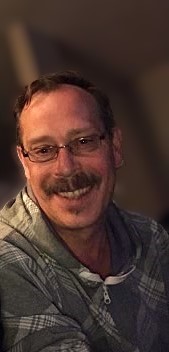
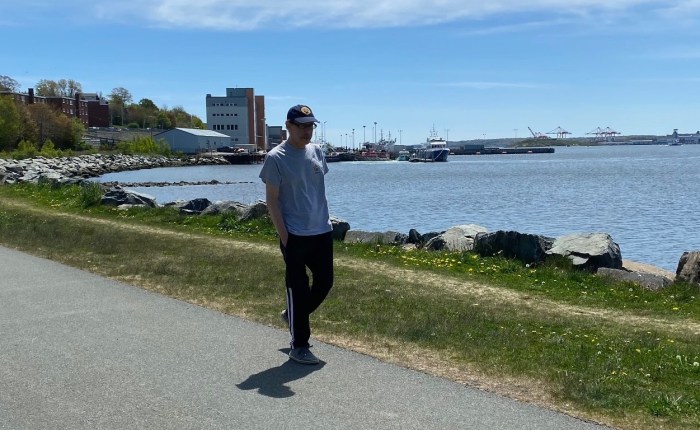
post scriptum: zamieszczona fotgrafia-portret, to zdjęcie mojego męża
Every boy and every girl need to have a poet, who reminds them of the power of love. Something they absolutely must be certain of, something that hangs like a heavy, sweet fruit from the low branches that you are forced to reach, pick in your hands and sunk your teeth into it. Absorb the sweet aroma, let juices flow from your lips to your soul.
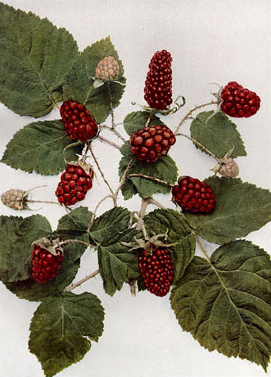
Let me be the poet, who will take you to the garden and show you the delicate foliage of the ancient orange shrubs and their sweet berries. The loganberries.
A sweet logan berry
hangs from your lips
like a promise of heaven.
What is heaven, you ask?
Heaven is like a kiss,
silent yet powerful.
Heaven is red like
quivering lips of logan berry.
Heaven is when you are
becoming someone’s berry.
A red, live, pulsating Loganberry.
How would I know, how would I dare to foretell stories like that? Because I am a poet and if poets know anything – they do know love, her ways and her magic. Poets know long walks by the small banks of streams, where the berries are plentiful in late summer evenings, and they see there pairs of young lovers picking the berries and placing them in the mouth of their beloved ones. Poets, being poets, go home and write a poem about it. After all, that is all they know how to do. Hoping to explain the ways of love to some young boy or girl. They are like the loganberry – all they know is how to grow and become sweet and inviting, hoping that some girl or boy will pick them and taste them. The rest is mystery like the morning mist climbing the shores of small stream.
My Three Loves never left me. I have never left them, nor have I forgotten them. Through all my early years as a teenager, in an old country on the old continent, country that was greyer than the buildings sorrowing people, who lived there.
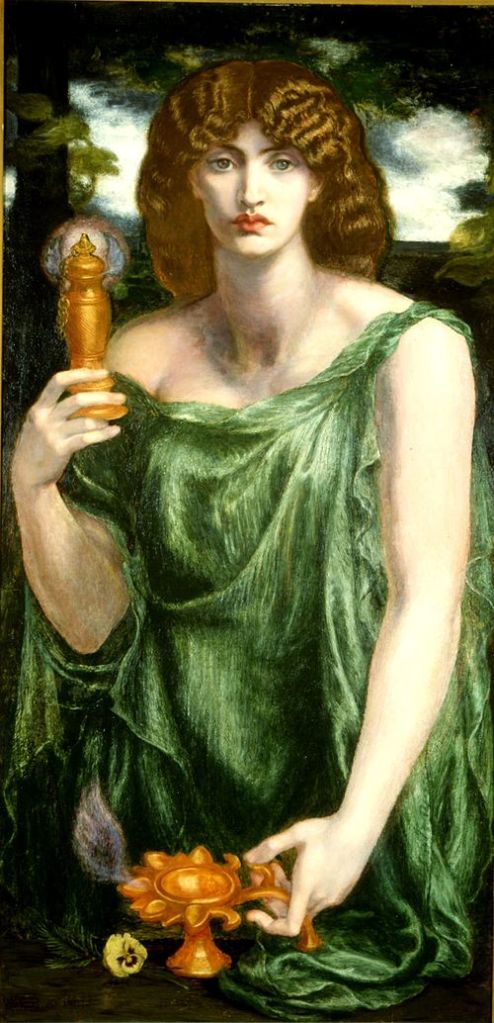
Mnemosyne
(by Dante Rossetti)
But my first love that had sprouted in my heart made it flowering, singing above the roofs of these grey buildings. The city of grey buildings, that rose from the ashes of the worst war that fell upon humankind. Yet – my first love gave it a warm embrace that belongs to the titanic Mnemosyne, mother of all the muses, daughter of Uranus and Gaia[i]. She was not the most sympathetic and meek of Titans with a slightly twisted taste in romantic escapades, after all she also bedded Zeus himself, who was logically speaking … her brother. But who’s blaming anyone? Not the Greek gods (or any gods, god forbid!) for their erotic (diss)behavior. I am merely a human, nothing more. For me then, in the grey city of my grey youth, Mnemosyne was the mother of Muses. That cleared her of any other crimes or indiscretions. Who would anyway, any other way? Surely, not when you are fifteen, seventeen or twenty! Love disregards all and any boundaries. And I was in love! Purely platonic, but fearless and furious; intellectually and emotionally on equal basis. And that love, otherwise called ‘friendship’, stayed with me my entire long life. I have never left her, she stayed with me in my traveling luggage all these decades.
My two other loves happened years after the first one. The next one happened almost unknowingly to my senses. It happened in that old country, still very much grey and poor, but on a threshold of new-found freedom, with dreams and appetites for brighter and greener fields ahead. A boy was borne of familial spring, just like the nymphs chasing after the image of Hyacinthus immortalized by songs of his Olympian lover – the God of Love Itself. But beware of love offered by gods, my dear boy! They never end well for lesser lovers. I’ll tell you a story here, later on, in the last chapter, of the price I paid for asking for, and being granted the Love Immortal. The grief is as deadly, as the disk of Apollion that killed his lover – Hyacinthus. But wait, I take back these warnings and the words of sorrow and grief. For Love Eternal outlasts grief and sorrow. Each time and every time. Lament is temporary and is a sign of temporarily losing your perspective. If you grief losing a lover – the lover’s love will come back to you in time, for love can’t be solitary. It will seek and enter the other lover’s soul, because Love needs a nest.
Alas, we went too far in this true fable, the allegoric story of my ordinary life and my Loves Immortal.
Boy was born in the Old Country, as I said. We all rejoiced. Remember walking with my parents, his older sister (a child herself), and the little boy in a walking stroller, a long walk through the countryside near Warsaw, through fields and meadows, to an old palace of some aristocratic imminence and a beautiful stream running through the meadows. Of course, we all loved the new boy. But I had no idea how important, how encompassing, and not always easy at all, that love would be. Didn’t have to wait very long, though, just few more years, few more of my returns to that old familial country and I knew. It was unspoken, unexplained, but very clear. She sprung not suddenly and unexpectedly, didn’t come from ‘the bolt in the sky’ (as it did happen in my last Love Eternal).
It was warmly growing inside me, flowering with tenderness. He was still a child, whom I could carry on my shoulders, as we walked through the streets of that old city that used to be so grey in my youth. But now the city was truly beautiful, transformed by modernity and embracing Western Europe. With that, it embraced the traditions of old Greece, of Zeus and Plato, and Plato’s talks with the boy Phaidros. The sweet youth, who desired his teacher, the old Socrato, and a thought that there must be something wrong with him, since his beloved teacher would not accept the gift of his pupil’s young body. But Socrates was wiser than simple desire. He knew that the boy deserves better than a tired body of not very attractive nor a rich old teacher. That in itself, without any further arguments, proves that Socrat was perhaps in love with that youth and choose of his own will a chanced possibility of better future for Phaidros. A sacrifice, if you will.
Not unlike relationship between Herr Aschenbach and sweet adolescent Tadzio, in “Death in Venice”[ii]. Sweet, tender and innocent – until one afternoon Aschenbach runs away from Tadzio to a park, exhausted and ashamed of himself collapses on a bench and hears himself saying aloud the dreaded proclamation: I love you. But once you say it aloud there is no escape, no turning time back. Ha! That ‘thing’: your desire, your dream could be the abyss of torment. Bliss and condemnation eternal.
What happened in that novella, if it happened and why, is totally irrelevant to our discourse on Love Immortal. If you want to – buy or borrow that booklet from a library. It is not very long, but definitely it is master class of literature.
Hence – back to our story, my Second Love eternal to that boy from an old capital in Central Europe. Years (not that many in my calendar, but must have felt like an eternity in a teenager’s life of that boy) have passed and that boy, in a pivotal time of transformation into adulthood, comes to me in the New World, across the vast ocean and entire continent in search of his destiny(?), his ways through life. In short: in search of himself. At that time I was already well established, secured and totally committed and enthralled with my lifetime Love Eternal, one that consumed me happily, engulfed, and enthralled me without any hesitation. The one that was romantic and erotic. That boy from the Old Country came here exactly for these reasons, too. Firstly, he knew that I love him dearly and sincerely and I would not offer him anything that would be false, or based on pretense or judgment; would protect him, in as much as I could, from any harm that a sudden freedom can bring too.
That was the time, when my Love for that boy transformed to my Love Eternal: when he stopped being a boy from an Old Country, a nephew, for whom you care enormously – he became my Prodigal Son. Without any too strict connotation to the biblical story (of course, if needed, mistakes and transgressions would be forgiven – what proper father would not?). With another number of years the boy become a mature, well established, and educated man. For any parent, biological or emotional, it sounds like a solid reason to be proud. I am.
My Third Love
How should I name you, how should I call you, by what name? Who you are, who you were, where are you?
I can call you by my name for you are me. I can call you by your name for I am you. I can call you Love for you are My Love. Encompassing all my days and nights. Quivering like a blade of grass on summery meadow. Quivering and fluttering like my heart, when I call your name. I won’t be scared whispering to you: I love you – I will be brimming with pride, when I say it. You, who crossed the continent with me, to be with me. When I asked you, where we should settle for our sunset years, you answered: anywhere where you are going to be, because you are my Home.
When we met at the foothills of majestic Cordillera, bellow the amazing peak of Assiniboine Mountain, on the meadows flowing from the enormous Mount Temple, when we walked in the shadow of Mount Robson I wanted to hold your hand in mine. Wanted to show you how beautiful you look in the glory of these peaks surrounding you. Wanted to ask the angels floating around these peaks to come down and embrace you in their warm, godly wings. Just as I would, if I was a god. Maybe we were the gods? Didn’t we possess the most important attribute of deity: Love Eternal? Love that is everlasting. The Black Angel of Mercy in Hyde Park on Manhattan told us so, when we went on sunny October day to visit him.
When we walked the beaches of Northern Pacific in Tofino telling the anemones the story of our love – they danced in waves of happiness; when we walked the white beaches of Eastern Shore on Atlantic coast of Nova Scotia – the eagles danced above our heads and parasailors smiled seeing us traversing the beach.
You – my Third Love were the epitome of love, the Mount Everest of being alive. If I ever would lose the sense of smell – I would still remember the smell of your skin. If I ever lose my sight – I would still clearly see your eyes. If I ever lose my memory – I would want to not know who I am at all, because I would be nothing without the memory of Our Love.
You did talk to me last night, first time in a while. Yes, it was a strange night, followed by strange day. Or was it the other way around? When you are alone, without a set schedule or watch, things do get mixed up easily. Dates especially: Mondays become Fridays, Fridays Tuesdays. So what happened to Wednesday, you ask? Who cares what happened to Wedneday, perhaps I left it on a beach, or on a bench in some park? Maybe it is still in the shower when I saw it last time I was taking a shower? What? Do I not take a shower every day? Maybe not, maybe sometime I take a bath, who cares? You really are asking way too many questions and it is my story anyway. Be quite, just listen.
No, not you, Babycake – I’m talking to my alter ego. You wouldn’t ask such stupid, mundane questions.
But the day or the night when I was still in bed, when I was sleeping, I dreamt of you, I talked to you. Have not done it in a while. I thought that you just let it go, these talks of ours across the boundaries of life and death. Thought maybe there is some allotted time that you can do that and maybe you have used it up? I don’t know. Remember? I am the one still left alive, never been consciously to the other side.
None of it is important really, anyway. I have dreamt of you in my sleep. It woke me up and there you were, next to me. No, I couldn’t see you, but you were there talking to me, you were saying something important. You said that I have to understand that I am alone. That adjective ‘alone’ stood up as a mountain, a wall impregnable, forest too dense to walk out of it. I was getting used to be ‘alone’ in an adverb form.
Since I came back to our home, our former life here, in this city, this province, I have become very busy in many aspects: walks, friends, beaches, concerts, plans. It was just hard to go back to our home, our street. So I did it very seldom, hoping that it will allow me to function as normal as possible. And it did. Had evenings in bars, laughter, maybe a flirt or two. It seemed normal, I was spared any regrets. It was almost as I would finally get across that invisible line of Doctor Time, who heals old wounds; whose grief becomes first bearable, then transforms itself into a memory. Memory that is sad, but also happy that we did have our time, we found each other among the millions of people. As I was told many times, that it will get easier.
You think that was an expectation too easy, perhaps? I am not, after all, just a single guy ready for the picking and ready for harvesting. Is there anything wrong with it, isn’t it logical, practical?
I have reached to my writings of the early days after you were gone, to the first winter after you were gone and my constant visits to the gravesite in Pictou. Yes, that old ancestral town, where we were going to build our home, and spent the rest of our lives in that home. We did not.
(notes from my writings after John’s passing by the end of November 2022)
Pictou
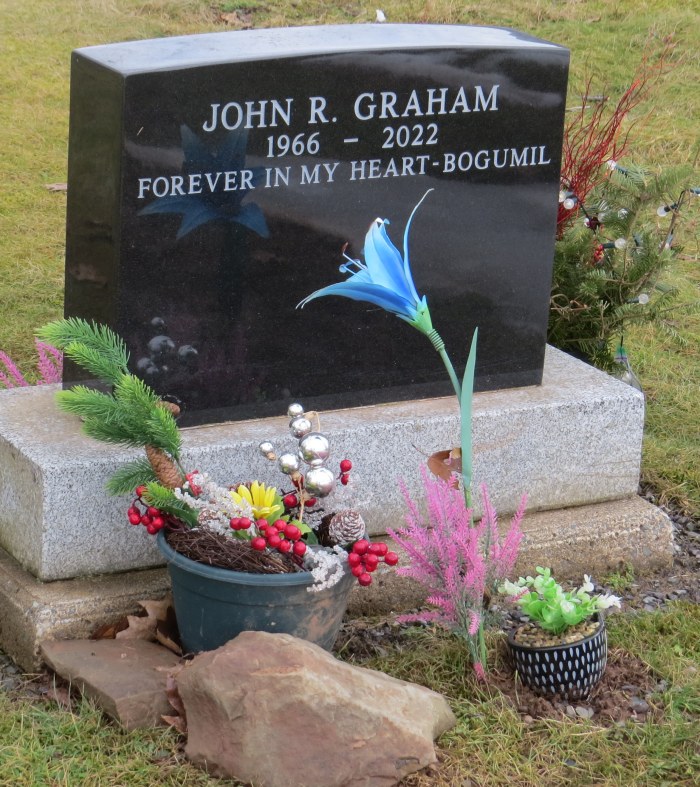
One year. It is hard as hell. Came to Pictou to spent time on the cemetery where we put your ashes. It’s windy, very cold. Desolate place. There was no one else there, on the cemetery. I know – it is only a stone with your name on it. Yours, your parents, and your baby brother you never had a chance to know. And now, there is also your oldest brother Fraser, who was laid there just few months ago.
Cleaned around a bit, threw away old winter flowers, and fixed things. Fixed things? How to ‘fix things’? Nothing can be fixed, when everything is broken.
Yes, I know that you are not there, not under the ground. You are with me. Forever. I have engraved on that stone myself that you are forever in my memory. I looked at the letters and smiled. In my memory, really? That’s what it all came to? Our Love, our life: to be remembered? How silly words could be, when they try to describe emotions, feelings. But still hoped that many years from now, when all of us, who knew you and me, would be gone – a stranger would wander to that gravesite and he would think, that the guy who is buried there was indeed ‘non omnis moriar’, that part of him lived in that other guy’s heart. Nice thought.
You and that Love of ours are engraved not on the stone, but in my soul.
Me? I don’t remember who I was before I met you. I was just waiting. Waiting and searching for you – and I have found you.
Now, now it is almost three years later. I am here, back to our good life on the shores of the other ocean. Were we had home, a nest, were we had dozens of friends, people we cherished and who cherished us. Some were ours; others were exclusively yours or mine. The two halves of Us were surprisingly very independent and strong, if only by the constant knowledge that the other half is there to make it whole.
I don’t have that knowledge anymore. The other half is gone, it is just me left. Those many people I have known, and who sought my presence are still here. Not all of them, granted. Some have left either this life (as you), or this city. But some are still here. None seem to really need me. I am not sure I need them. Of course there is some curiosity, some friendly waving of a hand: how nice to see you again, you are looking good … and so on. I thought that I would need to search for them myself, that I would want it very much. But if I’m always finding excuses and ‘important things’ that prevent me from doing it – am I really?
I have one important friend and, strangely enough, one with the shortest amount of time we spent in this city before we left for Nova Scotia. Less than a year, I think. After my dearest nephew had to go back to Poland, but still this young and very mature nephew was my angel in the first month after John was gone. Then my niece with her husband and son came to stay with me. But he, that younger friend of mine from Vancouver, somehow helped me in the dark months after I was left alone in Halifax. The rest seemed like eternity. Eternity of being in hell, or waiting for the hell’s gates to be opened, to swallow my world. At these dark times that younger friend kept me connected to the world and people by phone. Our long conversations were instrumental of me getting the skeleton of myself back into me.
That is how I did return. To the place of Our home, our happiness. These places somehow were the strongest magnet for me. I submerged myself in going alone, for days on end, on long walks through parks, streets, squares, building were we lived, were my mom lived, were I was with my sisters, my nephew and niece. Places that were calling me. Yes, places, much more than people.
I think that we all have these special places, sometime in many countries, on different continents. Special places that act as an anchor on a ship of life. Where we can drop that anchor and stay safely in some magical Bay of Memories.
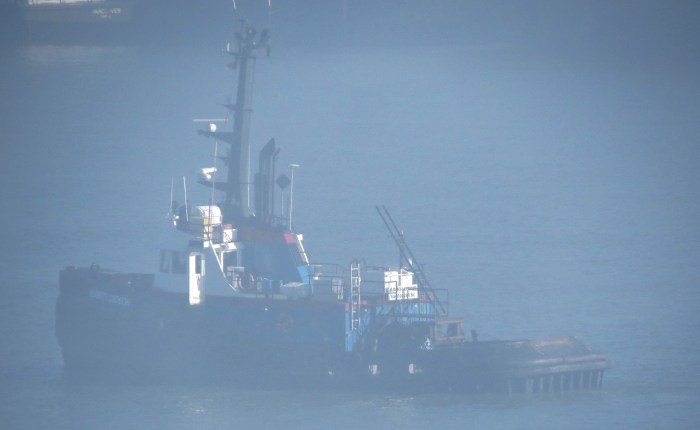
It is also a time to untie that line across the sides of our two separate boats: mine and the one belonging to my younger dear friend. He has journeys to make across the sea himself, his journey, not ours. That is also a part of me being alone. My boat is rusted a bit, engines are old. It will still make it though, the last long sailing, perhaps passing the Cape of Hope (not the Cape of Horn), back to original shipyard of its maiden voyage. Then I will rest.
After that rest, I will go alone on many walks to many places (some might not exist materially anymore, but will in my world) that will call me. Solitary walks. It will be like existing in two different dimensions.
One day (no, not in my sleep) perhaps suddenly, out of the blue, I will see you taking the same trail or road and walking toward me, and I will stop being alone. I do hope so. Even in a faint split second before the big Nothingness.
It is what it is. Could be silent, but even than it is not nameless.
Yet, we will not call that name today. We know what it is. Sad but proud; weeping but not hysterical. Sad but understanding; resigned but not broken.
Thinking – strangely enough – about two old movies, that made an enormous effect on me as a very young boy. One with Lamberto Maggiorani in “Bicycle Thief” [i] and incomparable Gulietta Masina in “La Strada”[ii]. Dreams and loves. Devotion and standing by your loves no matter what. Beyond the beyond.
Words. Many words.
The soft and the tense.
Words that can pierce,
be sharp but still true.
They are an umbrella
on a rainy day:
it does not bring sunshine,
does not clear the sky,
but it saves you from being wet.
Perhaps there is even a chance
that such an umbrella
will take a flight with you
to the clouds, to the skies.
It is better to be silent
than to use the thread of words
for making a garment
of lies and half-truths.
Walk silently through
the park filled with good words
where leafs whisper
the promise of a kiss and
touch of fingertips and eyelashes.
Words should never be
like grains of sand in a desert
or they will lose their meaning.
It is good to thread them
on strands of necklaces,
make earrings of them –
it makes them easily accessible,
without the need to always
use a coin for new ones.
Words, you see, are like
years and days: they are
on very limited number.
The story lives
in your heart and soul,
not in thesauruses.
Words are the keys
to books unwritten, yet.
(Polish vrsion – both were written simultaneously, not a translation)
I takoż to jest w ten dzień powracający, jak zły szeląg i jak dobra piosenka. Nawet rymy, których doprawdy nie lubię, same siadają na bieli kartki bez zapytania. Ot tak, okrakiem i bezczelnie, niczym lokalny osiłek na zabawie wiejskiej w jakiejś remizie w zabitej dechami wsi. O! Naturalnie, że Focault język oczyszcza z naleciałości burżuazyjnej naftaliny, że Tatarkiewicz uszlachetnia mowę i pismo klasycznym pięknem prostych kolumn doryckich. Popatrz – nic to nie pomogło wszak. Posłuchaj – słyszysz Bacha, czy słyszysz wielką, hałaśliwą śmieciarę, która zabiera z podwórek opasłe pojemniki na śmieci i odpadki? Nowoczesność i postmodernizm też przegrały, też przegadały wszystko przy szklance wina, jak ich poprzednicy. Tą samą stawkę – jutro.
Od pokoleń robimy to samo, siadamy do stolika, rozdajemy pięć kart i liczymy, że dostaniemy cztery asy. Pierwszą kartą dostaną jest As, więc podbijamy stawkę kilkakrotnie w górę. Po otrzymaniu kolejnych kart okazuje się jednak, że mamy tylko tego jednego, pierwszego asa i tylko dwie pary: ‘trójki’ i ‘szóstki’. Szanse zwycięstwa diametralnie się zmniejszyły. Ach, jesteś intelektualistą, filozofem, cóż to za gra – poker?! Ty tylko w brydża. Dobrze, graj. Skończyłeś licytację? O, gracie ‘cztery bez atu’ z partnerem! Brawo! Szkoda tylko, że partner ma tylko jednego asa i ani jednego króla … . Szansę ciągle masz, ale doprawdy tylko minimalną, ciut, ciut ledwie.
To samo zaiste z tą poezją. Czasem rym pcha się przemożenie. Prosisz, tłumaczysz. Koniec końców chwytasz za kołnierz i wyrzucasz za drzwi, basta. A tu guzik, rym wraca przez okno!
Pewne rzeczy, uczucia same wybierają z rymem czy bez. Nie ma co kombinować nowoczesnego jazzu, gdy tylko stara fuga rzecz najprościej wyłoży. Glen Gould może ten temat lepiej wyjaśnić. Tak, tak, wiem. Gould nie żyje od wielu lat. No ale to o ten właśnie dzień chodzi. Tych, których już tylko pamiętamy. Więc tego dnia możesz z nim (żywym, czy martwym) porozmawiać. Hollow Day, Zaduszny, Dziady – dzień pamiętania. Nie można pamiętać do przodu, tylko do tyłu. A w tyle jest zawsze masa dobrego i masa złego. Nie oszukujmy się, jeśli pamiętamy to naturalnie i te złe też pamiętamy. Rzeki pragnień i niechęci, przyjaciela razem z katem. Bo wszak czasem śmiejesz się i płaczesz sam.
Wczorajszego dnia zgubiłem wiersz. W samym centrum starego Vancouveru, na Westendzie. Siedziałem z przyjacielem przy otwartym oknie swojej ulubionej kawiarni na ulicy Davie i przyszedł do mnie sam. Na papierowej serwetce zaczął się zapisywać. Ktoś jednak do nas podszedł, zaczął rozmowę. Znajomy sprzed kilku miesięcy. Właśnie wybiera się w podróż do Europy i zaczyna ją od Polski. Widać, że nie jest obieżyświatem, jak ja, boi się tej podróży, tego jak tam się znajdzie, czy podoła, czy porozumie się po angielsku.
Nudzi mnie ta rozmowa, bom ją już z nim właśnie w tej kawiarni przed paroma miesiącami miałem. Przyjaciel jest dużo bardziej rozmowny, zadowolony wręcz i udziela szerokich wyjaśnień na wątpliwości i lęki stroskanego podróżnika. Nie brał udziału w naszym pierwszym przypadkowym spotkaniu i nie nuży go to. Ja nie lubię przeżuwać, niczym krowa, dwukrotnie tej samej trawy. No i ten wiersz zaczęty, który w ogóle na naszą rozmowę nie zwraca uwagi. Znudzony tymi tłumaczeniami wyskoczył zwyczajnie przez okno na ulice i tyle go widziałem! Za nic miał gadanie baedekerowskie, przewodnikiem nie mógłby być.
Żal mi trochę tego wiersza-nicponia było i szepnąłem dwa słowa żalu na fejsbuku o tym i lęku czy gdzieś nie sczezł w śmietniku lub nie zdziczał na gałęziach starych świerków w pobliskim Stanley Parku. Znajoma odpisała, że była tam też, że widziała jeden wiersz zaczepiony o gałązkę, dmuchnęła z nadzieją, że przyleci na mój balkon w mieszkaniu. Rano sprawdziłem – nie przyleciał ladaco, zresztą to spory kawałek i pewnie by nie dał rady.
Jadę więc dziś tam ponownie. Może siedzi tam gdzie nie bądź, czeka i jest mu trochę głupio, że jak szczeniak wyskoczył na ulicę.
Zachciało ci się przygody, ladaco! Jakby ta, którą ja ci oferowałem dając ci życie nie była wystarczająco ciekawa. Może i nie była. Ale wiersz młody, nieznający ni świata ni ludzi małolat, cóż może o tym świecie ogromnym wiedzieć? Pewnie nawet jednej choćby książki nie przeczytał, nie spotkał jeszcze choćby jednego innego wiersza! Ach, młodość jest tak nierozważna …
Więc wrócić chciałem, znaleźć go, bo com zaczął, skończyć muszę.
Wiersz, jak cała ulica i jej mieszkańcy, po polsku nie mówi, tylko po angielsku. Więc tak go też i zapisałem, bo sam nie byłby w stanie inaczej siebie odczytać. A nie przystoi, by wiersz sam siebie nie rozumiał.
Melriches on Davie Street
Red is a very bold colour.
Independence is a very sweet feeling.
Davie in West End
has a human air to breath.
*
Grocery store in the middle:
a place of business, of exchange
money for food. Our daily bread.
Bold ref sign starring at me
sitting by the window in Melriches Café.
That sign announces at Urbi:
“Davie Street Independent”.
**
It is a busy street, few steps
from the beaches of the ocean.
People move by on the sidewalks.
Some hurry to somewhere,
others saunter about without aim.
They offer a smile, they talk
to each other, greet you with a nod.
Men dress like a woman nonchalantly;
women avoid covering themselves
with expensive jewellery gimmicks.
***
Their roles are interchangeable –
some men fancy macho style.
They scream with wardrobes:
I am butch and strong,
your dream fruit hanging from
low tree branches, ready to be picked.
But they scream like that
not to passing women,
but to the passing men.
And women understand their language
without a hint of animosity or jealousy.
****
A black crow hurriedly looks
around the cafè’s tables placed
on the side of pavement in search
of tasty morsels that fell to the ground.
They do not leave any tips for the waitress.
*****
On a bench next to my café
a girl kisses a boy,
just when another glamorous boy
walks for his date with another boy,
and an elderly couple slowly strolls
holding trembling from age hands.
She is grey and her hips are not swaying,
he uses a cane to overcome the typical
aged hips constrictions – the price of experience.








 > > Pogwarki < <